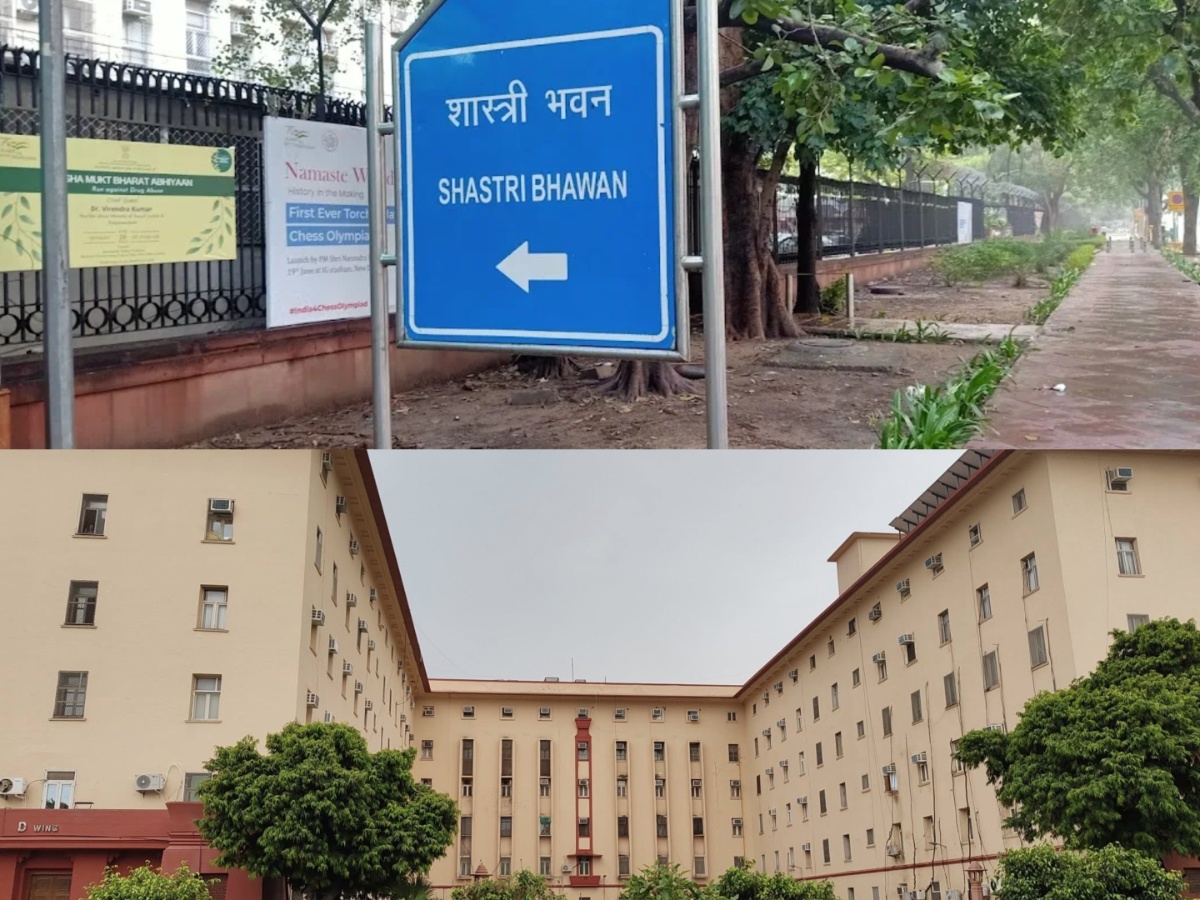
Shastri Bhawan and Krishi Bhawan
The demolition of Krishi Bhawan and Shastri Bhawan means that two landmark buildings of the central government in India’s capital are now becoming part of history. These are not merely structures of brick and concrete, but living witnesses to the dreams, struggles and achievements of independent India.
Krishi Bhawan played a central role in shaping policies that took the country from chronic food shortages to self-reliance in food production. Shastri Bhawan, meanwhile, housed key ministries that shaped education, law and governance. In their place, the government plans to construct the fourth and fifth buildings under the Common Central Secretariat (CCS) project, part of the larger Central Vista redevelopment plan.
Krishi Bhawan was built in 1957 and Shastri Bhawan in 1967. Recent media reports indicate that demolition work is set to begin soon.
Krishi Bhawan and the Green Revolution
Krishi Bhawan was designed by architects of the Central Public Works Department and served as the headquarters of several ministries, including the Ministry of Agriculture and Farmers Welfare, the Ministry of Rural Development, and the Ministry of Animal Husbandry, Dairying and Fisheries.
In the years following independence, India faced a severe food crisis, with widespread concern about hunger and shortages. During the 1960s, the foundations of the Green Revolution were laid within the walls of Krishi Bhawan. Eminent agricultural scientist Dr MS Swaminathan and renowned Mexican scientist Norman Borlaug held detailed discussions here with farmers and fellow scientists to plan the transformation of Indian agriculture.
Their ideas led to the introduction of high-yielding seed varieties, improved fertilisers and modern farming practices, fundamentally changing food production in the country.
“Many famous leaders worked as Agriculture Ministers from this building. Names like C Subramaniam, Babu Jagjivan Ram, Sharad Pawar, and Devi Lal made big decisions here for the country’s farmers,” says Choudhary Tarif Singh, a farmers’ leader from Delhi.
In more recent years, major schemes such as the Pradhan Mantri Kisan Samman Nidhi (PM-KISAN), crop insurance programmes and initiatives promoting organic farming were administered from Krishi Bhawan. Beyond policymaking, the building functioned as a coordination centre, working closely with state governments to support farmers and improve agricultural outcomes nationwide.
Also Read: Cabinet approves Union Budget 2026-27
A hub of ministries at Shastri Bhawan
Located on Rajendra Prasad Road, earlier known as Queen Mary’s Road, Shastri Bhawan housed more central government offices than perhaps any other single building in the capital. Before its construction, the site accommodated government bungalows and even a primary school.
Over the decades, several ministries functioned from here, including the Ministry of Human Resource Development, now the Ministry of Education, the Ministry of Law and Justice, the Ministry of Information and Broadcasting, the Legislative Department, the Ministry of Culture, and the Ministry of Chemicals and Fertilisers.
Named after former Prime Minister Lal Bahadur Shastri, the building became a busy administrative hub dealing with crucial aspects of governance, from education and law to culture and information.
“For all those connected with the law profession, Shastri Bhawan is very important as the Ministry of Law and Justice is here. I hope that the new building will be grand,” says Utkarsh Soni, an advocate of the Delhi High Court.
Fate of the murals
Visitors to Shastri Bhawan often noticed the striking murals that adorned its walls. The carefully blended colours gave the building a distinctive visual identity, drawing the attention of employees and visitors alike.
These murals were created in 1968 by renowned artist Satish Gujral, whose work can also be seen at places such as the Delhi High Court and the old Odeon Cinema. Murals, paintings executed directly on walls, trace their origins to early human history, when cave paintings depicted everyday life using natural pigments. Over time, the art form evolved in complexity and technique.
With the impending demolition, questions have arisen about the future of Gujral’s murals. As part of India’s artistic heritage, many believe they should be preserved or relocated rather than lost.
An uncertain future for the monkeys
Another unanswered question concerns the hundreds of monkeys that inhabit the premises of Krishi Bhawan and Shastri Bhawan. For years, they have roamed freely through the corridors and lawns, coexisting with thousands of government employees who work in the two complexes.
At lunchtime, it was common to see small groups of staff eating together while monkeys sat nearby, gesturing quietly in the hope of being offered food. The daily interactions were largely peaceful, reflecting an unusual coexistence between humans and animals in the heart of the capital.
Where these monkeys will go once the buildings are demolished and new structures come up remains uncertain.
Krishi Bhawan and Shastri Bhawan were more than administrative offices. They embodied key chapters of India’s post-independence journey, from overcoming hunger to building modern institutions of governance. As they give way to new structures, they leave behind memories of the roles they played in shaping the nation and the aspirations they once housed.
Read More: North Block’s final chapter in budget-making
A 24-year-old delivery executive died on Oct 20 after ingesting poison following an assault over…
CAQM reviewed dust pollution in Delhi and enforced GRAP-1 rules after AQI fell to 'poor'.…
Over 1 lakh of 4.56 lakh Form 6 voter enrollment applications in Delhi have been…
NDMC cut water and power near Race Course Mosque during a demolition drive, affecting nearby…
BNSS caps custody at 24 hours and requires production before a Magistrate; force permitted only…
An SEM court reserved its order on extending the judicial custody of CJP leaders Saurav…


