Delhi: Going door to door distributing Special Intensive Revision (SIR) Enumeration Forms (EFs), Anganwadi worker Kavita Mishra has little time to think about her primary job. As calls from her health centre keep interrupting her rounds, she says the Election Commission’s electoral duties have left her struggling to balance two full-time responsibilities.
“The doctors are a bit annoyed that I have to take on this responsibility, but there is nothing that can be done since I’ve been asked to do this. The seniors have told me to focus more on Anganwadi work, but there is only so much I can do,” Mishra said.
She checks off one house after another until she reaches the slums adjoining Munshi Ram Colony at Timarpur. She primarily functions as a Block Level Officer (BLO) in the Mukherjee Nagar area, and during her work, she has become quite knowledgeable about its functioning. “The ECI possibly suggested my name again due to my earlier work as a BLO. I have been a BLO for the past three to four years,” she said.
Initially, in 2023, she was empanelled as a BLO to conduct a door-to-door survey. However, this time, her workload has increased, including conducting a survey for the upcoming Census. “The pressure is a lot this time, and the facilities provided to us are just not enough,” she said.
How BLOs function
During the SIR process, BLOs act as the main field functionaries, with one assigned to each polling station, which usually serves about 1,000 electors.
Their core responsibilities start with distributing EFs to every voter. BLOs help these individuals match and link their current details with records from the last SIR conducted in 2002–2004.
To ensure thoroughness, BLOs must make at least three visits to each elector’s residence. During these visits, they assist in filling out and collecting the EFs, gather Form 6, and obtain declaration forms for new registrations, without needing any additional supporting documents at this stage.
Finally, BLOs are responsible for cleaning the electoral rolls. They do this by actively identifying deceased individuals, residents who have permanently moved, and voters mistakenly registered at more than one location.
Monetary compensation
Radha Devi, an ASHA worker and BLO in Timarpur, has also been assigned the task of distributing SIR forms in the Munshi Ram Colony area.
Through sunshine and rain, her scope of work remains the same. “They expect us to work regardless of the weather. Even in heavy rain, we are expected to visit houses. There is no strict rule, but we must complete the entire process by the end of July, so it is clear there is essentially no downtime,” she said.
Leaning under a shade, she places her slingback, containing sets of documents, to one side, and sighs. “Pressure from our dispensaries alongside the impending stress prevalent throughout the electoral process has led to numerous other BLOs falling sick earlier, but there is no sense of empathy put forth by the commission itself,” she said.
“Our job as Anganwadi or even ASHA (Accredited Social Health Activist) workers is not worthwhile. As things stand, our pay remains low, and on top of that, we are expected to conduct these field visits with the pay that we get,” she said.
Earlier in April, ASHA workers in Delhi went on strike and protested at the Delhi Secretariat, demanding the government urgently resolve their long-standing grievances.
Their main demands include raising their monthly honorarium from Rs 3,000 to Rs 15,000, along with a mandatory increment every three years.
During the demonstration, Prakash Devi, the Vice President of the Delhi ASHA Workers Association, emphasised that the incentives announced by the central government were not being paid.
Despite demonstrations and numerous strikes in the past in the national capital, their demands have not been met. “They fail to pay us our usual salaries. Even as we handle the pressures of being the first point of healthcare providers and also serve on election duties, our pay remains unchanged. Moreover, even with very low salaries, the government only manages to pay us in a lump sum across four quarters. Sometimes, the pay also includes arbitrary deductions,” claimed Deepika, an Anganwadi worker who has been working in the Chandni Chowk constituency as a BLO in the Matia Mahal area.
Similarly, Kavita pointed out that the commission had promised an honorarium. “They did not specify whether it would be given after we complete our duties as BLOs during the SIR, or once the final updated electoral roll is released, but they have said all workers would receive some amount of money, although that has not been disclosed,” she said.
We last received money in April for the previous three months. Many other workers still have not received their payments. Yet, we are expected to work daily,” she added.
Encountering patriarchy
The situation worsens when considering the patriarchy that ASHA or Anganwadi workers face regularly. Even as they attempt to hold a session on SIR and its related processes peacefully, many men in these spaces remain unreceptive. “Many men think that they know better than I do just because they are a man and I am a woman. The entire debate starts and ends with that, since they feel that it is beneath them to listen to us,” said Anita Devi, an Anganwadi worker and BLO in Chandni Chowk constituency.
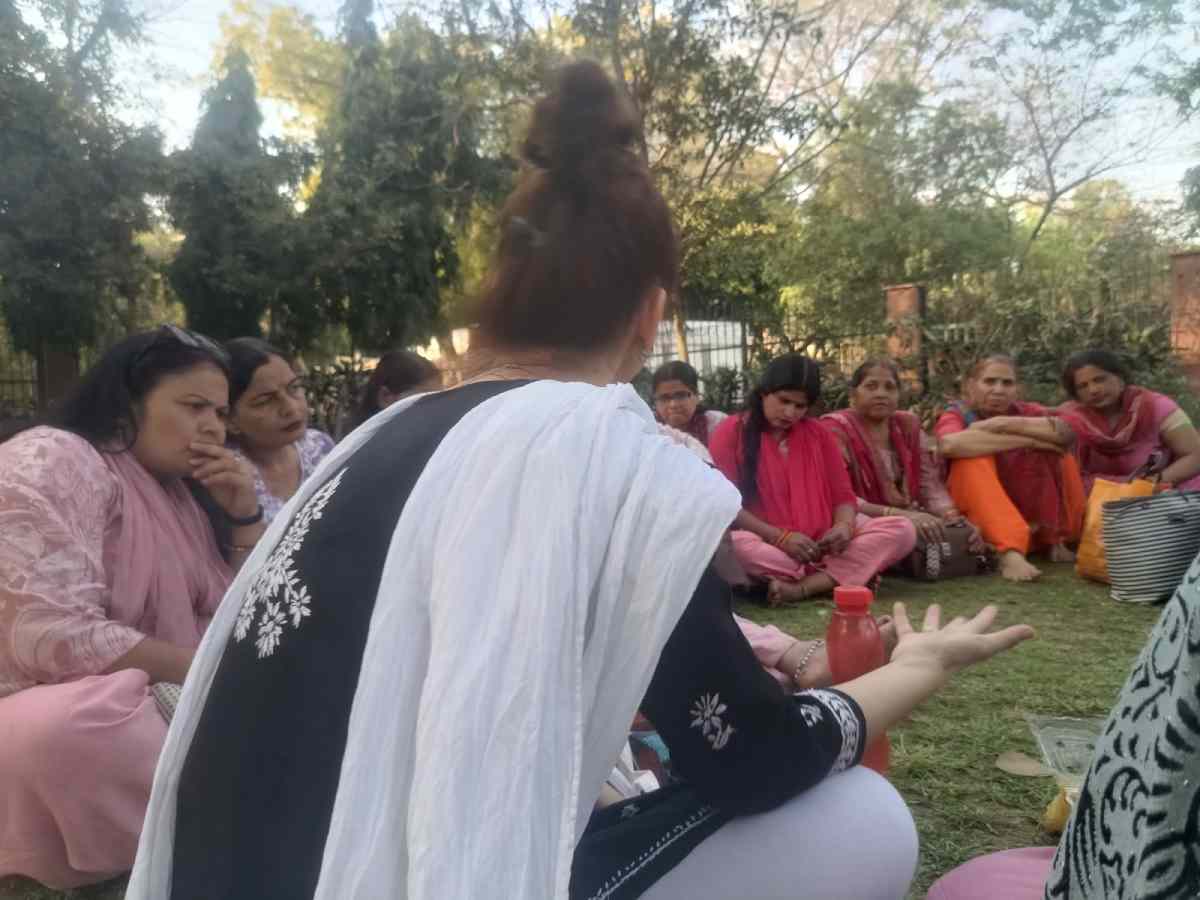
Similarly, a situation had unfolded at Kavita’s block as well. While conducting a session on SIR and how the process is set to follow, she had organised a talk in the area. “I gathered every adult living in the area around the space that I was telling them about the entire process from. I spoke about almost everything, and then, when the entire talk was done, I stopped. Then, a man approached me and tried to correct me with whatever he had learnt from WhatsApp. That made me angry and very uncomfortable,” she said.
Yet, amid all these struggles, their duty as the first line of defence during medical emergencies must still be followed. “Many ASHA and anganwadi workers have been exempt from the BLO process this time, except for a few, including me, especially after other states received multiple letters highlighting the pressure. On June 28 and 30, we conducted a door-to-door polio drive, and coincidentally, the SIR process also started on the latter date,” Kavita said.
Earlier in June, Anganwadi workers across Karnataka, claiming they are under immense pressure due to unrealistic deadlines and targets, wrote to the ECI seeking an exemption from BLO duties.
They argued that the ongoing SIR of electoral rolls has disrupted their main responsibilities of caring for children, pregnant women, and lactating mothers.
Currently, more than half of Delhi’s electorate has been covered under the ongoing SIR of electoral rolls, with enumeration forms distributed to over 7.64 million electors by 8 pm on June 5. However, only 2,78,070 forms, or 1.92% of the electorate, have been digitised so far, according to data released by the office of the Chief Electoral Officer, Delhi.
At least 50 cases have already been reported this month; NCPCR guidelines mandate help desks,…
DMRC says zero reduction in train trips, attributes decline to security measures and public apprehension…
A Delhi court denied bail to a former DU professor accused of raping a student,…
Delhi Police charged seven dhaba workers in the fatal beating of a Manipuri musician who…
Seven Delhi STPs failed DPCC standards in September, dumping high levels of faecal coliform and…
AISA chief Neha Bora petitioned the Delhi HC against a police notice requiring a peace…

