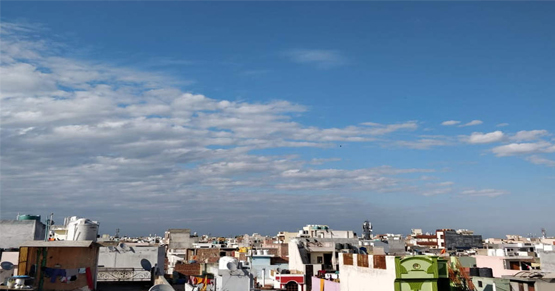
The Indian Meteorological Department has predicted mainly clear skies for Delhi after the national capital experienced heavy rainfall for over a week.
“Delhi is expected to witness mainly clear skies in the next two days, following which it will turn to partly cloud till April 11. While the minimum temperature will hover between 17 to 19 degree Celsius, the maximum temperature will be somewhere around 34 degrees,” the IMD told Patriot.
On Wednesday, the minimum temperature in the national capital settled at 15.9 degrees Celsius, three notches below the season’s average. According to an IMD bulletin, the maximum temperature is expected to hover around 32 degrees Celsius. The relative humidity at 8.30 am was 69 percent, the bulletin added.
Delhiites on Tuesday woke up to showers in the morning with the minimum temperature settling at 16.3 degrees Celsius, two notches below the season’s average.
The relative humidity was recorded at 95 per cent. According to data shared by the IMD, the city registered a rainfall of 16 mm between 8:30 AM on Monday and 8:30 AM on Tuesday.
As per the data from Central Pollution Control Board (CPCB), the overall Air Quality Index (AQI) at 11 am stood in the moderate category at 126.
An AQI between zero and 50 is considered “good”, 51 and 100 “satisfactory”, 101 and 200 “moderate”, 201 and 300 “poor”, 301 and 400 “very poor” and 401 and 500 “severe”.
According to a bulletin by the ministry of earth sciences, air quality is likely to remain in the moderate category from April 6 to April 8.
Gold rods worth Rs 4.03 crore, weighing 3.2 kg, were seized from a Dubai-arriving passenger…
Delhi recorded its coldest night of the month so far, with the minimum temperature dropping…
Elected to the Delhi Golf Club general committee, Mansher Singh says he wants to build…
A $780 million market built on pavements, where the pleasure of reading meets the price…
Supreme Court advocate Abhishek Pawar alleges women were denied washroom access for seven to eight…
Each day of closure costs shops in Khan Market and Connaught Place between Rs 60,000…
