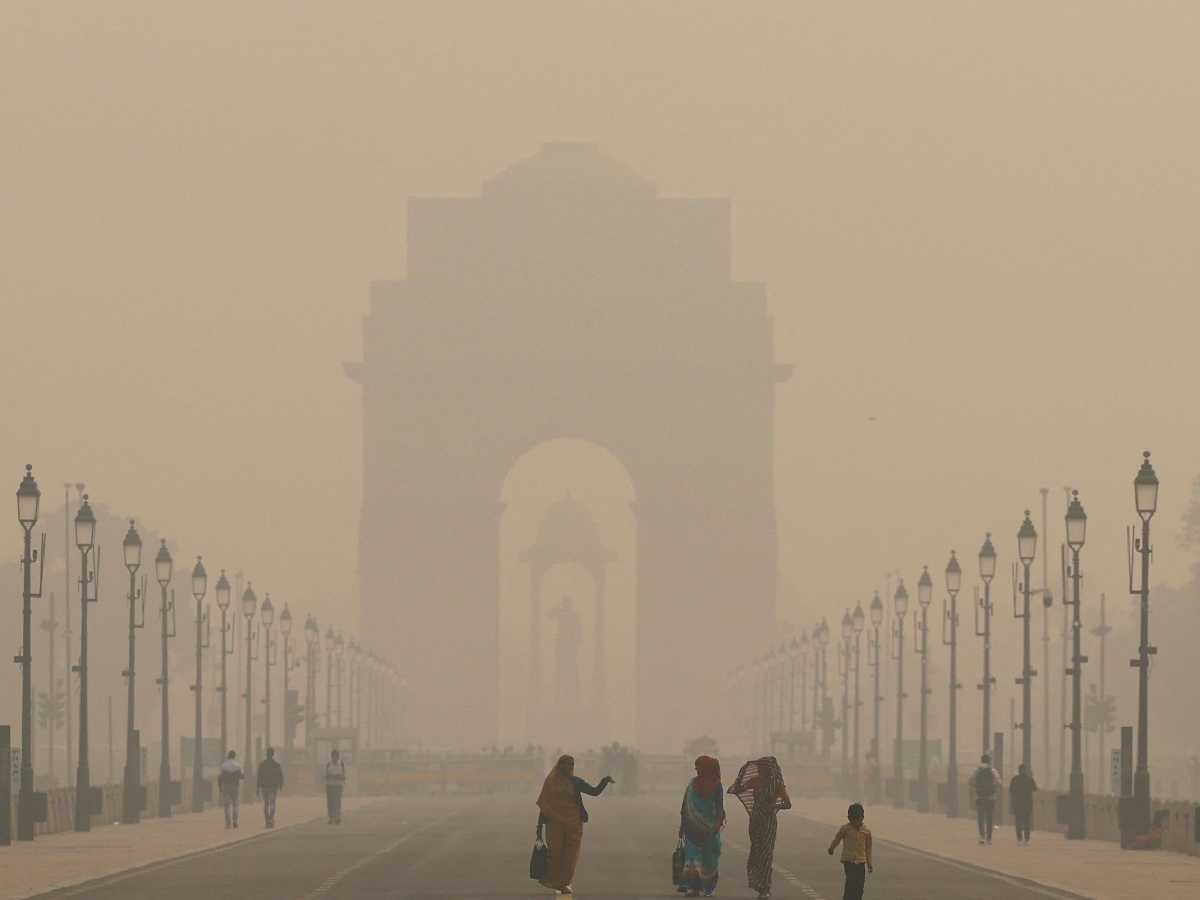
Delhi AQI: In 2026, India’s national average PM2.5 levels saw a modest decline, dropping from 50.6 µg/m³ in 2024 to 48.9 µg/m³, according to findings based on the World Air Quality Report 2025. The data offers a narrow sign of progress in the country’s long battle against air pollution.
Yet in the capital, New Delhi, the improvement masked persistent volatility. Seasonal smog, dust storms and winter emissions continued to drive dangerous spikes in pollution levels. While Delhi’s annual average concentration fell by around 8%, the city still grappled with severe monthly fluctuations.
Environmental experts said the data reflects a pattern of “uneven gains” — incremental annual improvement undermined by episodic surges that keep public health risks high.
The most dramatic surge occurred in April, when a massive dust storm swept across north India, pushing Delhi’s PM2.5 levels up by 15% for the month. The report highlighted dust storms as an increasingly important driver of short-term pollution spikes, alongside anthropogenic sources.
“Dust events are becoming more intense and frequent,” said a senior scientist at a Delhi-based environmental monitoring agency. “They are now a major contributor to short-term pollution spikes, alongside traditional sources like traffic and industry.”
While spring brought dust, winter once again proved to be the capital’s most severe pollution season. In December, Delhi’s average PM2.5 levels surged by 44%, driven by crop residue burning in neighbouring states, temperature inversions, industrial emissions and continued emissions from vehicles and construction.
Also Read: Light rain likely in Delhi on Sunday afternoon, evening: IMD
The wider Indo-Gangetic Plain — identified in the World Air Quality Report 2025 as one of the world’s most polluted regions — experienced even sharper increases. Cities across Uttar Pradesh recorded an average spike of 62% in PM2.5 concentrations during the same period.
Among them, Loni in Ghaziabad district emerged as India’s most polluted city in 2025, with its annual average concentration rising nearly 23% to 112.5 µg/m³ following extreme pollution episodes in March, April and December.
For Delhi residents, the consequences were tangible. Hospitals reported an uptick in patients suffering from respiratory illnesses, asthma attacks and cardiovascular complications during peak pollution periods.
“Every winter, we see the same pattern,” said a pulmonologist at a major government hospital in central Delhi. “Pollution levels rise, and so do emergency visits. It’s not just discomfort — it’s a serious health crisis.”
India’s air quality challenges persisted despite policy efforts aimed at curbing emissions. Vehicular emissions, industrial activity, crop residue burning and construction dust continued as dominant sources of pollution.
The National Clean Air Programme (NCAP), which set a target of reducing pollution levels by up to 40% by 2025–2026, has faced criticism in the World Air Quality Report 2025 for uneven implementation and allocation of resources.
Nearly 64% of NCAP funding has been directed towards road dust reduction measures such as mechanised sweeping and water sprinkling. By contrast, only 15% has been spent on tackling biomass burning, 13% on vehicle emissions and just 1% on industrial pollution.
Environmental analysts said this imbalance has limited the programme’s effectiveness.
“Focusing heavily on road dust addresses only part of the problem,” said an independent air quality researcher. “Without stronger action on vehicles, industry and crop burning, the gains will remain marginal.”
Another key concern is the programme’s emphasis on PM10 rather than the finer and more harmful PM2.5 particles, which penetrate deep into the lungs and bloodstream. Weak enforcement of emission norms and relaxed sulphur regulations for coal-fired power plants have further complicated efforts.
Public frustration boiled over in November 2025, when Delhi witnessed rare protests against air pollution after PM2.5 levels surged into the hazardous range. Daily average concentrations during the episode peaked near 460 µg/m³.
Hundreds of residents gathered at India Gate, wearing masks and holding placards reading “I miss breathing,” as the capital grappled with toxic air.
In response, authorities implemented emergency measures, including closing schools, shifting offices to remote work, banning construction activities and restricting diesel generators. While these steps provided temporary relief, they did not address long-term emission reductions.
“The response is often reactive,” said a policy analyst based in Delhi. “What the report shows clearly is the need for sustained, structural interventions rather than crisis-driven measures.”
Aakiz Farooq, Climate and Energy campaigner at Greenpeace India, told Patriot that Indian cities are witnessing worsening air quality beyond just Delhi.
“Indian cities are witnessing steadily worsening air quality. It is no longer just a question of whether Delhi is the most polluted… many major cities across the country are now grappling with dangerously high pollution levels,” he said.
He added that transportation emissions, particularly from private vehicles, are playing a growing role.
“The rapid rise in private vehicles, particularly SUVs, has significantly contributed to growing CO₂ emissions and urban air pollution,” he said. “As more people shift toward heavier personal vehicles, transportation emissions are becoming a major driver of deteriorating air quality.”
Farooq also urged citizens to take responsibility.
“Those who own or can afford private cars… can make a meaningful difference by pledging to reduce their usage,” he said, adding that a shift to public transport could reduce emissions and build pressure for cleaner urban mobility.
“The findings reinforce that India’s air pollution crisis demands sustained, systemic interventions… rather than short-term or seasonal responses.”
The situation in Delhi reflects a broader regional challenge. Central and South Asia continues to record the highest annual average PM2.5 concentrations globally, with 17 of the world’s 20 most polluted cities located in the region in 2025.
Of the 358 cities analysed across 10 countries, 71 reported annual PM2.5 levels exceeding 50 µg/m³ — more than 10 times the World Health Organization’s recommended guideline.
India maintains the region’s most extensive air quality monitoring network, followed by Pakistan and Kazakhstan. However, coverage remains uneven, particularly in rural areas.
A notable development came in September 2025, when Punjab’s Environment Protection Agency launched a real-time air quality dashboard covering 10 major cities, improving public access to pollution data.
Globally, air pollution is increasingly recognised as a major public health risk, contributing to diseases such as heart disease, stroke and cancer.
For Delhi, the challenge remains immediate and local. Even as national averages show modest improvement, residents continue to grapple with hazardous air for significant parts of the year.
As policymakers weigh the next phase of interventions, the World Air Quality Report 2025 suggests a shift towards sustained emission reductions, stronger enforcement and regional cooperation.
For millions in the capital, the findings reinforce a stark reality: while annual averages may be inching downward, the air they breathe day to day remains dangerously unpredictable.
Read More: Delhi: Residents near waste-to-energy plants say they breathe toxic air every day
Delhi recorded its coldest night of the month so far, with the minimum temperature dropping…
Elected to the Delhi Golf Club general committee, Mansher Singh says he wants to build…
A $780 million market built on pavements, where the pleasure of reading meets the price…
Supreme Court advocate Abhishek Pawar alleges women were denied washroom access for seven to eight…
Each day of closure costs shops in Khan Market and Connaught Place between Rs 60,000…
Delhi generates nearly 15,000 tonnes of waste daily, prompting the government to deploy 1,000 mechanical…


