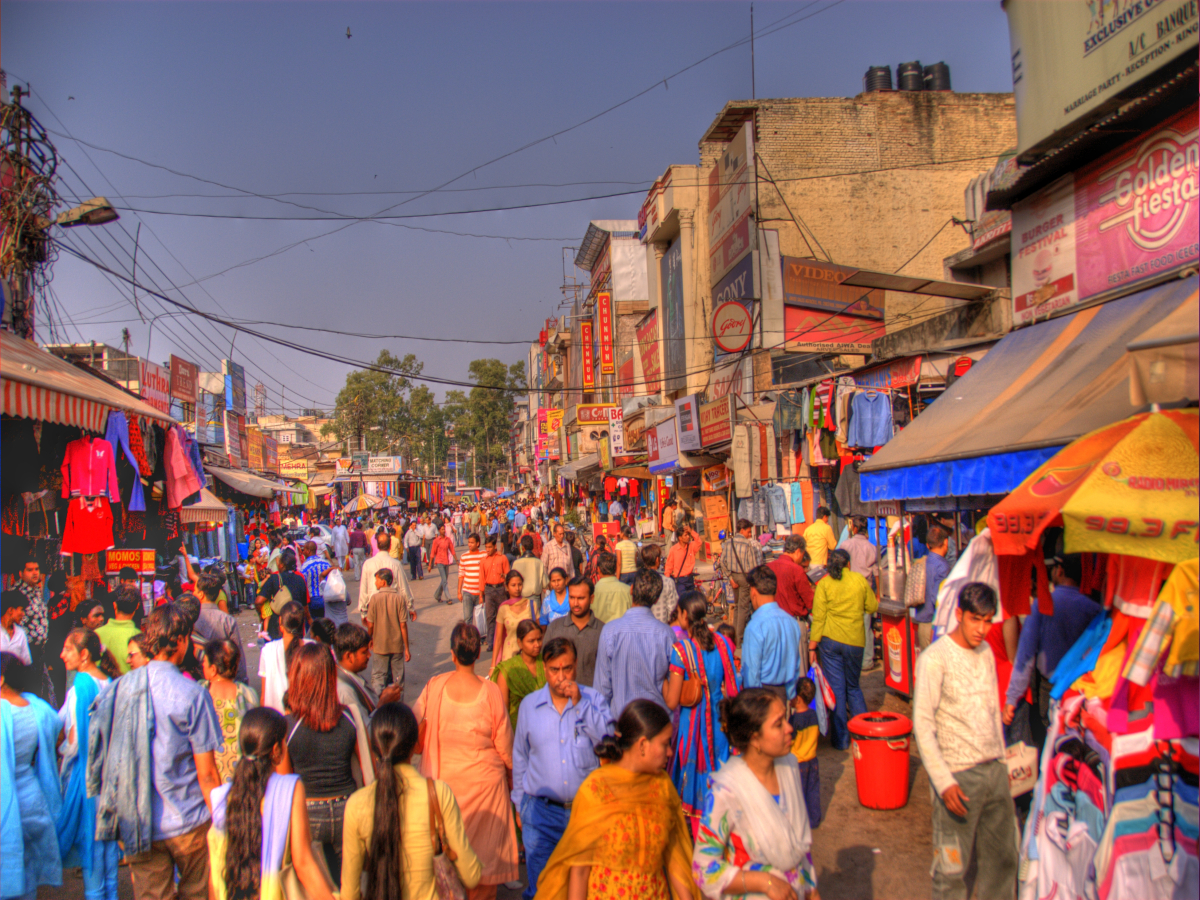
Lajpat Nagar market in 2006
Anyone even slightly familiar with Lajpat Nagar will tell you that, despite changes over the decades and a more diverse population, it still retains the essence of a refugee colony. Established in 1951, the echoes of 1947 continue to resonate here. Even after 75 years, Lajpat Nagar stands as a place of refuge for those uprooted during the Partition and unrest in Kashmir and Afghanistan. It was built on the land of Jamrudpur.
Nearly four decades ago, noted author Manohar Shyam Joshi found inspiration for characters like Haveli Ram, Veeranwali, Ralyiram, Labhayaram, and Shanno in Lajpat Nagar for his iconic television series Buniyaad. First aired in 1987 on Doordarshan, the story revolved around a Punjabi family displaced from Lahore in 1947. Even today, one can almost imagine those characters walking through the lanes of Lajpat Nagar.
It is said that change is the law of nature, and Lajpat Nagar has certainly evolved. Today, you will find Punjabis, Sindhis, Kashmiris, and Afghan refugees running shops side by side as well as living amicably here. “I can say that the only difference is that some arrived earlier, others later. In many ways, Lajpat Nagar has become an ideal place for displaced communities to rebuild their lives, offering both shelter and livelihood,” says Bikram Updhaya, an author and resident of Lajpat Nagar-IV.
View of AIIMS
There are still elderly residents who recall a time in the 1950s when AIIMS was visible from Lajpat Nagar-IV. That was when the colony had just begun to take shape. After the Soviet invasion of Afghanistan in 1979, Muslim refugees from Afghanistan sought shelter here. Later, waves of Hindu and Sikh refugees also arrived following Taliban attacks. In recent years, many Kashmiri families — mostly Muslims from the Valley — have moved here, either as tenants or homeowners. Interestingly, several families of Chinese origin also consider Lajpat Nagar their home, working as beauticians or chefs. Former Delhi Ranji Trophy player SS Lee was also from this locality.
Lajpat Nagar-III is known for its larger plots. Satish Gujral lived here for decades, and his house became a landmark where he created many of his paintings. Similarly, novelist Gulshan Nanda lived in Vikram Vihar in Lajpat Nagar-IV. Even today, his house near Gurunanak Market is identified by his name.
When fortunes changed
For Lajpat Nagar, 1974 was a defining year when Nehru Place came up. Thousands began working there and found Lajpat Nagar a convenient residential option. “Rental income improved the financial condition of local residents. They began expanding their homes — first adding rooms, then entire floors. This transformation significantly altered the socio-economic profile of the colony,” says Shrikant Bhatia, a prominent member of the Sindhi community in Lajpat Nagar.
Mysterious Mahatma
If you know Lajpat Nagar’s geography, you would know Amar Colony. Near Gurunanak Market, in the old double-storey flats, lived a man in saffron robes known simply as “Mahatmaji.” He lived in a small hut filled with religious books and images of deities. No one knew his real name. People from nearby areas — East of Kailash, Chittaranjan Park, Vinobapuri, and Srinivaspuri — visited him seeking solutions to personal problems. He never accepted money and spoke sparingly. Active from around 1955 to the 1990s, he disappeared without a trace one day. Rumours spread — some claimed he took jal samadhi. Even today, older residents remember him with reverence.
Rahmat, Mini, and Lajpat Nagar
Most people are familiar with Rabindranath Tagore’s Kabuliwala and its unforgettable characters, Rahmat and Mini. Their simplicity feels timeless. If you wish to see a modern version of Rahmat, visit Lajpat Nagar’s Central Market or Gurunanak Market. But today’s Rahmat has changed. He no longer sells dry fruits or lends money. Instead, he runs Afghan restaurants, travel agencies, or medical shops catering to fellow Afghans. He carries a mobile phone instead of a cloth bag.
Understanding Delhi’s autorickshaw drivers is not easy. First, they ask you where you want to go, and once you tell them, they may refuse. Then they offer reasons such as wanting only a short ride. However, many drivers readily agree to one destination — Lajpat Nagar.
If you ask an auto driver to go to Lajpat Nagar, in most cases, they will agree without hesitation. As the ride begins, they often ask which part of Lajpat Nagar you wish to go to.
You might wonder why auto drivers are so willing to go there. Lajpat Nagar is centrally located in south Delhi, allowing drivers to easily find onward rides to other parts of the city. They regularly pick up passengers heading to Nehru Place, INA, Delhi Haat, and South Extension.
Once an auto driver reaches Lajpat Nagar, rides tend to come quickly. They do not have to wait long for passengers, which is why the area remains a preferred destination.
So, Lajpat Nagar has come a long way over the decades. While it still retains the refugee colony character, it continues to welcome others into its fold.
A $780 million market built on pavements, where the pleasure of reading meets the price…
Supreme Court advocate Abhishek Pawar alleges women were denied washroom access for seven to eight…
Each day of closure costs shops in Khan Market and Connaught Place between Rs 60,000…
Delhi generates nearly 15,000 tonnes of waste daily, prompting the government to deploy 1,000 mechanical…
Delhi Police has issued an NOC for the Congress rally at Ramlila Maidan on November…
CJP chief Abhijeet Dipke received conditional bail following his arrest for participating in a Connaught…

