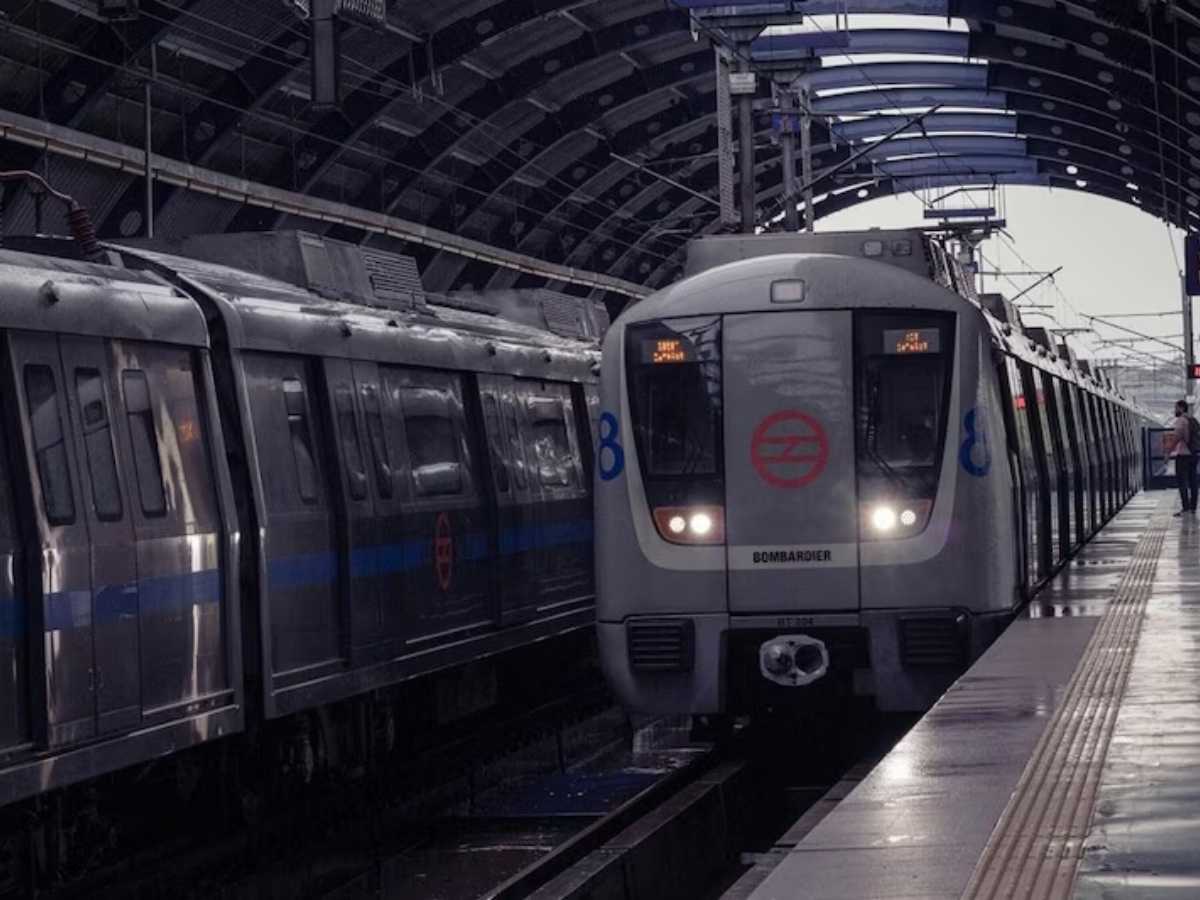
Footfall in the Delhi Metro network dropped sharply on October 10, the day the Cockroach Janta Party (CJP) held its first large demonstration in the national capital over electoral malpractice, which was supported by civil society organisations, student bodies and political parties, according to Delhi Metro Rail Corporation (DMRC) data.
To put matters in perspective, Patriot exclusively accessed daily footfall data from October 1 to October 13, which revealed a pattern of restrictions that affected passenger turnout. On October 10, the DMRC recorded 32,12,571 commuters, while on October 3, with regular crowd footfall, it recorded 59,43,880.
In percentage terms, the total number of commuters on board fell by 45.9% on October 10.
October 3, a Saturday, was the day after the CJP called its first protest against Chief Election Commissioner Gyanesh Kumar; October 10 saw the second. A comparison between regular days and protest days shows a similar trend, with security deployment and movement restrictions remaining high.
On October 2, Friday, when the CJP and Left groups had announced their ‘Save Democracy’ march, the footfall in Delhi’s metros was 40,12,925. However, on a regular Friday, October 9, footfall was again more in line with typical weekday levels, at 72,99,003. Thus, data suggest that on the first declared day of the protest, which saw the closure of 12 stations, footfall fell by around 45%.
The protests prompted extensive security arrangements across central Delhi, with police personnel deployed at key locations and restrictions imposed on movement around sensitive areas. The measures, including barricading and regulating access to Metro stations, drew criticism from petitioners who filed contempt pleas in the Supreme Court, alleging that authorities violated its October 9 order directing that Metro services and public movement not face a complete shutdown. Allegations that journalists were prevented from reporting freely during the protests also intensified scrutiny of the police response.
However, the DMRC has maintained that its services remained “fully functional” on October 10, despite the sharp decline in passenger footfall amid security restrictions.
In separate affidavits filed in the Supreme Court on October 14, DMRC chairperson D Thara said there had been “zero reduction in the total volume of metro operation or the number of train trips”. The network recorded 32.12 lakh passengers on October 10, compared with around 58 lakh on a typical second Saturday.
The DMRC attributed the decline to public apprehension amid the protests and security measures, rather than any disruption to train services. It said ordinary commuters were “compelled to forgo their usual day-to-day activities” that day.
Also Read: Behind kitchen doors: Delhi restaurants and meaning of sustainability
Fewer restrictions
The corporation said entry and exit restrictions were imposed at 45 of its 303 stations on October 10, down from an initial list of 57 stations. It maintained that 258 stations, or more than 85% of the network, remained fully operational and accessible.
Of the 45 stations where access was regulated, 14 key interchange stations, including Rajiv Chowk, Kashmere Gate, Central Secretariat, Mandi House, Hauz Khas, Dilli Haat-INA and Netaji Subhash Place, continued to provide uninterrupted interchange facilities, the affidavit said. Restrictions at the affected stations were lifted by 10 PM, said the DMRC.
It added that the full service schedule had been maintained, with 271 trains making 4,157 trips during the day. The affidavits came amid concerns that barricading and restrictions at Metro stations had impeded public movement, potentially violating a Supreme Court order of October 9 requiring proportionate restrictions.
Thara, in her affidavit, sought discharge from the contempt proceedings initiated by the Supreme Court following a special hearing on October 11. She said the DMRC would act in accordance with assessments and directions issued by law enforcement agencies to ensure the smooth functioning of the network.
The affidavits also referred to restrictions on October 12, when Metro services at six stations were suspended from 6 AM to 4 PM, with the closure later extended until 5 PM. The restrictions coincided with the opposition bloc’s ‘March for Democracy’ towards the Supreme Court.
Also Read: Delhi gets off to its most polluted October start in three years
Substantial decline
While the DMRC maintained that train operations had continued as scheduled, passenger figures showed a substantial decline in ridership compared with a regular Saturday.
Kedar Nath, a DMRC spokesperson, said footfall usually drops on weekends. “We have noticed that our trains have recorded a significantly larger chunk of passengers on weekdays than on weekends. This time around the weekend dip has been slightly more, but it is not staggering,” he said.
Meanwhile, the Union Ministry of Home Affairs and Delhi Police Commissioner Anurag Kumar have filed affidavits before the Supreme Court, tendering unconditional apologies in response to contempt petitions alleging violations of the court’s October 9 order during the protests.
The petitions concern restrictions imposed on public movement, including the closure of 12 Metro stations. In its October 9 order, the Supreme Court had directed that Metro and railway services, as well as public movement, should not be subjected to a complete shutdown.
A contempt petition was filed on October 10, alleging that the authorities had failed to comply with the court’s directions. Appearing for the Centre, Solicitor General Tushar Mehta submitted that the affidavits formed part of the judicial process and expressed concern over media reports presenting the matter as one in which unconditional apologies had been offered without adequate context. The Chief Justice of India said the court had not yet seen the reports in question.
The said protests have seen more than 7,000 detentions since October 10. Presently, CJP co-conveners Ashutosh Ranka and Saurav Das have been remanded in judicial custody for a period of five days over allegations of trespassing and going to the denotified protest site of Jantar Mantar.
A Delhi court denied bail to a former DU professor accused of raping a student,…
Delhi Police charged seven dhaba workers in the fatal beating of a Manipuri musician who…
Seven Delhi STPs failed DPCC standards in September, dumping high levels of faecal coliform and…
AISA chief Neha Bora petitioned the Delhi HC against a police notice requiring a peace…
Average AQI of 171 in the first week of this month; falling temperatures and stubble…
Delhi Police dismissed claims of disrupting CR Park Durga Puja, stating actions strictly enforced court-mandated…
