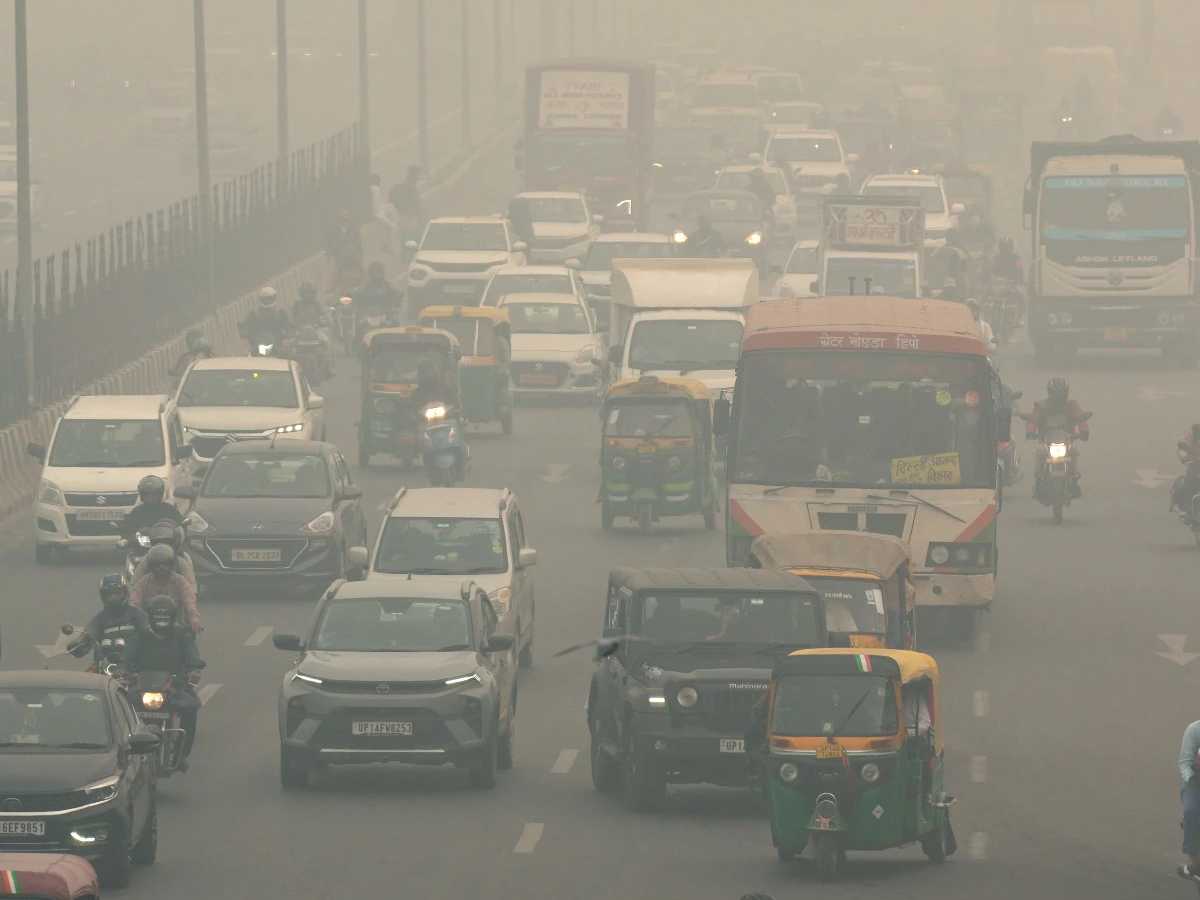
Delhi Pollution: Delhi’s annual PM2.5 levels rose in 2024 for the second consecutive year, despite a 37 per cent drop in stubble burning in Punjab, Haryana and the national capital, according to a new report.
The report by think tank Centre for Science and Environment (CSE) said Delhi’s annual PM2.5 concentration increased to 104.7 microgrammes per cubic metre in 2024 — a 3.4 per cent rise from the 2023 levels. This is also more than twice the national ambient air quality standard of 40 microgrammes per cubic metre.
While the 2024 average is still 9.6 per cent lower than the 2018 peak of 115.8 microgrammes per cubic metre, it is 3 per cent higher than the three-year average of 2021-2023, indicating a gradual reversal of earlier gains made between 2018 and 2022, it said.
Also read: Two HMPV cases detected in India, confirms health ministry
The report highlighted that the total annual fire counts (on account of stubble burning) dropped by 37.5 per cent in 2024 in Delhi, Punjab, and Haryana. Punjab recorded a 75 per cent decline, and Haryana, a 37 per cent decline.
Anumita Roychowdhury, executive director, research and advocacy, CSE, said the rise in PM2.5 levels cannot be seen as an annual aberration due to meteorological factors and consistent rise indicates the impact of growing pollution in the region.
“Delhi seems to be losing its air quality gains from past action. Local and regional sources of pollution including vehicles, industries, open burning of waste, use of solid fuels, construction and dust sources have offset the gains — undermining the longer-term progress over the past decade.
“Delhi cannot hide behind the smoke screen of farm fires anymore. Despite a 71.2 per cent drop in stubble fire incidents during the October-December 2024, the winter pollution has remained elevated, upsetting the annual trend,” she said.
According to Sharanjeet Kaur, programme officer with CSE’s Urban Lab, real-time data from Delhi’s monitoring stations for the winter period (October 1-December 31) reveals a troubling 26 per cent surge in peak pollution levels compared to the previous year during the early phase of winter.
The city experienced 17 days of severe or worse air quality, alongside two extended smog episodes with average smog intensity of 371 microgrammes per cubic metre and 324 microgrammes per cubic metre, respectively.
This has kept the average levels elevated, Kaur said.
Also read: HMPV in India: Delhi govt directs hospitals to stay prepared
Delhi recorded two major smog episodes this winter: from November 13-20 (about eight days) and from December 16-20 (about four days).
The average daily intensity of this smog stood at 371 microgrammes per cubic metre and 324 microgrammes per cubic metre, respectively. At least three continuous days of severe AQI is considered a smog episode.
A $780 million market built on pavements, where the pleasure of reading meets the price…
Supreme Court advocate Abhishek Pawar alleges women were denied washroom access for seven to eight…
Each day of closure costs shops in Khan Market and Connaught Place between Rs 60,000…
Delhi generates nearly 15,000 tonnes of waste daily, prompting the government to deploy 1,000 mechanical…
Delhi Police has issued an NOC for the Congress rally at Ramlila Maidan on November…
CJP chief Abhijeet Dipke received conditional bail following his arrest for participating in a Connaught…
