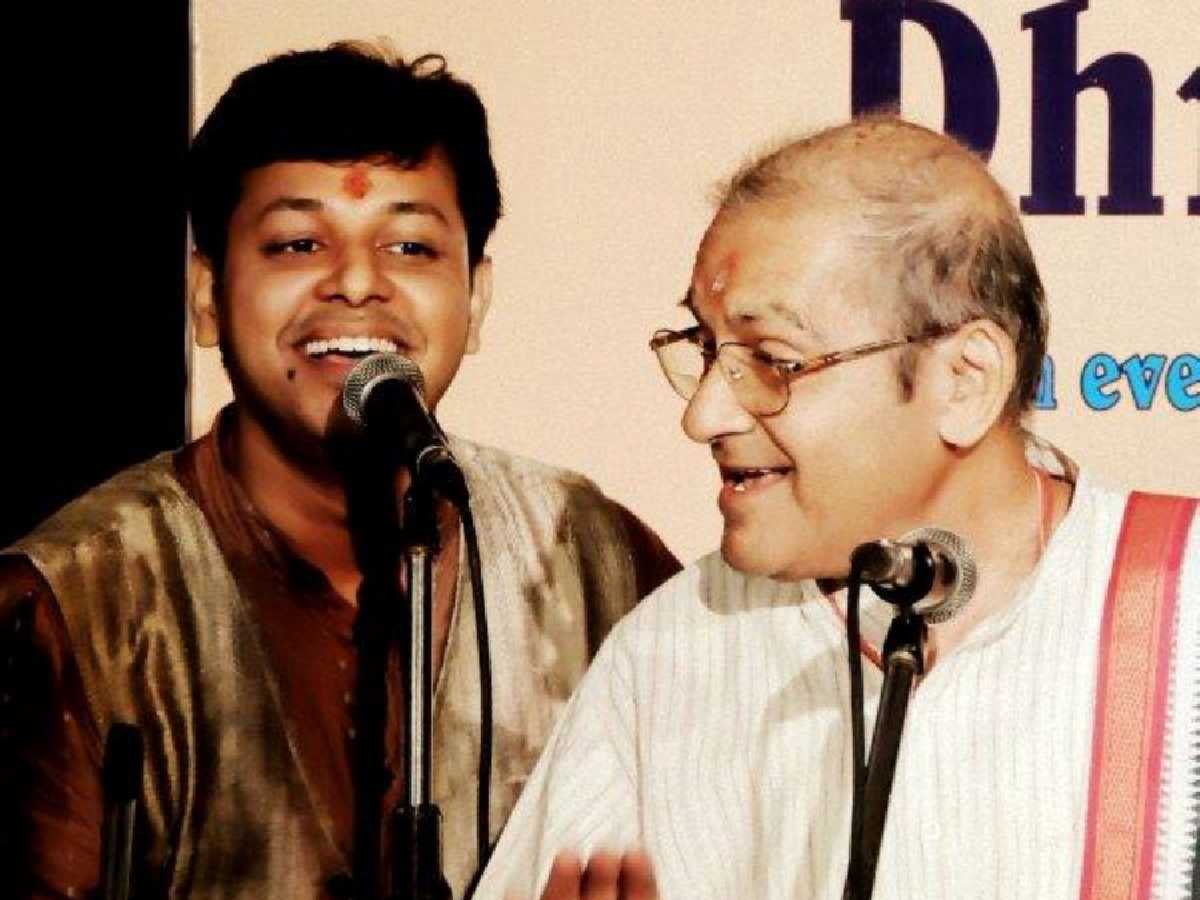
Like many ambitious young professionals, Sumeet Pandey pursued management studies after graduation and secured a well paid job in a multinational company in Delhi. However, the pull of music, inherited from both parents, proved irresistible. Eventually, he left his corporate career behind to train under Darbhanga dhrupad exponent Pt Abhay Narayan Mallick in Noida.
Reflecting on this decision, Sumeet explained that music was deeply ingrained in his lineage. His paternal great-grandfather, Pt Ram Prasad Pandey, was a distinguished musician and was honoured with the title Bihar Ratna. As a child, he received training from his grandfather, Pt Virendra Mohan Pandey. His maternal grandfather, Pt Siyaram Tiwari, was a Padma Shri awardee.
While his family encouraged him to secure a stable job, his passion for music was unwavering. Conversations with his grandfather reinforced his resolve to continue the family tradition. Encouraged by his family, he dedicated himself entirely to his musical training for 15 years until the passing of his Guru, Pt Abhay Narayan Mallick.
Also read: Gurugram: A mindful retreat for the senses
The rigorous training
His training under Pt Abhay Narayan Mallick was both demanding and immersive. Travelling to Noida daily was taxing, and during the hour-long bike ride home, he would repeatedly go over the musical phrases he had learned. Once home, he attempted to notate them, but his Guru discouraged learning through notation, insisting that dhrupad must be absorbed organically.
This method echoed the training of previous generations. Pt Ram Chattur Malik, his Guru’s granduncle and a court musician, would teach young Abhay musical phrases before departing for the Darbar, expecting him to have mastered them upon his return. To avoid detection, the young disciple would erase any notations from the walls. Decades later, Sumeet found himself in a similar situation, unable to record his learnings in writing.
His Guru, despite being in his seventies, was energetic and fully committed to passing on his knowledge. Over time, he allowed Sumeet to stay overnight, enabling longer and deeper training sessions. By 2013, Sumeet had left his job completely and began travelling with his Guru for concerts, learning firsthand the nuances of performance and event management.
Navigating challenges in a competitive field
Breaking into the world of classical music proved to be a formidable challenge. Unlike playback singers who find opportunities through reality and talent shows, classical musicians have no such platforms. “There are very few opportunities,” Sumeet observed. “Apart from the handful of top stars, the second tier of artists struggles. The gap between the two is vast. Concerts are not ticketed, patrons are few, and without performance opportunities, an artist stagnates.”
Determined to create platforms for himself and his peers, he established the Pt Siyaram Tiwari Memorial Sangeet Trust to host small concerts. He recalled how hearing people speak with admiration about his grandfather’s music and personality made him realise the depth of his legacy. At 15, when his grandfather passed away, he had not fully understood his stature. “For the past 10 years, we have been organising biannual festivals in Delhi and Patna, where we honour two artists at each event—one senior and one junior,” he said, adding that so far, these events have been exclusively for dhrupad exponents.
Balancing artist and organiser roles
Balancing his artistic pursuits with the demands of organising events has been a challenge. Sumeet acknowledged that taking on the role of an organiser was not ideal, as it diverted focus from his art. “The ecosystem is not supportive. Constantly having to project yourself, call organisers for a concert, and build your own opportunities—these are distractions from your art. For excellence, you need to be completely focused, or your work remains mediocre.”
The perception of dhrupad
Discussing the perception of dhrupad, he argued that presenting it as the toughest genre of classical music—simply because it is the oldest—is counterproductive. “Young musicians often stay away, assuming it is too difficult. But in reality, any art form is difficult to master. Dhrupad is no different. However, it does require a certain stillness and calm to truly absorb.”
Finding appreciation abroad
While the domestic classical music scene poses challenges, Sumeet has found considerable appreciation abroad. “Singing in Europe has been gratifying. Audiences in the West have a deep appreciation for dhrupad.” Over the years, he has performed across Europe, including in Paris, Rome, Madrid, Budapest, Brussels, and Berlin.
Teaching at the University of California, Los Angeles (UCLA) last year was another enriching experience. During his three month tenure, 15 graduate students trained under him and performed a small concert together, an achievement he found particularly rewarding. His journey to UCLA came through a Fulbright professional scholarship, which enabled him to introduce dhrupad to a new audience.
Also read: Facing mortality together: How Death Cafés are helping people talk openly about dying
A supportive partnership
Today, Sumeet lives in Delhi with his wife, Ritika, a consultant. He credits her unwavering support as instrumental in his musical journey. “I wouldn’t be pursuing music the way I am had it not been for her. In fact, she even plays the tanpura with me in concerts.”
Coforge opened its first library in Noida in February 2024; it now claims a combined…
Of the 237 spa centres across 10 zones with valid MCD licences, the South East…
CTI chairman Brijesh Goyal said the Rahul Gandhi rally could affect wholesale and retail markets…
Established to mark the university’s 25 years, Jubilee Hall has witnessed generations of student life.…
Delhi inaugurates the 70th National School Games, hosting over 14,000 participants in 14 sports across…
Delhi High Court asked "Doosra" filmmakers to respond to Sourav Ganguly's plea over alleged violation…
