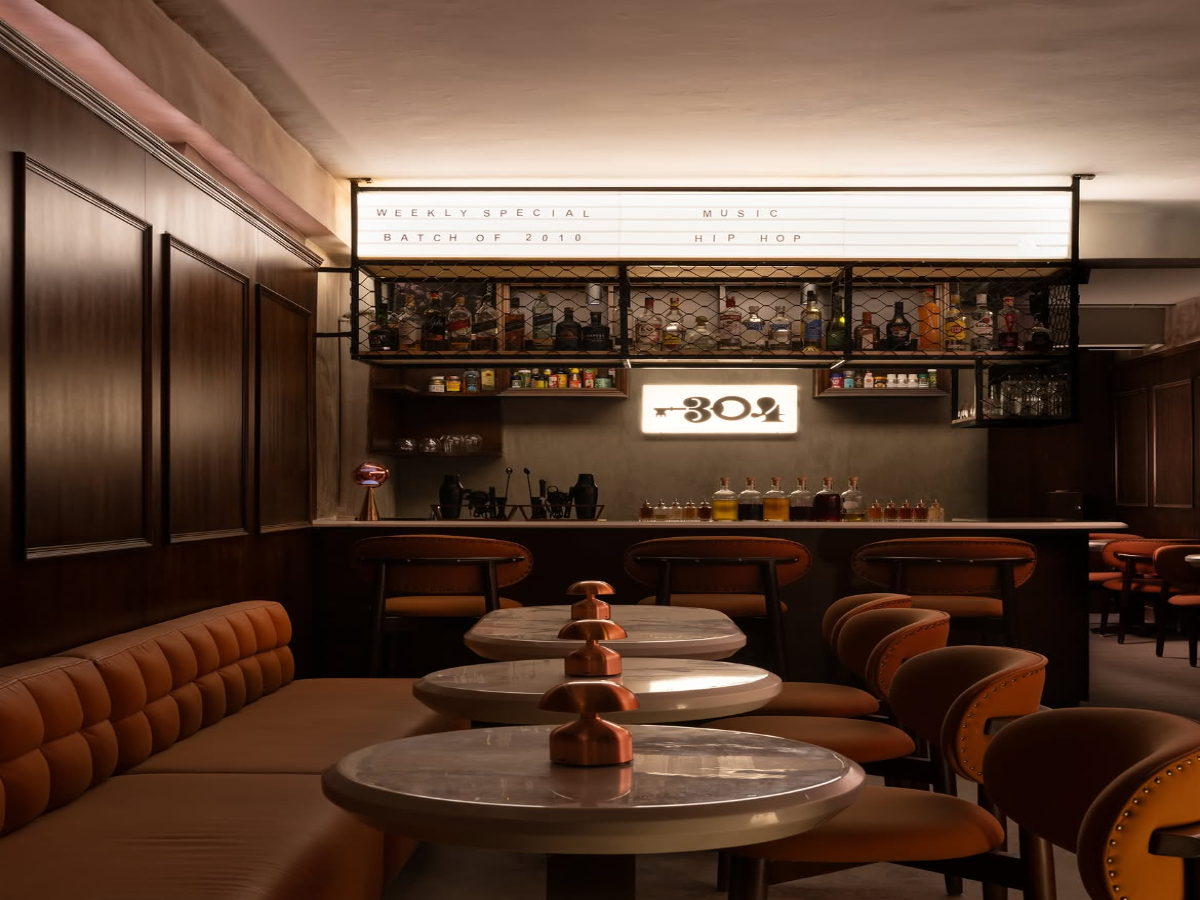
The 304 listening room does not use reflective surfaces for a better audio-centric experience
Delhi’s newest nightlife obsession isn’t another rooftop bar or a themed restaurant. It is the listening room, a concept borrowed from Japan’s century-old kissa culture, where music is treated as the centrepiece of the experience.
Over the past few months, three concept-driven spaces — 304 in Greater Kailash, Together in Vasant Vihar and The Agave Room — have opened in Delhi, each sharing a common philosophy: slowing people down and bringing them back to the joy of listening.
The idea has its roots in Japan’s ongaku kissaten cafés that emerged nearly a century ago, where visitors gathered to hear classical music through high-fidelity sound systems. After the Second World War, these spaces evolved into jazz kissaten, where expensive vinyl collections and carefully designed acoustics allowed strangers to enjoy music together, often in near silence.
Unlike modern bars where music often competes with conversations, listening rooms are designed so that sound becomes the main attraction. The concept has steadily grown beyond Japan and has now taken root in Delhi.
College room-cum-cocktail bar
Hidden inside Greater Kailash is 304, a compact 30-seater listening room and cocktail bar where every design choice serves a purpose.
Sachin Bobal, co-founder of 304, says he and his partners wanted to do more than open another premium bar.
Unlike conventional bars that rely heavily on mirrors and glass, 304 deliberately avoids reflective surfaces. The interiors are built almost entirely with wood, leather and heavy curtains.
“When sound comes out of the speakers, these materials absorb unwanted reflections and let you hear cleaner music,” Sachin explains. “Glass may look beautiful, but it interferes with sound quality. We wanted the best listening experience possible.”
Music here is played on vinyl records.
Each day follows a dedicated musical theme. Thursdays belong to rock, Fridays to pop, Saturdays to favourites from the 1990s and early 2000s, and Sundays to retro classics and disco sessions. Reservations are organised around these genres.
“What we have realised in the last three months is that most people are actually coming for the music,” Sachin says. “The cocktails and food make them stay, but music brings them in.”
Rock nights have particularly become popular. “When we play Linkin Park, Pink Floyd or AC/DC, people know every song,” he says. “They sing along, and that is probably our favourite night of the week.”
On weekends, pop and millennial playlists gradually transform the intimate listening room into a lively space where guests eventually get up and dance during the final hour.
Taste of nostalgia
The cocktail bar takes its name from the founders’ college room, where years of friendships, conversations and memories were made. Those memories now appear throughout the cocktail menu.
Drinks such as ‘The Girlfriend’s Room’, ‘The Drunken Bastard’ and ‘Sadar Bazaar’ are inspired by people, places and traditions that shaped their college years. Even the ingredients inside each cocktail are chosen to represent those memories.
The nostalgic storytelling extends beyond cocktails.
The founders wanted 304 to become what they call a “neighbourhood nostalgic bar,” where guests begin sharing stories of their own.
“When we tell people how this place came together, they start telling us about their own college days,” Sachin says. “That emotional connection becomes part of the experience.”
The menu blends cultures much as the space itself does.
Instead of traditional bar snacks, the kitchen serves modern Indian-European fusion in the form of small plates inspired by Japanese flavours. Familiar dishes are reimagined with playful twists — umami golgappas, makhani dal nachos, gobhi fries and gajar matar momos sit alongside creative cocktails. Even the bar’s signature rasmalai shots have become favourites among regulars.
Together, finding the cat
A few kilometres away in Vasant Vihar, another listening room has taken a different route to the same idea.
Together is hidden down a narrow alley, and guests are simply told to “find the cat.” The black cat has become the identity of the bar, but the real attraction lies beyond the entrance. Visitors walk through a dimly lit corridor lined with vinyl records before entering a cave-like room where the first thing they notice is not the décor or the cocktails, but the music.
That was always the intention, says co-founder Dhruv Kapoor.
“We wanted to build a space where music wasn’t happening in the background,” he says. “Listening should be the first thing people experience when they enter.”
Unlike conventional bars where DJs compete with conversations, Together places sound at the centre of the room. Vinyl records fill the walls, and an elaborate sound system delivers every note with clarity. The architecture itself helps carry the music across the intimate 30-seater space.
The idea also comes from a personal place.
Dhruv is a musician, while his business partner, Vansh Pahuja, has long admired Japanese culture. Their travels to New York and Japan convinced them that Delhi was ready for a space inspired by the Japanese kissa culture. Together, they officially opened Delhi’s first listening room in February 2026.
“It is a time when people are going back to traditional things and analogue experiences,” Dhruv says. “Vinyl culture fits naturally into that.”
Unlike 304, Together does not dedicate specific evenings to different genres. Instead, the music changes naturally throughout the night. “The beauty of listening is that your mood changes,” Dhruv says. “You can move from jazz to rock to pop in one evening.”
The drinks menu is designed like a playlist, with cocktails named Track 1, Track 5, Track 8 and Track 10 instead of conventional names. Inspired by Japanese highballs, the cocktails lean towards bold umami flavours rather than sweet, familiar drinks.
Food is also inspired by Japanese comfort cuisine.
Instead of elaborate restaurant dishes, Together serves bar bites such as chicken karaage, dumplings made with Japanese Kewpie mayonnaise, crispy sandos, tacos wrapped in wonton sheets and dry ramen or mazesoba. Recently, the kitchen added wholesome Super Bowls, including teriyaki chicken bowls and firecracker tofu bowls.
Perhaps the most interesting part of Together is its mascot.
“The idea is that everybody who enters is a curious cat,” Dhruv explains. “Cats naturally find their favourite corner in a room. We want our guests to do the same.”
More than tequila
If 304 celebrates nostalgia and Together celebrates vinyl culture, The Agave Room, which opened in March 2026, centres the listening experience around storytelling.
Created by beverage expert Vijay Prakash, popularly known as Veepee, and hospitality professional Vinay Singh Chand, The Agave Room revolves around tequila, mezcal and the traditions surrounding agave spirits.
Veepee spent years travelling through Mexico learning about agave cultivation and local drinking rituals before bringing those experiences to Delhi.
“My journey began in Mexico,” he says. “With The Agave Room, I wanted to introduce these spirits to India in a way that stays rooted in land, craft and ritual.”
Every cocktail forms part of what the founders call The Ritual, where each drink is linked to one of five elements — Earth, Fire, Water, Air and Teotl.
Cocktails such as The Harvest, Melon Flow, Hot and Holy, Guava Whisper and Golden Union are designed around flavours and stories. The beverage programme, created by Veepee along with mixologist R. Ngaovane (Ava), focuses on layered flavours while educating guests about agave-based spirits.
The food menu has been carefully paired with the drinks.
Guests can choose from dishes such as Black Bean and Quinoa Salad, Stuffed Chilli, Mexican Meatballs, Jackfruit Carnitas, Chicken Chipotle Flatbread, Pork Ribs and the dessert Loco for Coco. Inspired by Mexican flavours, each dish is designed to complement the tequila and mezcal selection.
Unlike many bars that chase Instagram aesthetics, The Agave Room has built its interiors around natural materials.
Stone finishes, textured walls and earthy green shades reflect the five elements that shape its identity. The 68-seater space shifts personality through the week, hosting slower tasting sessions on weekdays before transforming into a livelier venue with Afro-house, disco and electronic music over weekends.
Beyond bars and dance floors
Delhi’s nightlife has traditionally revolved around DJs, crowded dance floors and loud conversations. Listening rooms are quietly changing that idea.
In an age of endless scrolling and shrinking attention spans, perhaps the biggest luxury is not another cocktail or another playlist. It is simply the chance to sit back, put the phone away and truly listen.
Read More: A Pan-Asian lunch that brings Thailand, China and Japan to one table
Over 130 volunteers, doctors and lawyers mobilised legal, medical and mental health aid for CJP…
Delhi Police released a video claiming Dipke was informed of his grandmother’s death in custody…
MCD acted against 1,046 properties over illegal construction and unsafe buildings in Delhi between September…
AAP accused Delhi Police of using force against protesters and vowed to continue the CEC…
Saffron-clad groups allegedly attacked Delhi protesters, with Hindu Raksha Dal chief claiming responsibility for the…
Delhi Police issued fresh notices to CJP leaders in a case involving allegedly morphed objectionable…

