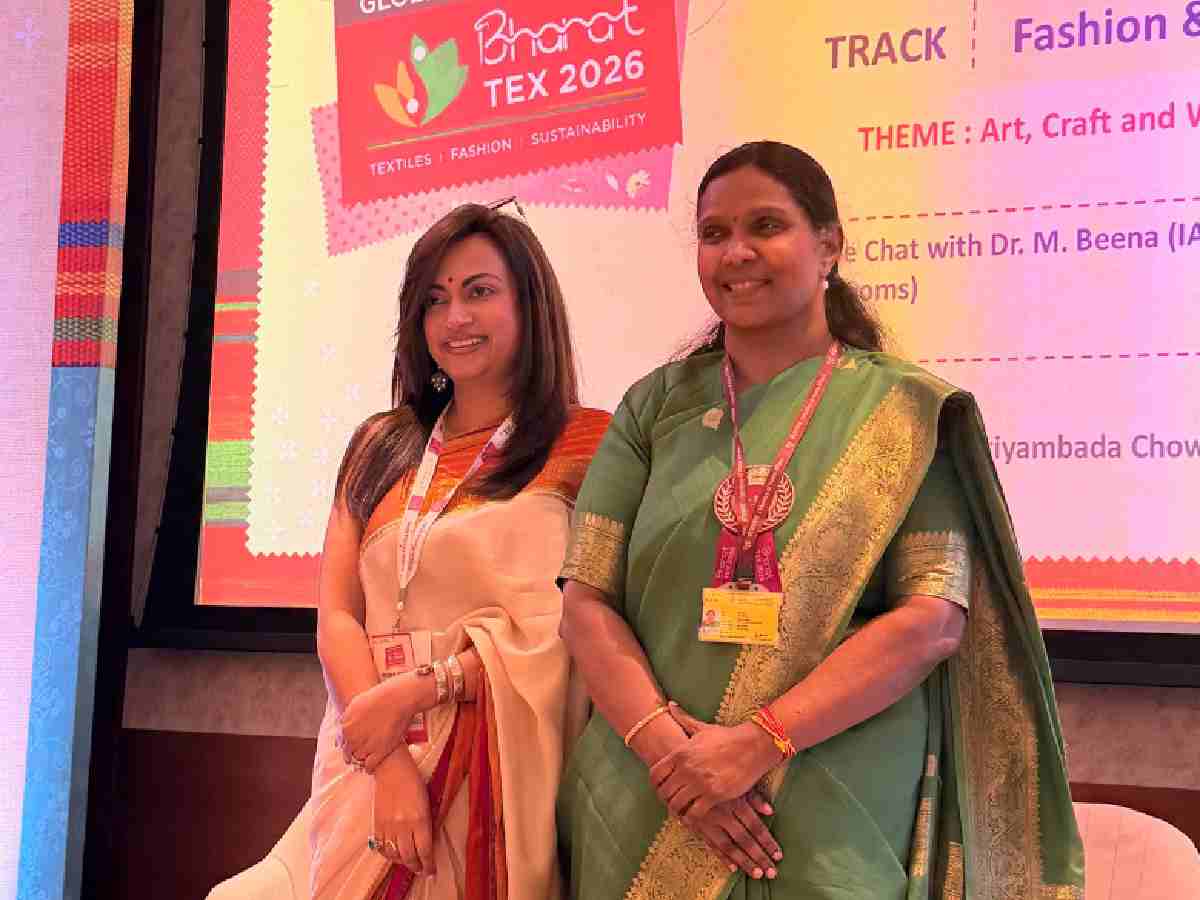
Priyambada Jayakumar (left) with Dr M Beena, Development Commissioner (Handlooms), Ministry of Textiles
Author and handloom advocate Priyambada Jayakumar called for a tailored approach to reviving India’s endangered handloom traditions, saying every weaving practice carries a distinct cultural legacy and requires strategies suited to its history and artisan community.
Speaking during a fireside conversation with Dr M Beena, Development Commissioner (Handlooms), Ministry of Textiles, at Bharat Tex 2026, Jayakumar highlighted the revival of Tangaliya from Gujarat, Awadh Jamdani from Uttar Pradesh and the GI-tagged Siddipet Gollabhama Saree from Telangana as examples of how traditional crafts can be sustained through coordinated efforts.
The session, held at Bharat Mandapam, examined the future of India’s handloom sector under the Viksit Bharat 2047 vision and discussed the role of policy support, artisan-led initiatives and public engagement in preserving traditional weaving practices.
“Every handloom weave carries the history, culture, geography and traditions of the region it comes from. When a weave dies, it is not just a craft we lose, it is an entire cultural legacy. There is no one-size-fits-all approach to reviving languishing handlooms,” Jayakumar said.
She said revival efforts must be designed around the unique characteristics of each weaving tradition rather than follow a uniform model.
Dr M Beena said women constitute the backbone of India’s handloom sector but remain underrepresented in areas such as design, raw material procurement, marketing and sales. She stressed the need to enable women artisans to participate across the value chain.
The discussion cited Tangaliya as a successful revival story after the craft had once been reduced to a single weaving family. It also highlighted efforts to preserve the intricate Awadh Jamdani weave and promote the Siddipet Gollabhama Saree, known for its distinctive handwoven motifs.
The session concluded with participants underlining the importance of continued collaboration between policymakers, artisans, designers and consumers to ensure India’s handloom traditions remain relevant while safeguarding the country’s textile heritage
NDMC set up a panel to review employee transfers since January over alleged anomalies, freezing…
From rare vinyl and vintage Bollywood posters to Y2K fashion and reworked denim, discover five…
Psychology students providing mental health support navigate academic pressure, emotional demands, grief and the challenge…
Delhi Police busted a fake Apple call centre in Naraina targeting US citizens via gift-card…
Union Cabinet approves Rs 1,789.52-crore ITMS for Delhi, covering 42 traffic corridors with adaptive signals,…
The Delhi High Court dismissed the third bail pleas of Umar Khalid and Sharjeel Imam…
