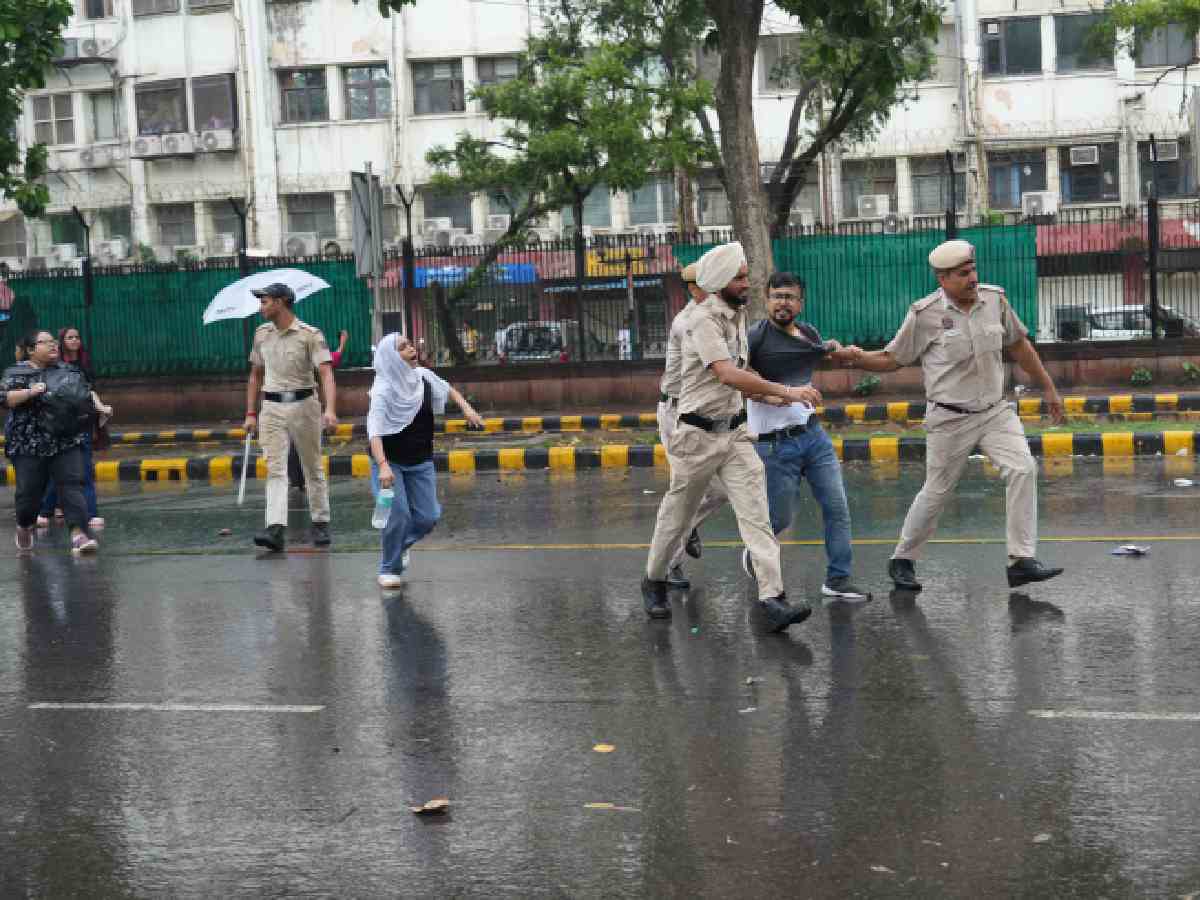
Since October 2, around 1000 protesters have been detained across New Delhi during a protest against Chief Election Commissioner Gyanesh Kumar over allegations of irregularities with the Special Intensive Revision of voter rolls. Delhi Police has registered three FIRs in connection with the protest.
What NDMA guidelines say
The National Disaster Management Authority’s (NDMA) guidelines on managing crowds emphasise that modern crowd management should move away from treating every gathering as a conventional “crowd control” problem.
Planning, risk assessment, communication and preparedness are meant to form the first line of response, with force used only when circumstances require it. The guidelines specifically note that crowd behaviour can differ significantly from individual behaviour and that police strategies should account for the mood, emotions and characteristics of the particular crowd.
That distinction is particularly relevant to protests. Under the section on the ‘Duty of Police and Magistrates’, authorities must facilitate public meetings where citizens exercise their right to assemble. Where the nature, timing and route of a gathering have been communicated, and the protest remains peaceful, the guidelines state that police and the administration should not interfere. Police are expected to respond quickly, professionally, competently and humanely.
Delhi Police standing order
Delhi Police’s Standing Order No. 10/2018, which deals specifically with protests around areas such as Central Vista, Jantar Mantar and Boat Club, provides a framework for regulating such gatherings. It covers prior permission, assessment of the likely impact on traffic, human safety and public tranquillity, restrictions on numbers where necessary, designated protest areas, and conditions governing marches and assemblies. The order also requires organisers to nominate responsible liaison persons and participants to comply with lawful police directions.
These provisions point towards regulation before dispersal. A crowd can often be managed through barricading, traffic diversion, controlling entry and exit, maintaining emergency corridors and ensuring that organisers remain in contact with the police. The NDMA guidelines, in the section on ‘Crowd Control’, describe controlling inflow, regulating the crowd at the venue and, where required, managing its outflow as important components of crowd management.
When force is permitted
The distinction between a peaceful protest and a violent crowd is also central to the question of force. The NDMA guidelines section on ‘International Standards’ states that the use of force should be avoided when dispersing a non-violent unlawful assembly. If force becomes unavoidable, the guidelines say to use only the minimum force necessary.
That is different from a situation in which an assembly becomes violent. In such circumstances, the police may need to intervene to protect people and property and to prevent further escalation. But even then, the NDMA framework does not treat an unlawful assembly as a blanket justification for unlimited force. The response is expected to remain connected to the actual threat.
The guidelines are particularly restrictive when it comes to firearms. They state that, in the case of violent unlawful assemblies, firearms should be used only when less dangerous means are unavailable and only to the minimum extent necessary. The document therefore places firearms at the far end of the escalation process rather than treating them as an ordinary crowd-dispersal measure.
Why proportionality matters
The question of proportionality becomes important at every stage. A protest that is noisy, obstructive or in breach of a regulatory condition presents a different situation from a crowd attacking people, destroying property or creating an immediate risk of serious injury. The police response has to reflect that difference. The NDMA guidelines specifically ask when force is useful and when persuasive or psychological tactics may be more appropriate.
There is also a practical reason for caution. Force used against a large crowd can create a new emergency. The NDMA guidelines note that firing, tear gas and other forceful interventions can themselves contribute to panic and stampede in certain circumstances. A crowd that suddenly begins moving in multiple directions can become dangerous. That makes the availability of safe exits, emergency access and medical assistance important considerations before a dispersal operation begins.
The guidelines also place saving lives and preventing further casualties among the principal objectives of police and administrative action during crowd control. This means crowd dispersal cannot be viewed only as removing protesters from a particular location. How the crowd will move, where people will go and whether the intervention could create a greater risk are also relevant.
Delhi Police’s standing order includes practical provisions for conducting demonstrations, including arrangements for orderly assembly and dispersal and access to water, first aid and medical assistance. These provisions are particularly relevant for large gatherings, where even a relatively minor confrontation can quickly become a public-safety issue.
The guidelines also caution against assuming that policing necessarily means using force. Their discussion of ‘Crowd Behaviour and Policing Strategies’ calls for a more considered approach to the use of force and emphasises the need to recognise effective policing that achieves its objective without force. The document specifically distinguishes between different types of crowds and notes that the approach to a political rally, for example, cannot automatically be the same as the approach to a crowd gathered after an accident or at a fair.
For Delhi Police, therefore, the question before dispersing a protest should be more specific than whether the gathering is inconvenient or technically unlawful.
The relevant questions are what the crowd is doing, what danger it presents, whether the situation can be regulated without physical intervention, whether clear directions have been communicated, whether organisers can assist in compliance and what consequences the proposed use of force could have.
Broad progression
The two documents together suggest a broad progression: peaceful assemblies should ordinarily be facilitated; gatherings that require regulation should be managed through planning, communication and control of movement; unlawful but non-violent assemblies should not be subjected to force where dispersal can be achieved through other means; and violent assemblies may require stronger intervention where necessary to protect people and property. Even then, the level of force should correspond to the circumstances.
The ultimate objective is not simply to clear a particular road or location. The NDMA guidelines identify restoring normality, protecting property, preventing casualties and safeguarding the wider social environment as crowd-management objectives. In that framework, a successful police operation is not necessarily the one that uses the most force, but the one that resolves the situation while keeping the risk to protesters, police personnel and bystanders under control.
For Delhi Police, the central principle emerging from the guidelines on managing crowds is that force responds to a specific situation and is not a substitute for crowd management. The standing order provides the more specific regulatory framework for designated protest locations, while the NDMA document sets out the broader approach to planning, communication, dispersal and proportionality. Read together, they place necessity, restraint and the nature of the threat at the centre of decisions on when a protest crowd should actually be dispersed by force.
Security has been tightened at Noida-Delhi borders ahead of Saturday’s CJP protest, with BSF deployment,…
NDTA advised Connaught Place shops to remain closed on Saturday as a precaution against expected…
Sarai Kale Khan and New Ashok Nagar Namo Bharat stations will close Oct 9–10 for…
Delhi Police deployed heavy security at stations, but valid ticket holders will pass without hindrance…
AISA president Neha Bora urged protesters to continue at Jantar Mantar despite arrests, comparing the…
Experts say exposure to Delhi-NCR's toxic air may contribute to gynaecological cancers by causing long-term…
