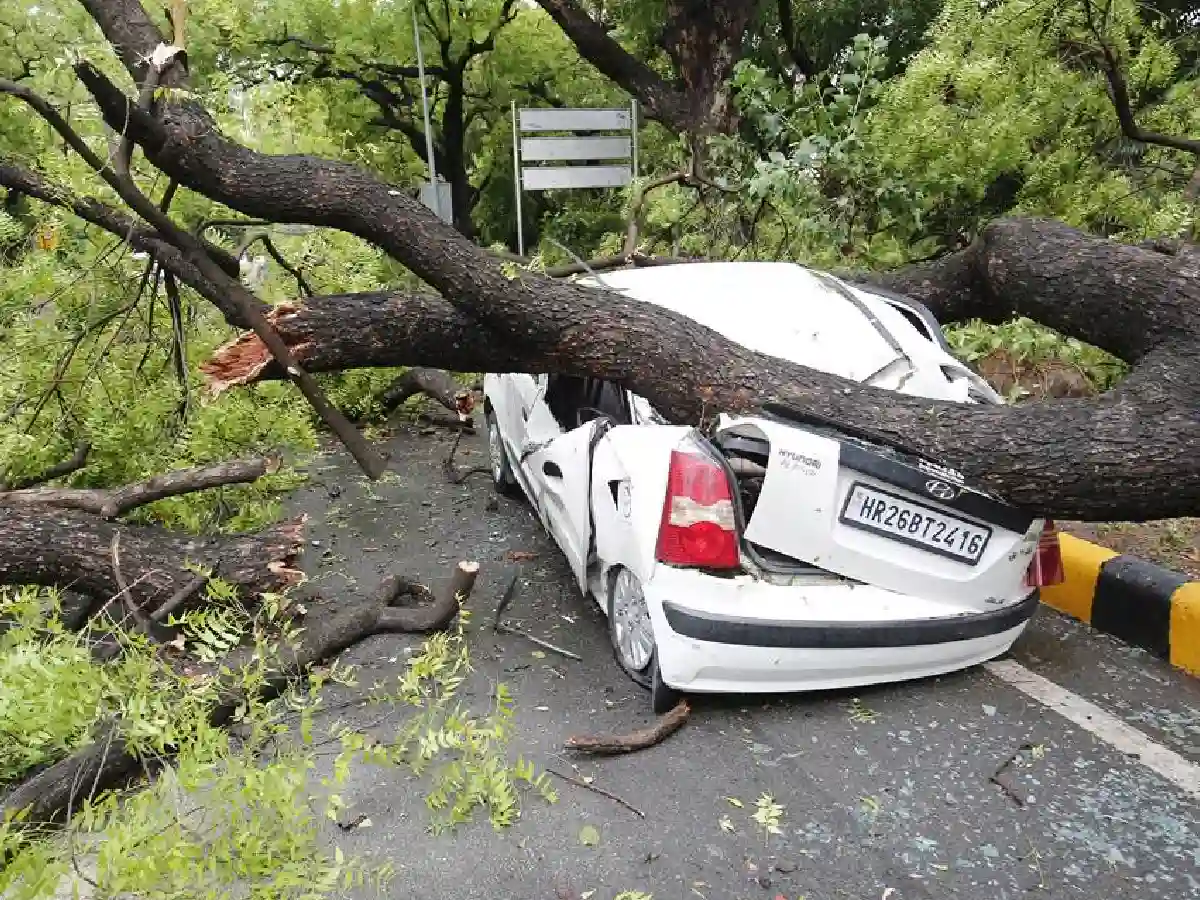
The heavy downpour that lashed Delhi on Thursday did more than flood streets and bring traffic to a crawl; it also tore through the city’s green cover, toppling more than 25 trees in the day.
One such fall, in the middle of a busy Kalkaji road, crushed a car, killing a 50-year-old man and leaving his daughter battling for life.
Environmentalists say the deeper cause lies in something more man-made — concretisation. Across the capital, pavements and road medians are often sealed with concrete right up to the tree trunks. While the intention behind the practice is to improve neatness and durability, experts say it starves the trees and weakens them over time.
“Concretisation is the main reason behind these repeated felling of trees,” said Sunil Kumar Aledia, Executive Director of the Centre for Holistic Development.
Also read: Delhi: Lal Kuan, India’s biggest kite market, turns colourful for I-Day
“We have been hearing about its harm since our childhood, but not much has been done to address the issue. The NGT (National Green Tribunal) has ordered that trees must not be cut in Delhi, but that alone is not enough. If you notice, many tree barks here are black — a sign that they are not getting enough nutrients,” Aledia said.
Aakiz Farooq, Climate and Energy Campaigner at Greenpeace India, said that even without cutting, trees are being slowly killed by encasing them in concrete.
“You will notice that trees in parks or jungles rarely fall. It’s the roadside trees, with roots trapped under footpaths, that give way. Concretisation weakens the roots, restricts their growth, and cuts off their access to water and oxygen,” he said.
The science is simple: trees need a loose soil bed to allow roots to grow outward and downward. But when a cement slab hugs the trunk, water cannot seep in, air circulation stops, and roots remain shallow. During the monsoon, when trunks swell with moisture, the concrete acts like a chokehold.
A 2013 NGT order directed authorities to remove concrete from a one-metre radius around trees, yet over a decade later, implementation remains patchy.
Delhi-based environmentalist Verhaen Khanna explained that cement around a tree’s base blocks water and air and prevents the trunk from expanding.
“In monsoon, this becomes fatal — the roots lose their grip, and if road digging cuts through them, the risk of collapse is even higher,” he said.
Urban planners say the problem is not just poor enforcement but also a lack of public awareness. Tree bases, when left unpaved, are often encroached upon or used as dumping spots, prompting civic bodies to seal them for maintenance. But the cost of that neatness is often a toppled tree.
The tragedy in Kalkaji is just the latest reminder that Delhi’s trees are losing their battle underground long before they fall. The rain may push them over, but it is the concrete that quietly tips the balance.
Elected to the Delhi Golf Club general committee, Mansher Singh says he wants to build…
A $780 million market built on pavements, where the pleasure of reading meets the price…
Supreme Court advocate Abhishek Pawar alleges women were denied washroom access for seven to eight…
Each day of closure costs shops in Khan Market and Connaught Place between Rs 60,000…
Delhi generates nearly 15,000 tonnes of waste daily, prompting the government to deploy 1,000 mechanical…
Delhi Police has issued an NOC for the Congress rally at Ramlila Maidan on November…
