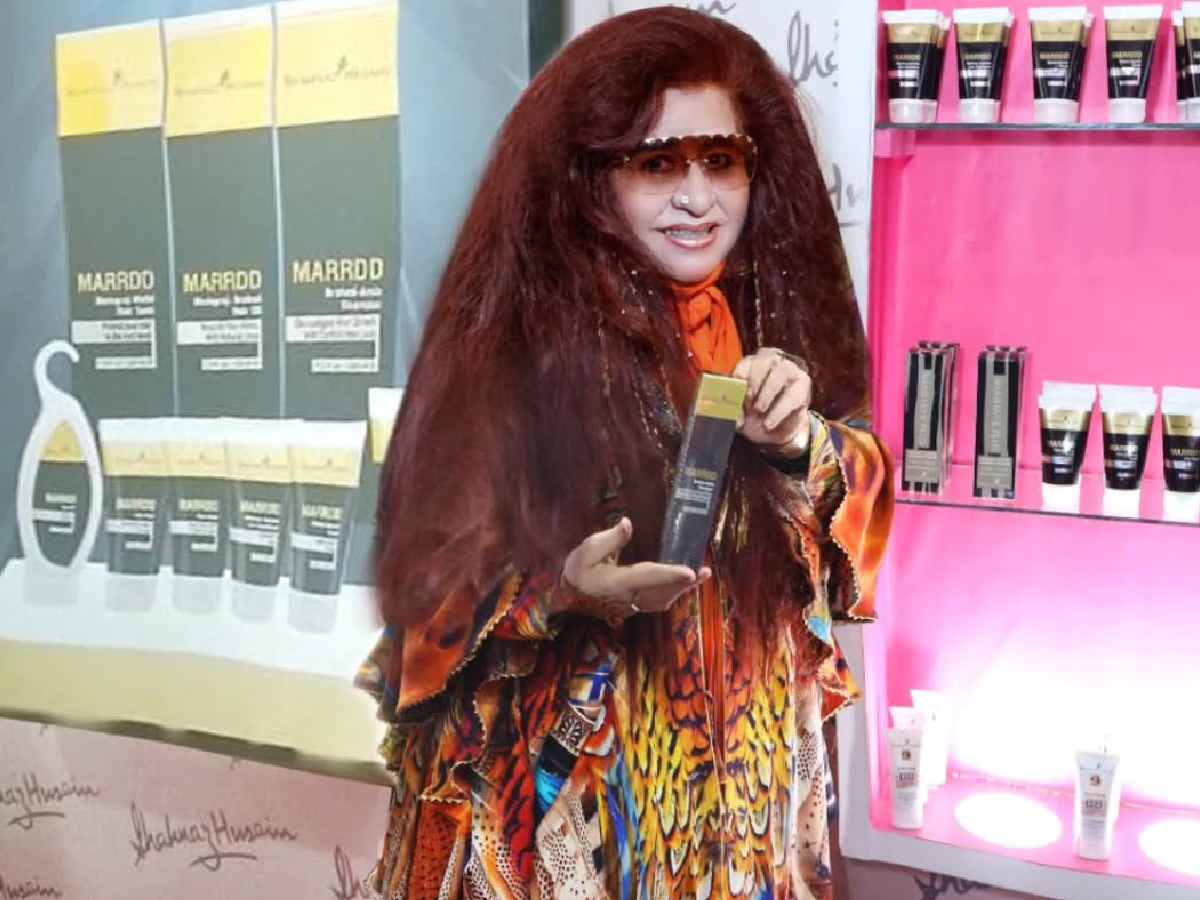
Shahnaz Husain
For more than half a century, Shahnaz Husain has been one of the most recognisable champions of Ayurveda-based beauty. With her henna-red hair, kohl-lined eyes and unwavering belief in India’s ancient wellness traditions, she helped reshape global skincare long before “clean beauty” and “sustainability” entered the industry vocabulary. Her empire grew not through advertising or celebrity endorsements but through a kind of missionary commitment to herbal care, an ethos she still sums up in a single line: “Beauty is my mission, my conviction, my life.”
At 80, the founder and chairperson of The Shahnaz Husain Group remains both internationally respected and locally cherished. Awarded the Padma Shri in 2006, she has lectured at Harvard Business School, where she is still studying as a case, as well as at MIT, Oxford and the London School of Economics. She has addressed the British Parliament, represented India at President Barack Obama’s World Summit for Entrepreneurs and walked the red carpet at Cannes. In 1996, Success magazine named her the “World’s Greatest Woman Entrepreneur,” the first woman to receive the honour in its 104-year history.
Behind the iconic persona lies a story intertwined with India’s shifting understanding of entrepreneurship, rooted in lineage, tempered by struggle and sustained by a desire to empower others.
A royal legacy, a childhood of expectations
Born Shahnaz Beg in November 1944, she grew up in a family that blended influence with intellectual rigor. Her father, Justice Nasir Ullah Beg, served as Chief Justice of the Allahabad High Court, while her mother belonged to the extended family of the Nizams of Hyderabad. Her great-grandfather, Sir Afsar Ul Mulk, and grandfather Osman Uddaulah were commanders-in-chief in the Nizam’s army. Another grandfather, Justice Samiullah Beg, was Chief Justice of the Hyderabad High Court, and her uncle, Mirza Hameedullah Beg, later became Chief Justice of India.
Privilege, however, did not shield her from early responsibility. Married at 14 and a mother at 16, she recalls her father’s deep regret. “He felt guilt for getting me married so early,” she says. He encouraged her to continue her education and pushed her to acquire the skills that would allow her to stand on her own.
She studied at St. Mary’s Convent Inter College in Prayagraj before traveling widely to train in Ayurveda, cosmetic therapy and cosmetology. From Tehran to London, and from Denmark to Germany, she earned diplomas she describes as “reassurances” to her father. Still, he left her with a question that guides much of her charitable work: “This world is temporary. What are you doing for your permanent world?”
A business built one herb at a time
Her turning point arrived when a classmate’s mother lost her eyesight after using a chemical eyeliner. The incident convinced her to create safe, plant-based alternatives. Herbal skincare was barely known in India when she opened her first clinic in 1971, mixing products by hand in her Delhi kitchen.
From those early efforts emerged a global network of 400 franchise ventures in 138 countries, all developed without animal testing. Her first franchise opened in Calcutta in 1979, followed by London in 1982. Her formulations, from 24 Carat Gold to Diamond, Pearl, Plant Stem Cells and Platinum, remain popular. Cult favourites like Shaeyes kajal and Shalife Premium continue to thrive across generations. “I address concerns at the root,” she says. “That is why the brand stays relevant.”
Her enterprise now includes salons, spas and government-supported skill development programs. More than 40,000 underprivileged women have completed training at her academies.
Even now, she insists that newer challenges lie ahead. AI-led product innovation is her next focus.
A global ambassador of Ayurveda
Her invitation to Harvard to speak on “creating a global brand without advertising” cemented her reputation as an unlikely corporate trailblazer. She became a formal case study, demonstrating that heritage, authenticity and instinct could rival large-scale marketing.
“What I’m selling is India’s 5,000-year-old civilisation in a jar,” she says. Even as beauty consumers shift toward quick-fix treatments such as fillers and transplants, her belief in Ayurveda remains unwavering.
A private world of poetry, service and reflection
Away from public life, Husain often reflects on her early love for poetry. She recalls winning Rs 500 in an international competition, enough to open her first bank account. Her philanthropic instincts deepen each year, shaped by her father’s question about permanence. At Delhi’s Blind Relief Association, she teaches grooming and self-care. Her ChemoLine range, created to ease the effects of chemotherapy, is donated frequently to hospitals.
“Legacy is emotional,” she says. “Awards do not matter as much as what you do for others.”
Financial independence for women is a message she delivers with striking clarity. “No woman should depend on a man for money. Men fear a woman who earns; they fear her non-dependence.”
Her brand’s nostalgic packaging, featuring a young Shahnaz looking dreamily into the distance, still carries her personal approval. One of her guiding rules remains constant: “Do not write anything without proof.”
Nature continues to offer her grounding. Watching the amaltas tree outside her window bloom each year, she says, has taught her how quickly life can pass. “I don’t want it to slip away anymore.”
Family, poetry, nature and charity now anchor her world. “There is nothing in the world that I want and don’t have,” she says. “So what am I struggling for?”
Families displaced by the Seemapuri building collapse spend another night on the streets as damaged…
Camera-based enforcement in Delhi generated around 40.6 lakh notices till September, but only about 2…
Delhi government to fast-track Rs 7,000-crore elevated Ring Road project, with two new Yamuna bridges…
Yamuna water quality deteriorated at three locations in Delhi in September, with BOD levels remaining…
Delhi liquor stores will remain shut on October 9 and 10 following police inputs to…
Strike began September 15; ESMA invoked by month-end has barred strikes for six months; drivers…
