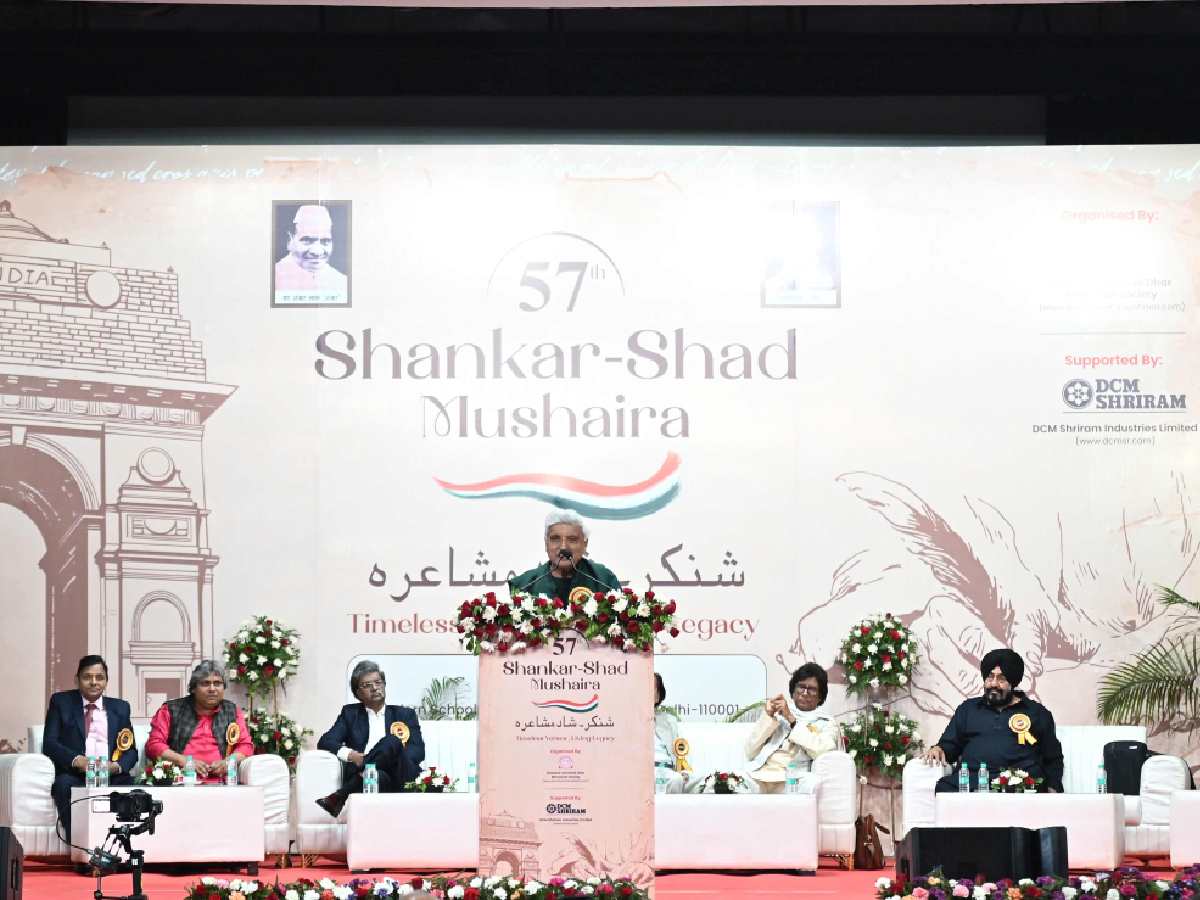
In a city that often rushes past its own history, pausing for a ghazal can feel like reclaiming something essential. On Saturday evening, that pause came alive as thousands gathered at Modern School on Barakhamba Road for the 57th Shankar Shad Mushaira, transforming the venue into a space of shared emotion and quiet reflection.
The annual literary gathering, organised by the Shankar Lall Murli Dhar Memorial Society in collaboration with DCM Shriram Industries Ltd, drew a diverse audience—college students, families, and elderly poetry lovers—who sat side by side, some with flasks of chai in hand, waiting for the first recitations to begin. Since its inception in 1954, the mushaira has remained a cultural anchor in the capital, carrying forward the legacy of Urdu poetry into contemporary times.
This year’s edition saw a pan-India line-up of poets from cities including Bareilly, Mumbai, Jodhpur, Kanpur, and Hyderabad. Renowned figures such as Javed Akhtar and Waseem Barelvi shared the stage with celebrated names like Sheen Kaaf Nizam, Rajesh Reddy, and Shakeel Azmi. They were joined by younger voices, including Zubair Ali Tabish and Hina Haider Rizvi, reflecting a vibrant intergenerational dialogue.
Beyond performance, the evening underscored poetry’s deeper purpose as a medium of connection. Addressing the audience, Barelvi described the transformative journey of a ghazal. “A ghazal leaves the poet the very moment it is spoken,” he said. “It then belongs to the listener who realises they are no longer alone in their grief.” His words resonated across the gathering, with many visibly moved by the shared vulnerability of the moment.
Madhav Bansidhar Shriram, Chairman of the organising society and Managing Director of DCM Shriram Industries Ltd, highlighted the significance of such cultural spaces in contemporary times. “We live in times where people hear but rarely listen,” he said. “This mushaira offered a sanctuary where thousands sat together, absorbed in every word, reminding us that poetry remains a powerful unifier.”
A key highlight of the event was the Shankar Shad Shayari Contest, which invited aspiring poets to present their work on a historic stage. With over 2,000 entries, the contest emphasised inclusivity across age groups, reinforcing the idea that creativity transcends generational boundaries. Shyam Kashyap Bechin, Satyendra Bharill, and Chand Kakralvi Khan emerged as winners.
Encouraging young writers, Akhtar urged them to remain authentic in their expression. “Write because the truth burns inside you,” he said. “The youth today feel deeply, and that gives me hope that Urdu will continue to thrive in their hands.”
The audience itself reflected the evolving cultural landscape. Young attendees found resonance in themes of identity, mental health, and emotional struggle, while older generations offered context and interpretation of classical Urdu expressions. The evening embraced linguistic diversity, with Hindi and Hindustani dialects seamlessly blending into traditional Urdu forms.
As the night drew to a close, the 57th Shankar Shad Mushaira reaffirmed its place as more than just a literary event—it stood as a living archive of shared human experience. In an age of fleeting digital content, the verses recited under the open sky lingered, leaving Delhi a little more connected than before.
An FIR over Jamia protests alleges Congress MPs Imran Pratapgarhi and Imran Masood unlawfully entered…
Delhi's 'Namo Yamuna River Safari' cruise will launch before Chhath, offering 40-minute family trips between…
Delhi's Old RTR flyover reopens for light vehicles today after repair work following road cracks,…
Visits to Govindpuri, Jangpura, Saket and Mayur Vihar show unlabelled corrosive substances sold for Rs…
Rescue teams recovered two bodies from the debris of a collapsed under-construction house in northeast…
Built on Jawaharlal Nehru’s vision, the Delhi landmark has witnessed the evolution of a young…
