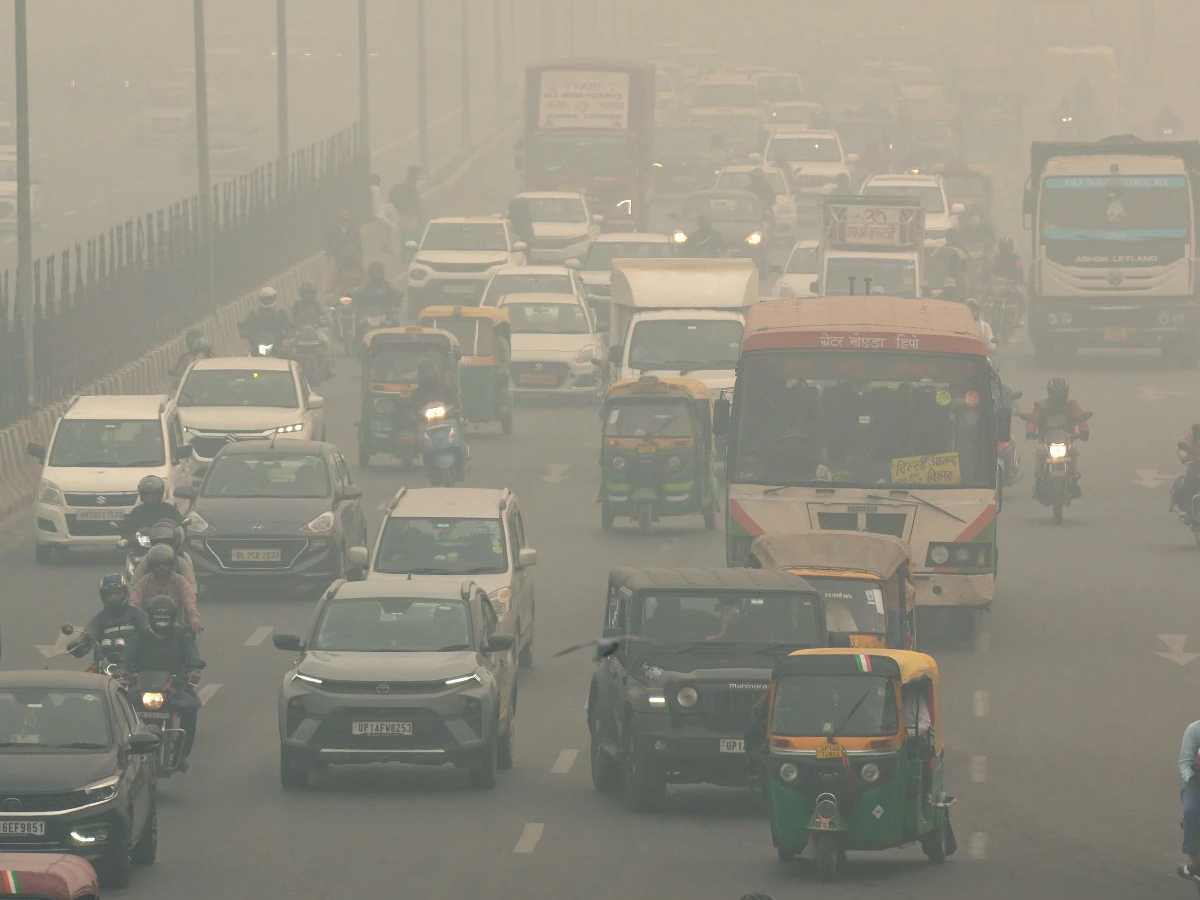
Even with farm fires at a multi-year low, Delhi-NCR’s winter air remains suffocating. For most of October and November, pollution levels hovered between ‘very poor’ and ‘severe’, fuelled by a rising “toxic cocktail” of PM2.5, nitrogen dioxide (NO₂) and carbon monoxide (CO) emitted mainly from vehicles and other local sources.
At least 22 air-quality monitoring stations in Delhi recorded carbon monoxide (CO) levels above permissible limits on more than 30 of the 59 days assessed, with Dwarka Sector 8 logging the highest number of breaches at 55 days, followed by Jahangirpuri and Delhi University’s North Campus, both at 50 days, according to a new analysis by the Centre for Science and Environment (CSE).
The analysis also highlights a troubling proliferation of pollution hotspots in the capital.
In 2018, only 13 locations were officially designated as hotspots. Now, several more locations routinely record pollution levels far higher than the city average.
Jahangirpuri emerged as Delhi’s most polluted hotspot, with an annual PM2.5 average of 119 µg/m³, or micrograms per cubic metre, followed by Bawana and Wazirpur (113 µg/m³), Anand Vihar (111 µg/m³), and Mundka, Rohini, and Ashok Vihar (101–103 µg/m³).
Vivek Vihar, Alipur, Nehru Nagar, Siri Fort, Dwarka Sector 8 and Patparganj were some of the new hotspots flagged by CSE.
Smaller NCR towns also recorded more intense and longer smog episodes this year.
Bahadurgarh experienced the longest continuous smog event — lasting 10 days, from November 9 to 18 — indicating that the region increasingly behaves as a single airshed with uniformly high pollution levels.
Also Read: Construction ban leaves daily-wage labourers in Delhi struggling for food and dignity
CSE’s assessment finds that early winter pollution has plateaued at unhealthy levels, driven mainly by local emissions, even as the contribution of stubble burning has dropped significantly.
The analysis — based on CPCB data — points to a “toxic cocktail” of PM2.5, nitrogen dioxide (NO₂) and carbon monoxide (CO), pollutants closely linked to vehicles and combustion sources, that has heightened health risks this season.
Researchers found that PM2.5 levels rose and fell almost in tandem with NO₂ during peak traffic hours. Between 7–10 am and 6–9 pm, both pollutants spiked sharply as vehicular emissions accumulated under shallow winter boundary layers.
While NO₂ showed rapid, traffic-linked peaks, PM2.5 recorded broader, slower-moving spikes. CO levels also breached the eight-hour standard at several locations across the city.
“This synchronised pattern reinforces that particulate pollution spikes are being fuelled daily by traffic-related emissions of NO₂ and CO, especially under low-dispersion conditions,” said Anumita Roychowdhury, executive director (research and advocacy), CSE.
“Yet, winter control efforts remain dominated by dust measures, with weak action on vehicles, industry, waste burning and solid fuels,” she added.
The report notes that stubble burning in Punjab and Haryana was significantly subdued this year, partly because floods disrupted the crop cycle.
For most of the early winter period, farm fires contributed less than 5 per cent to Delhi’s pollution, rising to 5–15 per cent on some days and peaking at 22 per cent on November 12–13.
While the decline in stubble burning prevented extreme pollution spikes, it did little to improve daily air quality, the report said. PM2.5 remained the dominant pollutant on 34 days, followed by PM10 on 25 days, ozone on 13 days, and CO on two days.
Throughout November, the AQI remained in the ‘very poor’ to ‘severe’ range, underscoring the persistent impact of Delhi’s local pollution sources — traffic, industry, waste burning, and domestic fuel use.
Although peak pollution levels this year were lower compared to the past three winters due to reduced firecrackers and farm-fire impact, average pollution levels showed almost no improvement.
PM2.5 levels for October–November were about 9 per cent lower than last year, but compared to the three-year baseline, no meaningful progress was observed.
Between 2018 and 2020, PM2.5 levels recorded a steady decline, partly due to the pandemic. Since 2021–22, however, annual averages have plateaued at elevated levels.
In 2024, the annual average rose sharply to 104.7 µg/m³, reversing earlier gains.
The report recommends a set of deep structural measures to tackle emissions across sectors — time-bound electrification targets, scrapping of older vehicles, expanded public transport and last-mile connectivity, and better walking and cycling infrastructure.
It also calls for parking caps, congestion taxes, cleaner industrial fuels, lower gas taxes, elimination of waste burning, improved waste segregation, and remediation of legacy dumps.
On Monday, Delhi’s 3 pm AQI stood at 303, placing it in the ‘very poor’ category, according to the CPCB’s air quality bulletin.
Families weigh safety and accommodation, while students who left after the Satya Niketan collapse worry…
Delhi announced winter anti-pollution rules, including construction bans, BS-VI entry norms, doubled parking fees, and…
Switch Mobility secured an order for 840 e-buses to be deployed with DTC in Delhi…
Delhi Police arrested two fake bank agents for defrauding a Shahdara man of Rs 15…
A 48-year-old motorcyclist was killed and a pillion rider injured in a truck crash on…
A 2.5-year-old girl died after falling into a 200ft borewell in Faridabad. She was pulled…
