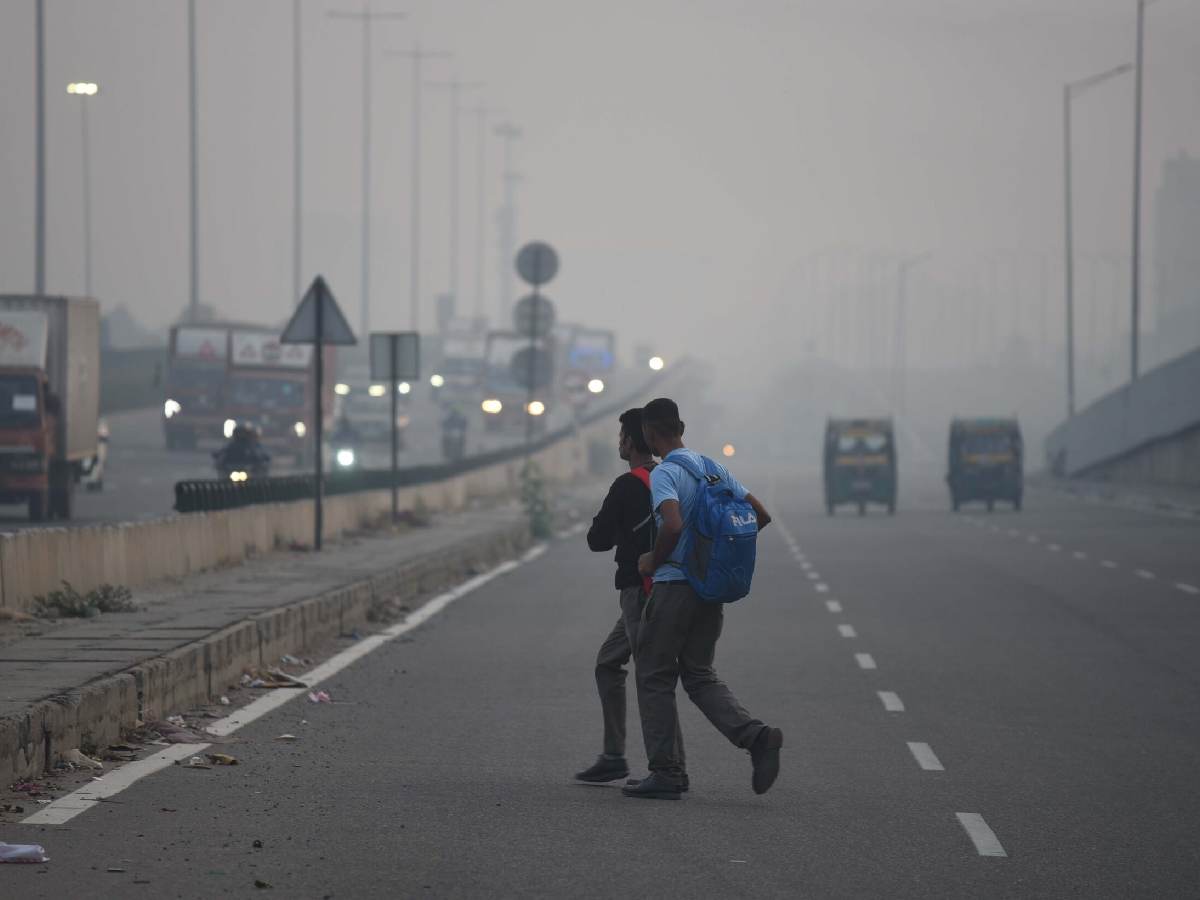
Air pollution: The Supreme Court on Monday said the air pollution issue in the Delhi-NCR cannot be treated as a “customary” case to be listed only during the winter months, noting that it will be taken twice in a month to find out short and long-term solutions to the menace.
In a significant shift from the usual narrative, a bench comprising Chief Justice Surya Kant and Justice Joymalya Bagchi said, “The issue of stubble burning should not unnecessarily become a political issue or an issue of ego.”
Questioning the usual blame on stubble burning as the key contributor to air pollution in Delhi-NCR, CJI Kant, who comes from a farmer’s family at Hissar in Haryana, asked, “Stubble burning was there during COVID, but why could people still see clear blue skies? This suggests other factors are at play.”
“We do not want to comment on stubble burning as it is incorrect to pass the burden onto people (farmers) who are hardly represented in this court,” the CJI said, adding, “The issue of stubble burning should not unnecessarily become a political issue or an issue of ego.”
Seeking clarity on immediate and long-term measures, the CJI asked the Centre to spell out specific steps of the Commission for Air Quality Management (CAQM), Central Pollution Control Board (CPCB) and others to apprise it of the short and long-term measures to tackle the menace of air pollution.
It listed the plea for hearing on December 10.
At the outset, the CJI said, “The Delhi pollution matter cannot be listed customarily in the month of October and rather it should be taken up regularly at least twice a month.”
Also Read: Construction ban leaves daily-wage labourers in Delhi struggling for food and dignity
Referring to Monday’s Air Quality Index (AQI), he said, “My brother (Justice Bagchi) tells me that just because this item is listed today and heard … there is improvement in the AQI levels.”
Additional Solicitor General Aishwarya Bhati, appearing for the central government authorities, referred to key contributors of air pollution and said “stubble burning, vehicular pollution, construction dust, road dust and biomass burning have been named as contributors”.
“I can give a detailed list of what steps have been taken under each of the heads,” she said.
Hinting towards other contributing factors, the CJI said during COVID-19-induced lockdowns, stubble burning happened as usual but still blue skies and stars were visible to citizens.
“Why? Something to be thought about and other factors. We would like to have a report within a week on the measures taken to contain other factors,” the bench said, adding it wanted to “see long-term and short-term plans”.
The CJI then referred to unplanned urban growth and rising aspirational population in the country and said, “None of the cities of the country were developed to accommodate this scale of population or with the thought that each home will have multiple cars. Let us see which measures are suggested to us and how these measures are implemented or are only on paper.”
The development of cities should have a negative impact on the quality of life, the CJI said.
The bench said it will ensure that the air pollution matter is listed twice a month throughout the year to monitor the implementation of long-term and short-term measures.
The bench said there should be a scientific analysis to ascertain the factor which is contributing the most to the problem.
“We cannot sit idle. Solutions must come from experts. The courts may or may not have those solutions, but we can provide a platform for all stakeholders to deliberate,” the CJI said.
Amicus curiae and senior advocate Aparajita Singh submitted that vehicular pollution and dust remain the biggest contributors to Delhi’s poor AQI.
She also flagged reports that several air quality monitoring devices were not functioning properly.
A counsel highlighted the chronic problem of cars parked on both sides of Delhi’s roads.
The CJI observed that while metro projects would eventually be a game changer, short-term measures were urgently needed.
On November 27, the top court agreed to hear on December 3 a plea concerning the deteriorating air quality in the Delhi–National Capital Region (NCR), saying the issue needed to be monitored on a regular basis.
“What magic wand can a judicial forum exercise? I know this is hazardous for Delhi-NCR.
“We all know the problem. The issue is what the solution is. We need to identify reasons and… the solutions can be given by the domain experts only. We hope and expect that long-term solutions are found,” the CJI had said.
On November 19, the court asked the CAQM to consider directing schools in Delhi-NCR to postpone open-air sports events scheduled for November–December to “safer months” due to toxic air levels.
It had declined to impose year-round restrictions under the Graded Response Action Plan (GRAP), an emergency framework that restricts polluting activities in severe conditions, and instead emphasised the need for long-term, sustainable solutions.
Alankrita Sahai on moving beyond pageants and modelling, finding substance in diverse roles and the…
A house under renovation collapsed in east Delhi's Tahirpur on Tuesday, killing one person and…
Police arrested two injured criminals after a Paharganj gunfight. The duo was wanted for a…
Delhi LG directed NSUT to develop tech solutions for civic issues like traffic, sanitation, and…
A suspected thief was killed after locals allegedly thrashed him and two others on suspicion…
Delhi Traffic Police issued 634 challans and removed 192 roadside carts and stalls during a…
