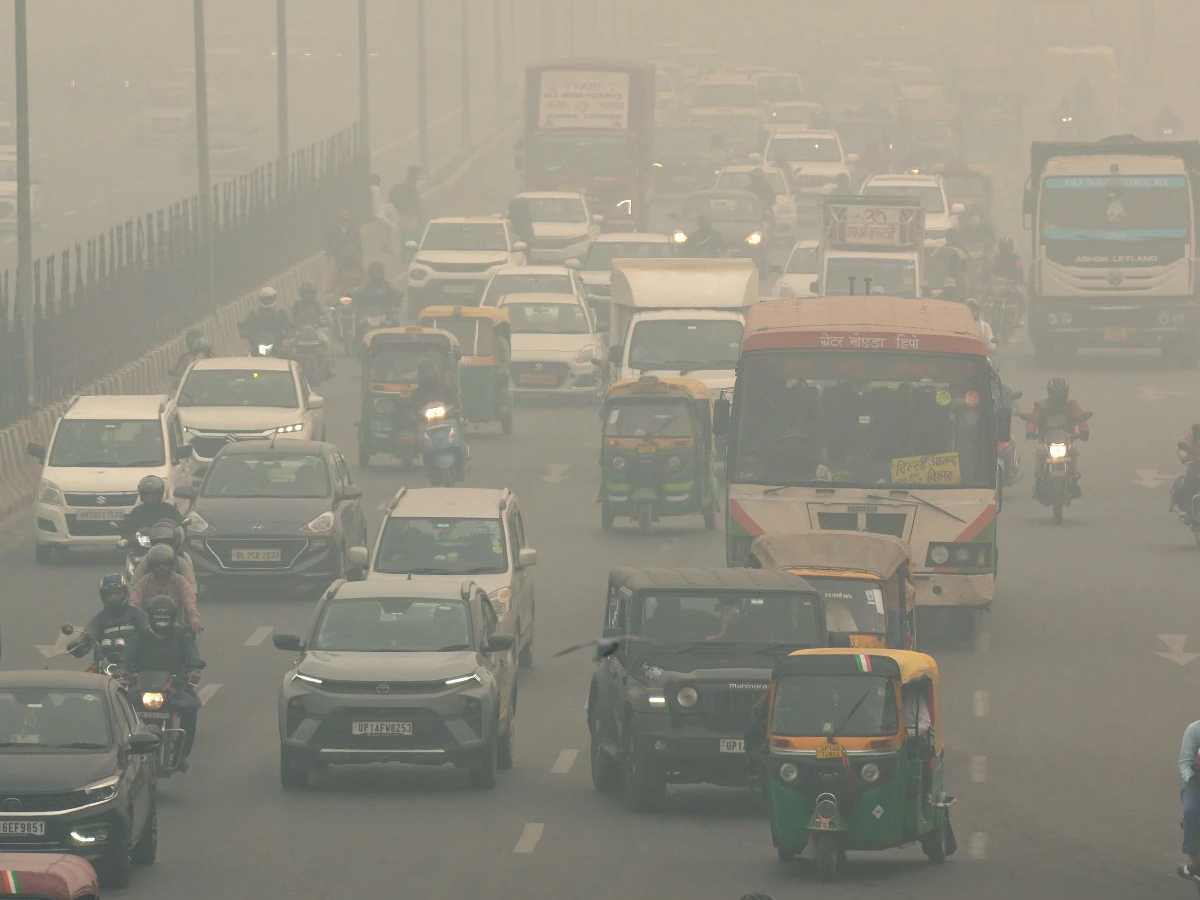
The Commission for Air Quality Management (CAQM)told the Supreme Court on Wednesday that vehicular pollution is the highest contributor to air pollution in Delhi-NCR and recommended 15 long-term measures to improve the worsening Air Quality Index (AQI).
Appearing for CAQM, Additional Solicitor General Aishwarya Bhati told a bench comprising Chief Justice of India Surya Kant and Justices Joymalya Bagchi and Vipul M Pancholi that a meta-analysis of studies from 2015 to 2025 attributes PM2.5 in Delhi to a mix of primary emissions and secondary particulate formation from sources within the National Capital Region (NCR).
The CAQM recommended the following measures to be introduced in a phased manner:
Time-bound phasing out of polluting vehicles from Delhi-NCR based on emission potential.
Strengthening of PUC 2.0 and monitoring of on-road vehicles with remote sensing devices.
Augmenting Regional Rail Transport and Metro Rail network with more lines and stations in Delhi and NCR.
Developing Multi-Modal Transport hubs connecting Metro and the Regional Rapid Transit System.
Ensuring last-mile connectivity along with a real-time passenger information system with location-based tracking of public transport.
Reviewing and revising respective electric vehicle policies to accelerate the transition of all vehicles to zero tailpipe emission vehicles in Delhi-NCR, and giving higher incentives to owners for scrapping old vehicles.
Expanding EV charging infrastructure, including swappable battery stations, expeditiously in line with vehicle growth.
Permitting retrofitting of vehicles to EV certification by ARAI/ICAT.
Augmenting city public bus services through e-buses/CNG as per model yardsticks and service-level benchmarks of the Ministry of Housing and Urban Affairs (MoHUA), based on population.
Developing a plan for a CNG/LNG fuelling network in NCR and on highways to shift long-haul trucking and other commercial vehicles to gas.
Installing ANPR cameras and automated RFID systems to ensure multi-lane free-flow enabled toll/cess collection at all Delhi border entry points.
Deploying an integrated traffic management system in Delhi and other major urban agglomerates, particularly Noida, Greater Noida, Ghaziabad, Meerut, Gurugram, Faridabad and Sonipat, for smoother traffic movement.
Implementing parking area management plans in Delhi and NCR.
Also Read: EV registrations rise in Delhi, e-rickshaws claim 42% share
Imposing higher environmental protection charges.
Intensifying enforcement through technology-based solutions such as automatic number plate recognition, radio frequency identification, remote sensing techniques and AI-driven surveillance.
Delhi inaugurates the 70th National School Games, hosting over 14,000 participants in 14 sports across…
Delhi High Court asked "Doosra" filmmakers to respond to Sourav Ganguly's plea over alleged violation…
Delhi L-G appointed Paralympian Suvarna Raj as State Commissioner for PwDs following her gold win…
DDA is planning Delhi's longest 24-km cycling track along the Yamuna floodplain, linking key eco-projects…
Police detained several anti-SIR protesters heading to the ECI headquarters in Delhi as mass gatherings…
An exhibition that revisits the significance of Indian Modernism through works from earlier and defining…
