Despite a sustained policy push by both the Union and Delhi governments to promote electric mobility, petrol-powered vehicles continue to dominate the capital’s roads, with electric vehicles (EVs) accounting for a relatively small share of total registrations.
Data from the Parivahan dashboard show that EVs made up 14.8% of all vehicle registrations in 2025. Of these, 6.3% fell under the category of strong hybrid electric vehicles. The remaining majority of vehicles continued to run on petrol or petrol-based hybrid systems.
In absolute terms, Delhi registered 8,17,817 vehicles in 2025, of which 1,21,516 were electric. This followed a trend similar to the previous two years. In 2024, 85,335 of the 7,11,111 vehicles registered were electric, while in 2023, 73,718 EVs were registered out of a total of 6,57,887 vehicles. The share of EVs stood at 12% in 2024 and 11.2% in 2023, indicating steady but incremental growth.
Petrol vehicles, however, continued to overwhelmingly dominate the market. In 2025, petrol-run vehicles and petrol-hybrid variants accounted for 6,54,249 registrations, or 79.9% of the total. A similar pattern was seen in 2024 and 2023, when petrol vehicles comprised 82.7% of total registrations in both years.
Early trends in 2026 suggest no immediate shift. Between January 1 and January 13, a total of 2,979 electric vehicles were registered, making up 7.6% of total vehicle registrations during the period. Petrol vehicles accounted for 33,870 registrations, or 87.4%.
E-rickshaws skew EV growth
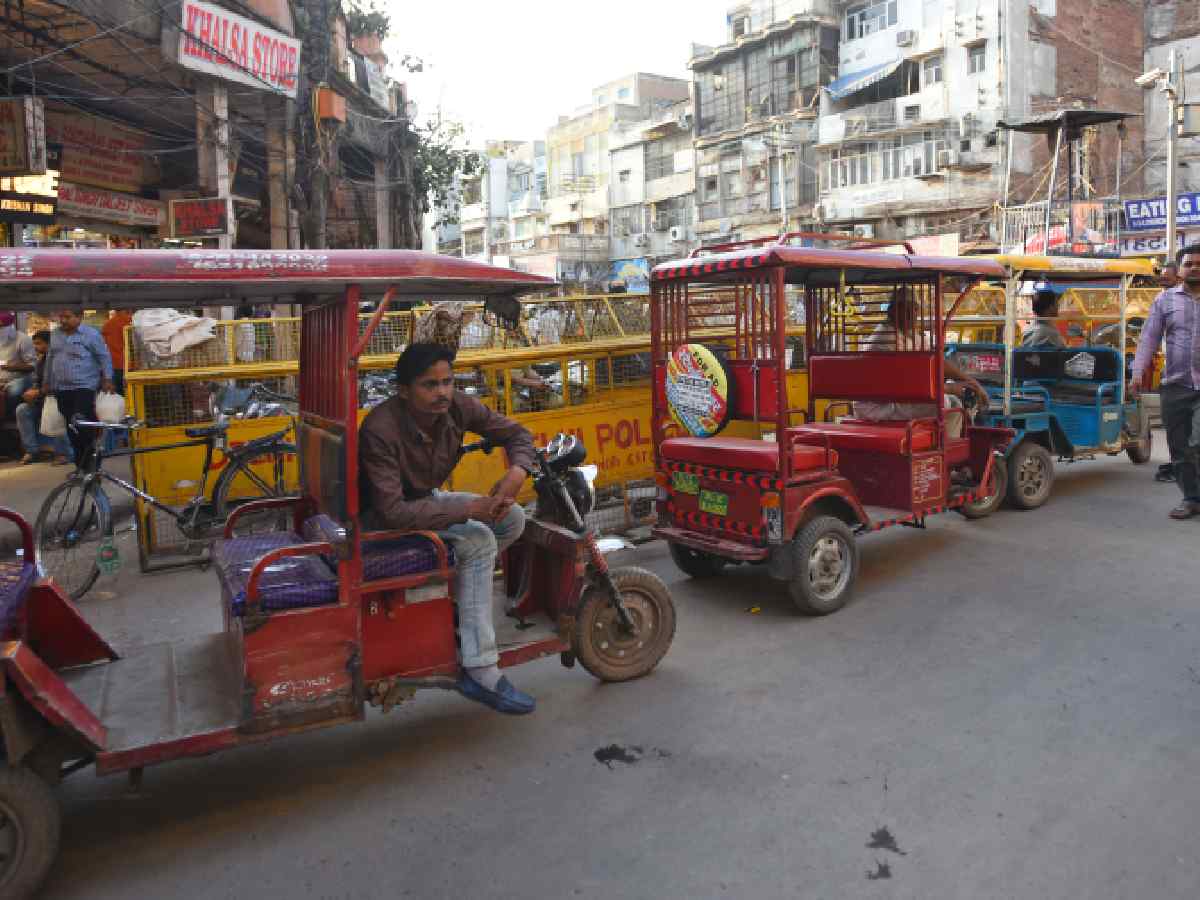
While EV registrations have risen in absolute terms, a closer examination reveals that much of this growth is driven by electric rickshaws.
In 2025, e-rickshaws accounted for 42.6% of all EV registrations. Their share stood at 37.1% in 2024 and 26.4% in 2023, pointing to a steady rise over the past three years.
This trend suggests that the share of personal electric vehicles — including two-wheelers and larger passenger EVs — has largely remained stagnant, with e-rickshaws contributing disproportionately to the overall EV count.
Safety concerns and court intervention
While e-rickshaws are widely regarded as an affordable and efficient mode of last-mile public transport, their rapid and often unregulated proliferation has raised serious safety concerns on Delhi’s roads.
On January 7, the Delhi High Court issued notices to the Delhi Government, Delhi Police, the Transport Department, and the Municipal Corporation of Delhi (MCD) following a public interest litigation (PIL) seeking urgent regulation of e-rickshaw operations across the capital.
A Division Bench comprising Chief Justice DK Upadhyaya and Justice Tejas Karia directed the respondents to file affidavits detailing steps taken to enforce existing regulations. The matter is scheduled for its next hearing on March 18.
The PIL was filed by Manish Parashar, whose eight-year-old daughter died in 2025 while travelling to school in an e-rickshaw. According to the petition, the vehicle — allegedly uninsured, speeding, and operating on a prohibited road — overturned, killing the child.
Represented by advocates Gaurav Arya and Naveen Bamel, the petition describes the unchecked growth of e-rickshaws as a “relentless menace” to public safety. It points to a Delhi Gazette notification prohibiting the operation and parking of e-rickshaws on 236 identified roads, restrictions that the petitioner argues are routinely violated.
The PIL further alleges widespread non-compliance with safety norms, including lack of registration, insurance, and valid driving licences, as well as frequent overloading of passengers.
Rising fatalities
Data from the Delhi Traffic Police underline the scale of the problem. Till December 2025, at least 24 deaths and over 100 injuries were recorded in incidents involving e-rickshaws. In comparison, 20 deaths linked to e-rickshaw accidents were recorded across the entirety of 2024.
E-rickshaw drivers, however, argue that many accidents are caused by vehicles operating outside the regulatory framework.
“The ones who are registered would not dare go against the rules of the road,” said Ram Manohar, an e-rickshaw driver near the Mayur Vihar Phase-1 Metro station. He added that registered drivers were required to follow regulations to avoid losing their permits. “It is mostly the unregulated ones, or those driving rented vehicles, who take reckless decisions.”
Others pointed to competitive pressures and risky behaviour among new drivers. “Some drivers think speeding and cutting corners will get them more rides,” said Raj Kumar, an e-rickshaw driver at the Saket Metro station. “It is greed, plain and simple. Even when we try to stop them, we are often threatened.”
Recent fatal incidents
Several fatal incidents involving e-rickshaws were reported in 2025.
On August 28, an e-rickshaw driver was killed in the Welcome area after the vehicle’s handlebars snapped, causing him to fall onto the road.
In September, a 16-year-old schoolgirl died and three others were injured in Paharganj after an e-rickshaw allegedly jumped a red light and overturned at a junction.
In October, a five-year-old boy was run over and killed in Sangam Vihar after an e-rickshaw used for water delivery was accidentally started by another child. Later that month, 74-year-old Komal Singh Chandel died in East Delhi’s Farsh Bazar when his e-rickshaw flipped while the driver attempted to avoid a collision with a scooter.
EV Policy 2.0
Against this backdrop, the Delhi Government is preparing to roll out a new Electric Vehicle Policy 2.0 aimed at accelerating the adoption of clean mobility across the capital.
Draft recommendations reviewed by the Transport Department propose enhanced consumer incentives, support for local manufacturing, and upgrades to power infrastructure to meet rising electricity demand. Officials have said the proposed policy would be Delhi’s most ambitious EV roadmap so far, combining subsidies, industrial support, and battery storage initiatives.
As the city pushes for faster electrification of its transport sector, the challenge of effective regulation — particularly of e-rickshaws — remains central to ensuring that the shift to clean mobility does not come at the cost of public safety.