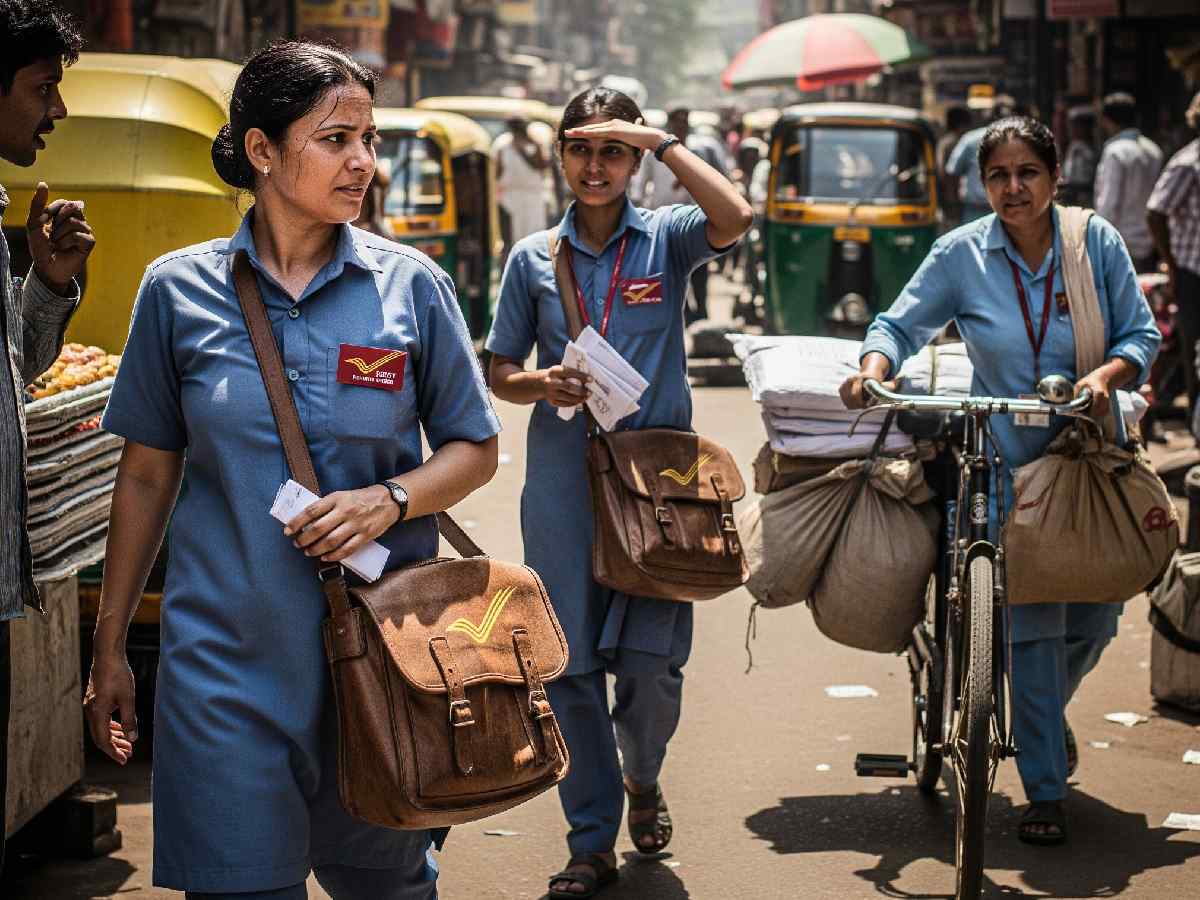
Photo courtesy: AI
Delhi boasts 509 post offices and a robust postal network. Yet, women working as post workers—still a rare sight—remain overlooked and underpaid. They carry more than parcels and letters; they deliver quiet courage, resilience, and a challenge to longstanding gender norms.
In a profession traditionally shaped by men, these women are forging new paths into public spaces, battling long commutes, street harassment, unsafe lanes, heatwaves, and domestic pressures. Though they represent a small portion of the workforce, their voices are becoming increasingly significant in conversations about gender equity, workplace dignity, and infrastructure gaps.
Breaking barriers in the postal sector
While a woman delivering mail still turns heads in many parts of the Capital, women like Ritu Kumari are gradually transforming this male-dominated profession. But their path is far from easy.
Ritu, 35, has worked as a postwoman for over a decade. Based at the Lodhi Road post office, she starts her shift at 7:30 AM. and walks nearly 12 km each day. “I joined with hope and pride. But walking with 10–15 kg of letters and parcels in this heat is punishing. We aren’t treated equally when it comes to facilities,” she says. “Sometimes, people are surprised to see a woman deliver mail. They either look at you with admiration or disbelief.”
Residents may be used to the sight of Ritu balancing her khaki bag, but the toll on her body remains largely invisible. “Back pain is constant. There are days when I don’t feel my feet after returning home. But I can’t afford to take leaves. There’s always the fear of being replaced.”
Also read: Leaving out someone like Shreyas Iyer shows India’s squad depth: Ross Taylor
Infrastructure gaps deepen inequity
According to the Department of Posts, over 4,000 women work in various capacities across Delhi’s postal services—postmasters, counter staff, and delivery agents. Yet, fewer than 10% of delivery personnel are women. For those who are, field duty presents far more hurdles than statistics reveal.
Clean and accessible toilets are a recurring concern. “Many of us avoid drinking too much water because clean toilets are unavailable during our routes. It’s a health risk, especially during menstruation,” says Kavita, 35, outside the Lajpat Nagar post office. In several sub-post offices, toilets are either unusable or located in unsafe areas. “I once fell sick because I held my urine for over six hours while delivering mail in Dwarka,” she recalls.
No protection from harassment
Safety is another major concern for women post workers. “I’ve been followed twice while delivering in a posh locality. Once, I had to run inside a building’s staircase to avoid a man tailing me on a bike,” says Shazia, 32, who works in Old Delhi. While male colleagues often help, there are no formal mechanisms to report or address such threats. “We need a helpline or a designated point person, but right now, we’re on our own.”
Uniforms designed for men
Another daily discomfort is the official uniform—designed for men. “The shirts and trousers are stitched for men. We either alter them or wear ill-fitting ones,” says Savita, a contractual delivery agent in South Delhi. “We’ve asked for salwar kameez options but never received a response.”
Contractual workers: unequal pay, no benefits
For contractual workers, most of whom are women, the conditions are even worse. Gramin Dak Sevaks (GDS), who form the bulk of the temporary workforce, receive neither fair pay nor basic employment benefits. “We do the same work, but earn much less than regular staff. No PF, no medical leave, no insurance. One injury or illness, and our job is gone,” says Shazia.
A 2023 audit by the Ministry of Communications revealed that over 35% of the GDS workforce in Delhi NCR lacks access to health coverage or maternity benefits. Despite managing heavy loads and long routes, they remain excluded from nearly all welfare schemes meant for permanent staff.
Digital push, analog challenges
India Post’s push for digital transformation has introduced new pressures. Delivery personnel are expected to operate biometric devices, GPS apps, and digital tracking systems—often without adequate training.
“We were given Android phones, but no training. We learnt from each other. The system crashes often, and we are blamed for delays,” says Shazia. “One time the app didn’t register my delivery for over three days. My supervisor thought I had skipped work.”
For older workers, the challenge is even greater. “I can read and write but understanding GPS and OTPs is not easy,” says Meena, 48, from Karol Bagh. “We’re expected to become tech-savvy overnight.”
Balancing work and home
The double burden of domestic work and demanding field duties weighs heavily on these women. Rani, a single mother of two, begins her day before sunrise. “After walking 10 km, I return home to cook, help my children with homework, and do household chores,” she says. “There’s no rest. But what option do I have?”
Social stigma adds to the strain. “My in-laws were upset when I joined. They said it’s a man’s job. But now they see the pride I take in my work,” Rani says.
Slow steps toward change
The Department of Posts has taken some steps—introducing gender sensitisation modules in induction training and piloting creche facilities at central post offices. But implementation remains spotty.
“I’ve heard there’s a creche at the head office, but for us in peripheral zones, there’s nothing,” says Aarti, who has a two-year-old daughter.
Postal unions are also beginning to push for change. Rajendra Soni, General Secretary of the Delhi Postal Employees Union, admits women’s concerns have long been overlooked. “We are pushing for women-friendly policies—safety audits, uniform redesign, menstrual leave, and equal pay for contractual workers,” he says. “But the bureaucracy moves slowly.”
“It’s not just about hiring more women”
Experts argue that true inclusion will require structural change. “It’s not just about hiring more women. It’s about enabling them to thrive,” says Dr Meenal Raj, a researcher on gender and labour. “We need systemic change, not token efforts.”
Also Read: Mohammed Siraj lights up The Oval as India script thrilling 2–2 series draw
One step at a time
Despite the odds, the women persist—with determination and dignity.
“When young girls see me delivering mail, they smile. Some ask if they can do this too. That gives me hope,” says Ritu, adjusting her khaki bag and wiping the sweat from her brow before walking to her next delivery.
Sometimes, social transformation does not arrive with slogans or headlines. It comes quietly, in the form of a knock on the door and a handful of letters—delivered by a woman walking Delhi’s streets, changing the city one step at a time.
An FIR over Jamia protests alleges Congress MPs Imran Pratapgarhi and Imran Masood unlawfully entered…
Delhi's 'Namo Yamuna River Safari' cruise will launch before Chhath, offering 40-minute family trips between…
Delhi's Old RTR flyover reopens for light vehicles today after repair work following road cracks,…
Visits to Govindpuri, Jangpura, Saket and Mayur Vihar show unlabelled corrosive substances sold for Rs…
Rescue teams recovered two bodies from the debris of a collapsed under-construction house in northeast…
Built on Jawaharlal Nehru’s vision, the Delhi landmark has witnessed the evolution of a young…
