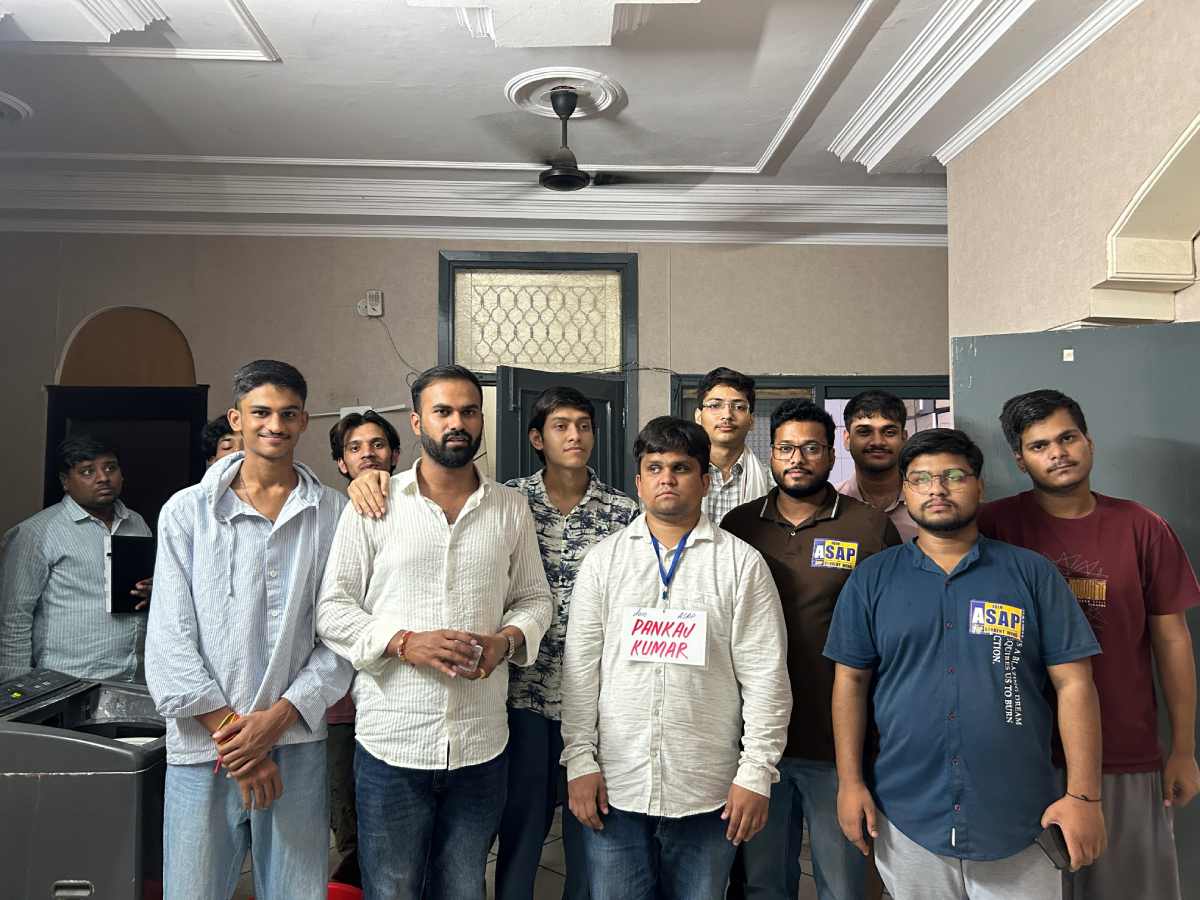
Pankaj Dhingra, a visually impaired law student at Delhi University’s Campus Law Centre, is contesting for the first time in the upcoming Delhi University Students’ Union (DUSU) elections. He is campaigning with the Aam Aadmi Party (AAP)’s student wing, the Association of Students for Alternative Politics (ASAP). He had sought to contest once before but was not given a nomination by the AAP at the time. Nominations for this year’s election are due to close on September 10.
Dhingra said blind students are often misjudged. “Blind students are often treated as if they are helpless or deserving of pity,” he said. “That is completely wrong.”
ASAP has said its campaign seeks to promote “alternative politics” centred on ordinary students and issues concerning equal access to education, opportunities and representation.
“This is more than a campaign. It is a statement that student politics must have space for every student,” the organisation said.
ASAP said students with disabilities should not merely be treated as beneficiaries of policies but should also have opportunities to participate in student politics and take up leadership roles. It said the DUSU election should also be viewed in terms of who gets represented, heard and allowed to lead.
Inaccessible infrastructure
Dhingra’s campaign centres on issues he said visually impaired students at DU have raised for years: broken lifts, inaccessible pathways, inadequate library facilities and a shortage of assistive technology.
Also Read: ‘Small but loud’: taking Himalayan voices to Delhi
“There are a lot of issues,” he said. “We don’t have proper ramps or adequate infrastructure. The Equal Opportunity Cell also doesn’t function properly.”
Dhingra has campaigned across North, South and East campuses, covering an estimated 35 to 40 colleges. He graduated from Kirori Mal College with Hindi as his subject and won the post of Secretary at Kirori Mal College election in 2024, an experience he credits with pushing him to contest at the university level.
His campaign comes as DU has introduced navigation systems in parts of the university intended to help students, including those with visual impairments, move around campus. Dhingra argued that this does not address the larger problem.
“What is the point of having a navigation system if the required study material is not available?” he asked.
‘Gaps in system’
Rishi, a visually impaired PhD scholar at DU, pointed to a gap between a facility existing and a facility being usable inside the university’s Central Library.
A room on the second floor designated for visually impaired scholars closes at around 5 pm, he explained, even though the floor itself remains open until approximately 11 pm.
“It is just that particular room that is closed,” he said.
Shivangi, a visually impaired master’s student who came to Delhi from outside the city, argued that accessibility also depends on whether a student has somewhere to live.
She said hostel accommodation for students with disabilities is limited across the university and that the shortage is uneven between disability categories. Every department, according to Shivangi, has very few seats reserved for Persons with Disability (PwD) overall, and the number available to visually impaired students is still smaller than the number of seats for students with other disabilities.
For a student arriving in Delhi without an existing support network, the shortage adds another barrier before academic work even begins.
Rishi recalled a period between roughly 2015 and 2018 when laptops were distributed to visually impaired undergraduates and MA students. That level of provision no longer exists, he said, and argued that for students from economically weaker backgrounds, a laptop is often an educational necessity rather than an optional device.
This concern comes against a backdrop of rising fees at DU. For the 2026-27 academic session, the university’s share of the combined student fee was raised from Rs 3,500 to Rs 4,100, an increase of more than 17%, following an earlier fee increase announced in July 2025.
DU’s admission rules continue to provide fee concessions for students with benchmark disabilities, with the exact concession depending on the programme and category. For postgraduate programmes, the university’s published rules provide for a 75% fee concession for PwBD candidates.
Fee disputes
There is also a documented history of fee disputes involving disabled students in the Law Faculty. In August 2024, the annual fee for students with disabilities in the three-year law course rose from Rs 216 to Rs 1,645, after rising from Rs 75 two years earlier. Students had sought a rollback at the time, describing the increase as an unfair financial burden.
Dhingra connects the financial question to the classroom. The university delivers the same lecture to everyone, he pointed out, but students do not have the same means of accessing it.
Blocked while campaigning
His campaign has also encountered obstruction from within DU’s student politics.
Deepak Bhansal, state coordinator of ASAP and a former DUSU president, alleged that Dhingra was stopped while trying to enter SPM College to campaign.
“When Pankaj was trying to enter through the gate, he was stopped very aggressively,” Bhansal said.
DU rules allow a candidate to campaign with five to 10 students from any college in the university, he explained, but he alleges that students at SPM College were warned against helping Dhingra.
“If you campaign for Pankaj Kumar, your attendance would not be given,” Bhansal said, describing what students were allegedly told.
He contrasts this with what he describes as more favourable treatment of ABVP candidates. “When there are a large number of ABVP candidates, they are welcomed,” he added.
‘Skewed election process’
Bhansal describes the run-up to this year’s DUSU election as marked by clashes between ABVP and NSUI at Rajdhani College, Bhaskar College, Satyawati College and LC One in North Campus, where he said the Proctor had to intervene.
He accuses the DU administration of favouring the ABVP and says candidates from other political groups who object are threatened.
“If you say anything against us, we will cancel your nomination,” Bhansal said, describing what he claimed were threats made to candidates.
He also raised concerns about the conduct of voting, claiming that in a previous election, EVMs highlighted certain candidates for the presidential post and alleging that non-teaching staff and professors have asked new voters to cast their ballot in favour of candidates of one particular outfit.
When Patriot reached out for a response to the allegations, Proctor Manoj Kumar Singh denied any such pressure by professors. No response was received from the Election Commissioner at the time of publication. The online version of the story will be updated, if a response is received.
The larger question
Dhingra wants dedicated spaces where PwD students can rest and work without being treated as outsiders. He is also critical of established student political groups, arguing they have raised the same accessibility issues for years without resolving them.
His candidacy raises a further question about the DUSU election process itself: whether visually impaired students can access manifestos and campaign material independently, navigate campaign venues, receive election announcements in accessible formats, and vote without unnecessary dependence on others. Bhansal’s account raises a related question, unconnected to disability: how easily a candidate outside the dominant political networks can campaign across the university.
Rishi’s and Shivangi’s accounts indicate that the accessibility problem at DU cannot be reduced to whether infrastructure exists on paper. A library can remain open while a room designated for visually impaired scholars closes early. A tactile pathway can exist while vehicles obstruct it. An Enabling Unit can function well in one college and fall short in another. A hostel system can have limited seats for PwD students overall, and fewer still for those who are visually impaired.
DU’s voters will decide whether Dhingra wins or loses. His campaign has put a broader question before the university: whether students with disabilities can participate in campus life and in the democracy that governs it, without first having to fight for basic access.
An FIR over Jamia protests alleges Congress MPs Imran Pratapgarhi and Imran Masood unlawfully entered…
Delhi's 'Namo Yamuna River Safari' cruise will launch before Chhath, offering 40-minute family trips between…
Delhi's Old RTR flyover reopens for light vehicles today after repair work following road cracks,…
Visits to Govindpuri, Jangpura, Saket and Mayur Vihar show unlabelled corrosive substances sold for Rs…
Rescue teams recovered two bodies from the debris of a collapsed under-construction house in northeast…
Built on Jawaharlal Nehru’s vision, the Delhi landmark has witnessed the evolution of a young…

