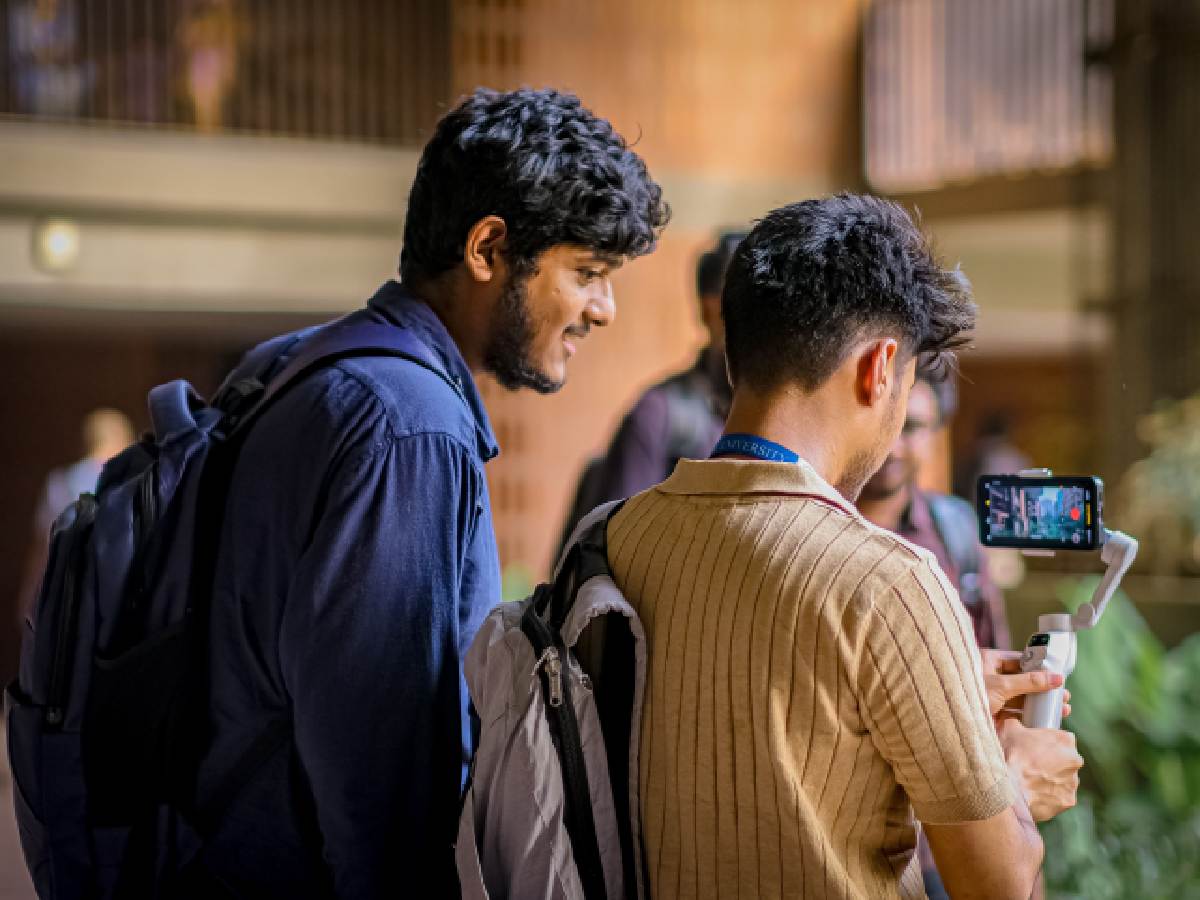
Make Connect helps students reach out to seniors beyond the classroom
In the high-stakes corridors of Delhi University, anxiety about student life often spreads like a quiet contagion. For thousands of undergraduates pacing college lawns, whether at the North Campus hub or specialised institutions across the Capital, the final year brings a persistent bombardment of unanswered dilemmas: CAT preparation versus off-campus placements, consulting case studies versus finance internships, or corporate corridors versus public policy fellowships.
Yet, for decades, access to genuine career clarity has been governed by an unwritten campus hierarchy. Students settled within campus societies and notable placement cells enjoy direct, informal access to seniors who have already cleared the hurdles. On the other hand, for quiet strivers, first-generation learners or students who lack the social energy to navigate networking, guidance relies on second-hand opinions, cafeteria rumours and unanswered Instagram DMs.
It is this systemic friction that Make Connect seeks to undo. It is a mentorship initiative operating under the registered non-governmental organisation Makes Sense, founded by Shaheed Sukhdev College of Business Studies (SSCBS) alumnus Pulkit Sehgal alongside co-founder Pranjal Jain. Make Connect has built a systematic pipeline that pairs undergraduate students directly with experienced alumni across fields.
Anatomy of campus gatekeeping
The momentum behind Make Connect arose from a realisation among friends who had already made it through most of their college life. During their final undergraduate year at SSCBS, Pulkit Sehgal and Pranjal Jain found themselves with rare breathing room. Placements had ended and looking around at their peer group, they noticed that success was rarely a question of intellect alone; it was an issue of democratic access.
“When people are part of flagship campus societies, they have built-in access to everything,” Sehgal notes, reflecting on the sharp divisions within college life. “They have access to the right seniors who are doing well. But folks who are not part of those inner circles, or who feel slightly underconfident reaching out, lack channels to vent or seek direction. The core thesis was simple: how do we make that top senior or mentor genuinely accessible to someone who does not belong to those exclusive societies?” he says.
Also Read: National Archives at 100: secrets, freedom fighters and legacy
While colleges within Delhi University typically have active placement cells, many institutional mentorship drives are introduced only a few weeks before campus recruitment drives begin. By then, altering academic trajectories or addressing major foundational skill gaps can be challenging. Often in colleges pairings are assigned at random, leaving students with seniors whose professional paths might not resemble their own. Make Connect provides students with guidance earlier on in their college life, helping them profit from early interventions.
Outside of college machinery, the prevailing alternative has been cold mailing and outreach on platforms like LinkedIn. For an anxious second-year student, messaging a senior analyst at McKinsey or Bain carries a fear of rejection. Make Connect was created to dodge this psychological barrier entirely. By turning cold calls into warm, pre-arranged introductions, the organisation eliminates the awkwardness of the first step.
How it works
Rather than framing mentorship as a six-month-long corporate obligation, Make Connect operates on a high-empathy model designed to reduce friction for both sides.
The operational workflow is secured by a coordinated digital intake system. Mentees fill out a brief, five-minute application outlining their current academic stage, career targets, target sectors and immediate challenges — ranging from CV drafting and case prep to managing time between academic coursework and competitive exams.
“When a student reaches out through our portal, we collect granular data on where they are struggling,” explains Gaurav Kumar, who oversees daily operations and matching logistics. “We run an automated matching code that pairs the mentee’s specific profile and goals with a mentor from our pool who has navigated that exact trajectory,” he adds.
“Relatability is much higher when the mentor understands the specific context of your campus,” Sehgal explains. “A mentor who walked the same corridors knows the exact grading curves, the society culture and the faculty dynamics. But even if we don’t have an alum from the exact same college, our network is wide enough that we pair them with someone who traversed that identical career pivot.”
Once a match is made, the administrative team introduces the pair directly, removing the need for tentative icebreakers. From there, the mentor and mentee connect for structured, one-on-one sessions, setting their own conversational flow.
Also Read: Clean air comes at a cost, and Delhi caterers are paying it
The mentor compact
A recurring challenge for non-profit volunteer models is mentor attrition. Working professionals in high-intensity sectors routinely endure 70-hour workweeks, leaving little room for pro bono community work.
To counter volunteer burnout, Make Connect instituted strict boundaries on volunteer commitments. Mentors are never burdened with extensive groups of students; each mentor is capped at one to three mentees, with an expected time investment of just one to two hours per month.
“We learned early on during our pilot phases that imposing a rigid quota — demanding five or ten hours a month—is counterproductive,” Kumar notes. “Mentors are doing this out of civic goodwill and personal obligation to give back; there is no financial compensation. One or two focused, high-depth phone calls a month are often more than enough to unblock a student’s dilemma, review their resume, or demystify an interview process.”
Screening potential mentors is equally measured, prioritising alignment and empathy. Mentors are primarily sourced through personal alumni networks, referrals and professional verification via LinkedIn, and the onboarding process avoids lengthy assessments. Instead, the team conducts brief introductory conversations to identify genuine motivation, communication warmth and adherence to safeguarding norms.
The base includes over 200 alumni from global consultancies like McKinsey & Company, Boston Consulting Group, Bain & Company and Alvarez & Marsal; financial giants such as KKR and Avendus; and premier institutions including IIM Bangalore, IIM Lucknow, XLRI and JBIMS.
Closing the feedback loop
Running a pro bono service across a distinct student population is not without friction. While securing busy mentors required continuous outreach, an unexpected hurdle was mentee satisfaction.
“Because the platform is free, some students treated scheduled calls casually, failing to show up or neglecting to prepare concrete questions. When there is no fee attached, a subset of students doesn’t take the session seriously,” Kumar observes. “They register, get paired with a senior professional who took time out of their weekend, and then fail to engage or drop off without notice.”
Also Read: Delhi: Proposed e-rickshaw rules spark livelihood concerns
“Our responsibility is to solve for that initial friction of breaking the ice,” Sehgal asserts. “Once that first conversation happens smoothly, the psychological barrier vanishes. The mentee realises the mentor is just another human who sat in the same classrooms a few years ago. From that point forward, the relationship sustains itself.”
Beyond careers
While Make Connect commands significant campus attention, it represents only one half of a broader vision. Its parent body, Makes Sense, was deliberately conceived as a dual-pillar support system addressing the two most acute stressors of youth: professional uncertainty and mental health.
“Guidance during college cannot be compartmentalised strictly into ‘corporate placements’,” Sehgal explains, describing the organisation’s ethos. “Students are navigating life transitions — they are figuring out who they are, how to balance familial expectations, how to survive academic pressure, and how to stay mentally healthy. Mentorship and psychological care are complementary pillars of the same journey.”
The road ahead
Having solidified its pilot projects within SSCBS, Makes Sense is executing an elaborate expansion roadmap across the wider Delhi University ecosystem. The organisation is actively scaling outreach into major North and South Campus colleges, including Hansraj, Hindu and Sri Venkateswara, onboarding new alumni nodes and establishing localised campus ambassadorships.
Also Read: The Delhi Nehru helped shape
For Gaurav and the student operations team, the day-to-day grind involves balancing collegiate coursework with database management, mentee check-ins, and mentor onboarding. For founders Pulkit Sehgal and Pranjal Jain, now established in the corporate and postgraduate sphere, the ongoing stewardship of the NGO serves as a permanent tether to their alma mater.
As Delhi University enters another gruelling recruitment and admissions cycle, the quiet revolution taking place across Make Connect’s digital matchmaking board offers a counterweight to campus elitism. In an educational ecosystem often criticised for leaving individual students to sink or swim, the initiative shows that a small group of alumni, armed with empathy, can replace intimidating barriers with open doors—one conversation at a time.
(Students and alumni interested in participating can access mentorship intakes or register as volunteer mentors at makessense.in)
A citizens' delegation headed to Environment Minister Bhupender Yadav's office in Jor Bagh seeking an…
Supreme Court noted Yamuna pollution rose despite huge funds, directing CPCB to monitor water quality…
Delhi Police busted a fake call centre in Pitampura, arresting 12 people for impersonating doctors…
The MCD said the roof collapsed while workers were removing shuttering from a newly constructed…
A hundred years after its Delhi building opened, the National Archives remains a place where…
A dispute over illegal liquor sales led to a double murder in outer Delhi's Bawana,…

