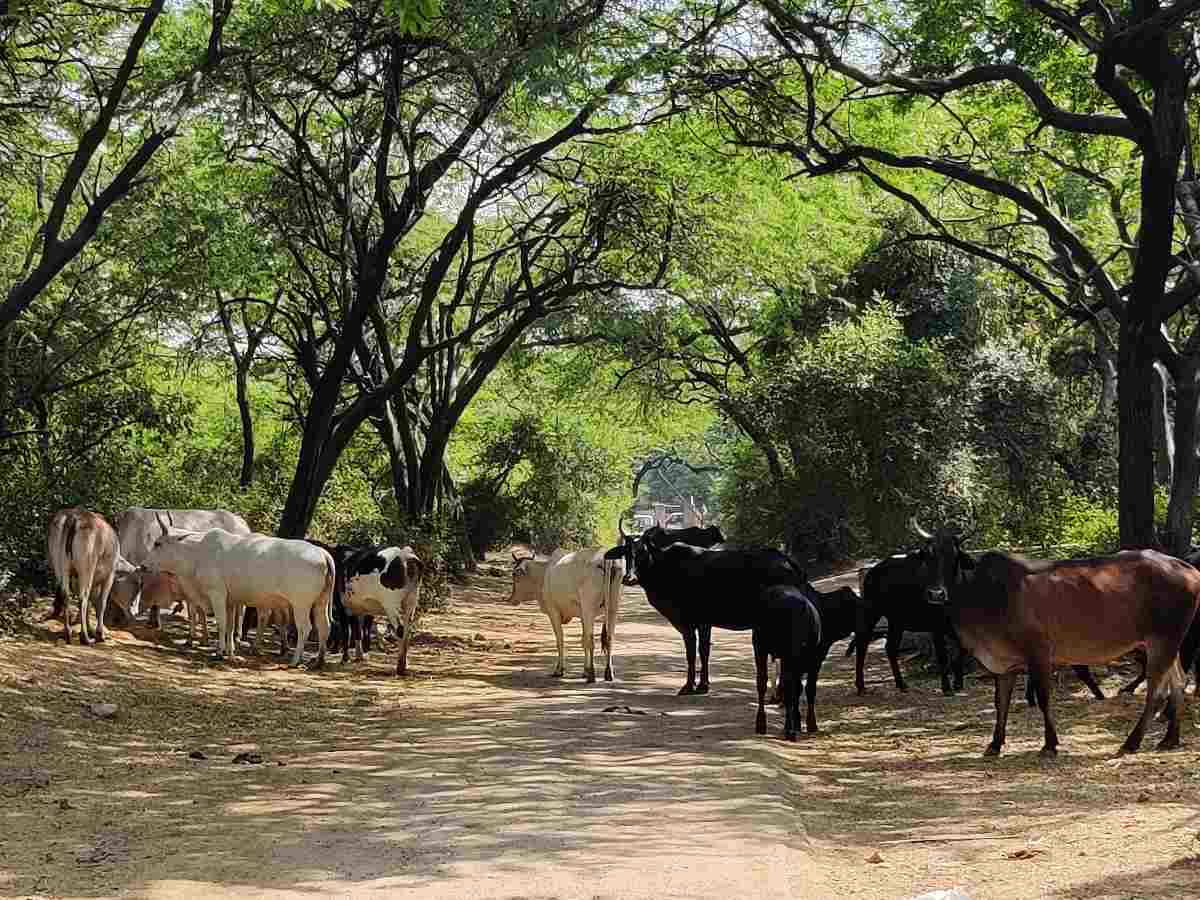
The Delhi Ridge Forest, one of the Capital's last remaining natural ecosystems
Walking through the trails of Sanjay Van, 75-year-old Chandan Kumar Gaurav pauses under the shade of trees and recalls a Delhi that he says looked very different decades ago.
For Gaurav, who was walking with his wife, the city’s remaining green spaces serve as reminders of a natural landscape that is gradually vanishing under the pressure of rapid urbanisation.
“It is sad to see the forest cover in Delhi declining. When I was young, Delhi had much better green cover, cleaner air, and more open spaces. We could actually feel the presence of nature around us,” Gaurav said.
Over the years, buildings, roads, and concrete structures have expanded everywhere. Green spaces like Sanjay Van are among the few places left where people can still breathe freely and connect with nature. These forests should be protected not only for us but for future generations,” he added.
His concerns mirror the findings of a recent study that has warned of a sharp decline in Delhi’s healthiest ecosystems over the last three decades.
A study by researchers from Jamia Millia Islamia found that Central Delhi lost nearly 74% of its healthiest ecosystems between 1991 and 2023, highlighting the impact of urban expansion, habitat fragmentation, and pressure on natural landscapes.
The study, titled ‘Crossing the ecological threshold: Spatio-temporal dynamics of blue-green space ecosystem health in Delhi using a VORR framework’, analysed 32 years of satellite imagery and found that areas classified as having “excellent” ecosystem health in Central Delhi reduced from 13.88 sq km in 1991 to only 3.63 sq km in 2023.
During the same period, areas with “poor” ecosystem health expanded from 38.57 sq km to 54.90 sq km.
Researchers studied forests, wetlands, water bodies, and green spaces by assessing vegetation productivity, ecological connectivity, resilience, and the capacity of landscapes to recover from environmental stress.
Across Delhi, areas with poor ecosystem health increased by 50.8% — from 541.47 sq km in 1991 to 816.36 sq km in 2023 — while the city’s median Ecosystem Health Index dropped by 53%.
A changing city
For residents who have observed Delhi’s transformation over the decades, the loss is evident beyond scientific data.
Vijay Jha, a 68-year-old resident of Saket, said the city has changed dramatically in front of those who grew up here.
“Development is important, but it should not come at the expense of nature. Places like the Ridge and other forest areas help the city breathe. If we lose them, future generations will only hear stories about the Delhi we once lived in,” Jha said.
The study found that Delhi’s stable natural landscapes, including forests, wetlands, open green spaces, and water bodies, declined from 49% of the city’s area in 1991 to nearly 30% in 2023.
Experts say the loss of such ecosystems not only affects wildlife but also the quality of life for millions of residents.
Losing natural protection
Environmentalist Bhavreen Kandhari said Delhi is losing the ecological systems that have historically safeguarded the city.
“My biggest concern is that Delhi is losing its natural life support systems. Forests, wetlands, and green spaces are not luxuries; they clean our air, cool our neighbourhoods, recharge groundwater, and protect biodiversity,” Kandhari said.
She emphasised that losing nearly three-fourths of healthy ecosystems is a warning sign that the Capital is becoming increasingly vulnerable.
“It means the city is more susceptible to heatwaves, flooding, and toxic air,” she added.
According to Kandhari, successive governments have prioritised short-term infrastructure development while neglecting long-term ecological security.
“Weak enforcement, poor planning, inadequate protection of wetlands and floodplains, indiscriminate tree felling, and treating green spaces as vacant land have steadily eroded Delhi’s natural assets. Development and conservation must go hand in hand. But that’s not how it is happening,” she said.
Restoring ecological balance
At the Central Ridge, one of Delhi’s most vital ecological zones, environmentalists emphasise that conservation should prioritise restoring native ecosystems rather than merely increasing plantation numbers.
Naturalist and environmentalist Pradip Krishen noted that the concept of green cover needs careful examination.
“The forest department and Delhi government claim that Delhi’s forest area has expanded. However, as environmentalists, we question what is actually present on the ground. Which trees are growing?” Krishen told Patriot.
“If foreign invasive plants are growing, then there is no point in being proud of it,” he added.
Krishen said restoration should mean bringing damaged landscapes back to their natural state.
“Removing invasive plants is not a bad thing because they are harmful. But the way it is being done is causing destruction of soil and remaining native shrubs and small trees,” he said.
He said some plantation efforts do not align with Delhi’s natural ecology.
“Municipal gardens are being planted on the Ridge. That is completely opposite to restoration. The planting is happening so densely that it resembles a rainforest, but there is no natural example of such forests here,” he said.
Climate and health concerns
At Asola Bhatti Wildlife Sanctuary, one of Delhi’s remaining natural habitats, visitors say such spaces provide relief from pollution and the stresses of city life.
Aditi Negi, a 45-year-old Hauz Khas resident who visited the sanctuary with her friends, said protecting these landscapes has become crucial.
“Whenever we come here, we realise how different the temperature and air feel inside a forest compared to the rest of Delhi. These places offer relief from noise, pollution, and the stress of city life,” Negi said.
“It is not only about planting trees. A forest is a home to birds, animals and many other species. Once these ecosystems disappear, we cannot easily recreate them. Delhi needs more natural spaces, not just more construction,” she added.
Aakiz Farooq, Climate and Energy Campaigner at Greenpeace India, said the findings come at a time when Delhi is already facing increasing episodes of extreme heat.
“Green spaces, forests, wetlands and other healthy ecosystems are not just biodiversity assets — they are critical climate infrastructure,” Farooq said.
“They help cool cities through shade and evapotranspiration, reduce surface temperatures and mitigate the urban heat island effect that makes densely built-up areas significantly hotter than their surroundings,” he added.
He said conserving and restoring green spaces should be treated as an essential climate adaptation strategy.
Beyond green cover
Ecologists say the findings reveal a deeper issue — the loss of functional ecosystems rather than just a decrease in vegetation.
Sohail Madan, an ecologist, author and educator who is the Director of WildTales, said the study should be treated as a warning regarding Delhi’s ecological future.
“The findings are deeply concerning, but unfortunately not surprising. Having worked in Delhi’s forests, wetlands and urban green spaces for over two decades, I have witnessed this gradual decline firsthand,” Madan said.
“What the study highlights is not just the loss of green cover, but the erosion of ecological functionality. Healthy ecosystems are complex networks that regulate temperature, recharge groundwater, support wildlife and provide essential services that cities depend on,” he added.
Madan said Delhi continues to support remarkable biodiversity despite being one of India’s most densely populated metropolitan regions, but many habitats have become increasingly fragmented and isolated due to urban expansion, infrastructure projects and changing land use.
“Small, disconnected patches of habitat cannot sustain ecological processes in the same way that larger, connected landscapes can,” he said.
According to him, the disappearance of forests, wetlands and green spaces directly affects residents by weakening the city’s ability to deal with climate challenges.
“Nature is not a luxury in a city — it is critical infrastructure. When forests, wetlands and green spaces disappear, Delhi loses its natural defence against heatwaves, flooding, air pollution and water stress,” Madan said.
“We then spend enormous resources trying to solve problems that healthy ecosystems would have helped prevent,” he added.
He said habitat fragmentation is also threatening urban wildlife.
“Many birds, butterflies, reptiles and small mammals lose food sources, breeding areas and safe movement corridors. Even common species begin to decline when their habitats become disconnected,” he said.
Calling for a shift from plantation-based approaches to ecosystem restoration, Madan said protecting existing natural areas should be central to Delhi’s planning.
“We need to move beyond plantation drives as the only solution. Planting trees is valuable, but restoring ecosystems is far more important. That means protecting native vegetation, removing invasive species, restoring wetlands and reconnecting fragmented habitats so ecological processes can recover,” he said.
“Development and conservation should not be viewed as opposing goals. Smart cities are those that integrate nature into urban planning because healthy ecosystems reduce heat, improve air quality, strengthen climate resilience and make cities healthier places to live,” he added.
“The question is no longer whether Delhi can afford to invest in nature. The real question is whether Delhi can afford not to,” Madan said.
Restoring damaged landscapes
Officials, however, say efforts are ongoing to strengthen Delhi’s ecological assets, particularly in the Southern Ridge.
A senior forest department official, said the focus should be on restoring healthy ecosystems rather than merely increasing the number of trees.
He said the Asola Bhatti Wildlife Sanctuary plays an important role in maintaining Delhi’s ecological balance as one of the last remaining parts of the Aravalli landscape.
“The Asola Bhatti Wildlife Sanctuary is one of Delhi’s most important ecological assets. The objective is not just planting trees, but restoring damaged landscapes into healthy, self-sustaining forests that support biodiversity, improve air quality, and bolster the city’s ecological resilience,” an official said.
He added that restoration efforts across the Southern Ridge aim to re-establish native vegetation and rehabilitate areas degraded by past disturbances, including mining.
“Planting native and Ridge-specific species will help recover the natural identity of the Aravalli ecosystem and ensure these landscapes continue to provide environmental benefits for Delhi in the coming years,” he further added.
Future of Delhi’s ecosystems
The study also found that Delhi’s ecological resilience — the ability of natural systems to withstand pollution, heat stress and land-use changes — declined from 0.61 in 1991 to 0.36 in 2023.
Krishen said restoration should focus on native species that can survive naturally in Delhi’s climate.
“There is already a water shortage in Delhi. Trees should be planted that can live in dry rocky soils and survive on their own. Our natural forests such as Mangar Bani survive without anyone watering them. We should learn from such ecosystems,” he said.
Kandhari said urgent measures are required, including a zero-net-loss policy for forests, wetlands and floodplains, restoration of the Yamuna floodplain, protection of the Ridge and stronger ecological assessments.
“Without urgent action, Delhi could become significantly hotter, drier and more polluted, with more frequent heatwaves, urban flooding, water stress and biodiversity loss,” she said.
“But this future is not inevitable. If we protect and restore our natural ecosystems now, Delhi can still become a more climate-resilient and healthier city,” she added.
As Delhi continues to expand, experts say the challenge is not simply increasing greenery on maps but preserving living ecosystems that protect biodiversity, regulate climate and keep the capital habitable.
Delhi inaugurates the 70th National School Games, hosting over 14,000 participants in 14 sports across…
Delhi High Court asked "Doosra" filmmakers to respond to Sourav Ganguly's plea over alleged violation…
Delhi L-G appointed Paralympian Suvarna Raj as State Commissioner for PwDs following her gold win…
DDA is planning Delhi's longest 24-km cycling track along the Yamuna floodplain, linking key eco-projects…
Police detained several anti-SIR protesters heading to the ECI headquarters in Delhi as mass gatherings…
An exhibition that revisits the significance of Indian Modernism through works from earlier and defining…


