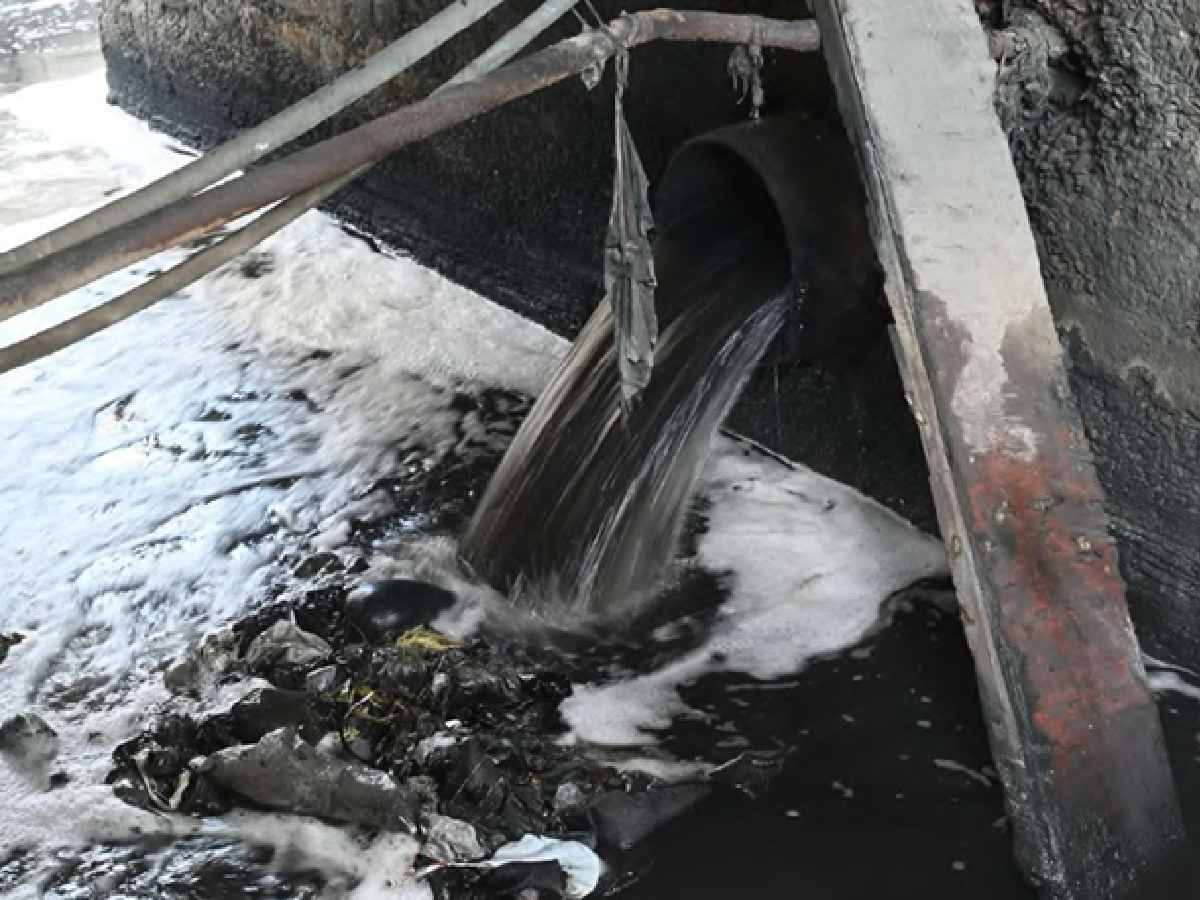
Chemical effluent flowing at the outlet of the Jhilmil CETP
Delhi’s Common Effluent Treatment Plants (CETPs) have come under sharp scrutiny after a Delhi High Court-appointed committee found widespread failures in their operation. Despite repeated claims by the Delhi Pollution Control Committee (DPCC) that plants are complying with prescribed standards, the ground reality reveals untreated effluent, faulty meters, and ageing infrastructure allowing toxic discharges to flow directly into drains leading to the Yamuna.
Environmentalists say the findings point to not just technical lapses but systemic neglect. “This is not just about broken meters or missing sensors,” said environmentalist Pankaj Kumar. “It is about an entire governance failure. For years, CETPs were showcased as proof of Delhi’s commitment to clean industry. What the committee has found tells us these plants are merely decorative structures, while the Yamuna continues to carry untreated waste.”
Faulty monitoring systems
Across CETPs, the absence of functioning meters and sensors was a recurring problem. At Bawana, one of the city’s largest industrial hubs, three Regional Effluent Pumping Stations are supposed to feed into the plant, necessitating three meters. Only two were functional, with the third lying defunct for months. More critically, the outlet meter has been non-functional since June 15, 2025 — leaving the operator unable to record or calculate the amount of treated water released.
Discrepancies also emerged between the Online Monitoring System (OLMS) and DPCC’s lab results. On June 12, 2025, OLMS showed a Biochemical Oxygen Demand (BOD) of 11.26 mg/L, while DPCC recorded 22 mg/L — nearly double.
Naraina’s CETP had similar lapses: its inlet meter was nonfunctional and the outlet meter had not been calibrated since October 2024. At Mayapuri, the last calibration was done in September 2019, with no inlet calibration ever carried out. At GT Karnal Road, both inlet and outlet meters were nonfunctional and OLMS had been out of order since December 2024, despite repeated complaints lodged with the vendor.
Also Read: Delhi records most deaths from manual scavenging in 2025
“DPCC has become a rubber stamp,” said Kumar. “Its reports are divorced from reality. If regulators cannot even ensure calibration of meters, how can they certify water quality?”
Ageing and broken equipment
Many CETPs are struggling with machinery that has not been replaced for years. At Naraina, the carbon and media filters had not been changed in five years, producing visibly poor-quality water. At Okhla, of 15 Activated Carbon Filters, seven were non-functional; of 24 Dual Media Filters, half were out of service. The plant’s outlet was seen frothing heavily, a likely result of untreated sewage and malfunctioning filters.
Keshavpuram’s plant, commissioned in 2005, continues to run on corroded pipelines, with no upgrades because of financial constraints. “The pipes at Keshavpuram are literally crumbling, but industries keep producing more effluent every year,” said Kumar. “It’s like running a hospital with broken equipment and still expecting patients to recover.”
At Jhilmil, the agitator — vital for mixing effluents — has been non-functional for over a year. The CETP society said it would only be replaced once its upgradation proposal, submitted in April 2023, was approved. “This is yet another example of paralysis by delay,” said Kumar. “An agitator is basic equipment. Waiting years for approvals while sewage pours into the drains shows how broken the system is.”
Overburdened by sewage
Several CETPs were designed to treat only industrial waste but are now also handling sewage. This dual load has stretched them beyond design capacity.
At Mayapuri, built in 1996 to treat effluent with 40 mg/L BOD, influent now enters with 200 mg/L BOD. Treatment has become nearly impossible, explaining why the water appears murky even after processing.
The SMA CETP, underutilised after industries relocated, now receives sewage from jhuggi clusters and industrial units, undermining efficiency. Its President admitted the plant was never designed for sewage. He also pointed out that treated water flows into the Jahangirpuri drain and eventually into the Yamuna, raising questions about downstream impacts. Oil-based effluents from nearby auto industries further strain the plant, which lacks equipment to remove oil and grease.
At GT Karnal Road, industrial inflow has fallen because many units shut down or moved, but sewage from unauthorised colonies and clusters has replaced it, overwhelming the system. Similarly, Jhilmil and Okhla discharge treated water directly into drains already carrying untreated sewage, nullifying any treatment effort.
Financial distress cripples maintenance
Most CETPs are run by societies funded by member industries, but widespread non-payment has left them unable to function. At Wazirpur, 75% of units are defaulters, leaving the operator unable to maintain the plant. At Badli, only 15% of members pay dues, forcing the operator to measure just five parameters — TSS, BOD, COD, pH, and TDS — while ignoring sulphides, phosphates, and ammoniacal nitrogen mandated by DPCC.
At GT Karnal Road, over Rs 7.17 crore remains unpaid by 472 members, delaying maintenance and leaving all four agitators non-functional. Samples collected from inlet and outlet points during inspection showed no visible difference between untreated and treated waste. The operator attributed this to ongoing filter cleaning, but until upgrades are completed, treatment remains ineffective.
In Okhla, 80–90% of industrial units have defaulted, stalling proposals for urgent upgrades.
Toxic discharges into city drains
The committee’s inspections found untreated waste flowing directly into drains. At Bawana, the escape drain carried pitch-black water. At Wazirpur, stormwater drains were clogged with solid waste and coloured discharge, likely from electroplating units. The operator admitted that current compliance with DPCC norms was possible only because of reduced inflow, and that an increase in industrial activity would quickly overwhelm the system.
“DPCC claims industries have been shifted from Wazirpur and adjoining areas, yet contaminated water is flowing into drains, which is clearly visible,” said Kumar.
At Badli, oil-rich effluents from service stations entered the CETP, which has no system to treat oil and grease. Dyes and chemicals suggested many units were bypassing their own Effluent Treatment Plants (ETPs). “This is a dangerous cocktail of oil, grease, and chemicals that the plant is simply not equipped to treat,” said environmental lawyer Ritwick Dutta. “What flows out is not treated water — it is a toxic brew that ends up in the river and groundwater.”
At Okhla, frothing chemical foam was observed in the Indrakalyan drain before it joined the Yamuna. “Frothing at Okhla is a visual symbol of how bad things have become,” said Kumar. “Anyone standing near that drain can tell this is not treated water. It is chemical foam flowing straight into the Yamuna.”
DPCC’s questionable oversight
The committee’s report ultimately raises troubling questions about DPCC’s monitoring role. Despite visible lapses and black water continuing to flow into city drains, DPCC has consistently reported that CETPs are meeting standards. With faulty meters, outdated infrastructure, and industrial units frequently bypassing treatment facilities, these claims now appear deeply questionable.
“DPCC has become a rubber stamp,” said Kumar. “Its reports are divorced from reality.”
The court steps in
The Delhi High Court had earlier criticised the Delhi State Industrial and Infrastructure Development Corporation (DSIIDC) for failing to ensure proper functioning of CETPs. The court’s decision to appoint an independent committee has now laid bare the scale of the problem.
“The Yamuna cannot afford another decade of this neglect,” said Kumar. “CETPs were meant to be a solution, but they have turned into symbols of apathy. The High Court must now ensure accountability is fixed — not just on operators but also on regulators.”
Five arrested, including bouncers, after a man was brutally thrashed to death at a Delhi…
MCD rolled out 12 multi-purpose anti-smog vehicles to suppress dust, wash roads, and tackle rising…
NSUI staged a dharna outside CP police station, alleging Delhi Police assaulted and detained women…
Delhi HC will hear a PIL on Oct 16 seeking to allow peaceful protests at…
DU has approved a ₹5,889 crore plan to build and reconstruct hostels, creating residential accommodation…
Delhi LG said the capital’s development priorities are interconnected, stressing that PPPs must be chosen…

