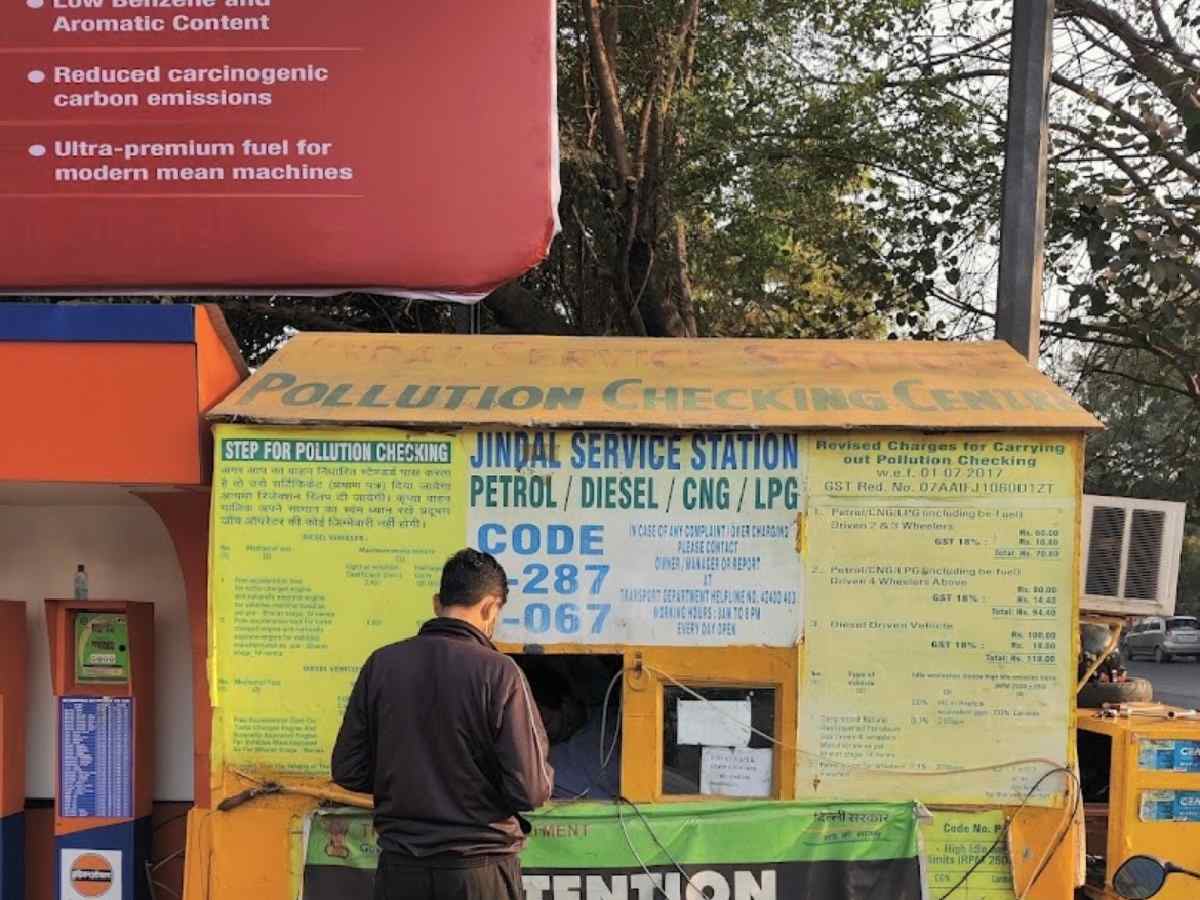
For a taxi driver in Delhi, getting a Pollution Under Control (PUC) certificate is part of keeping his vehicle on the road. Between fuel expenses, vehicle maintenance, insurance and daily earnings, the certificate is another requirement he cannot afford to ignore. But for many drivers, the bigger concern is whether the testing centres actually check their vehicles before issuing the document.
“Every time we visit a PUC centre, we expect the operator to check the vehicle properly. We pay for the test because it is compulsory. But sometimes the process is so quick that you wonder whether the machine has actually checked the emissions. If the government wants us to follow the rules, it should also make sure that the centres follow them as well,” said taxi driver Pramod Kumar, 46.
His concern comes as the Delhi government has approved Rs 5 crore in financial assistance to upgrade nearly 500 PUC testing locations across the city. Under the scheme, each eligible location will receive a one-time grant of Rs 1 lakh to improve its infrastructure, testing facilities and CCTV surveillance.
The government says the initiative will make pollution testing more transparent and prevent improper certificate issuance. However, the announcement comes against the backdrop of serious irregularities flagged by the Comptroller and Auditor General (CAG) and questions raised by the Supreme Court over the credibility of PUC testing.
For vehicle owners, commercial drivers and PUC operators, the issue is not simply about new cameras or improved testing cabins. It is about whether a certificate issued by an authorised centre actually confirms that a vehicle meets the prescribed emission standards.
Also Read: A 50-year-old building, a railway line, and warnings that went unheeded
Credibility of testing
Delhi’s PUC system serves private vehicle owners and thousands of commercial drivers who depend on their vehicles for their daily income. Taxi drivers, autorickshaw operators and delivery workers must keep their pollution certificates valid to continue operating.
For these drivers, a failed emission test can mean extra repair costs, another visit to the centre, and lost working hours. They also expect the same rules to apply to every vehicle.
Jyotbir Singh, 32, told Patriot, “Sometimes we have to leave our work and stand in a queue just to renew our pollution certificates. If the vehicle fails, we have to visit a mechanic, pay for repairs, and return for another test. We understand that pollution needs to be controlled, but the system should be fair. A driver who maintains his vehicle should not have to compete with people who can obtain certificates without proper testing.”
Taxi operators believe that digital testing records could reduce disputes between drivers and PUC centres. They want centres to provide actual emission readings instead of simply handing over a pass certificate.
Jail Singh, a taxi service owner and a taxi union representative, said, “Our drivers are not against pollution checks. They know that vehicles running throughout the day contribute to pollution and must meet the required standards. But the government must ensure that every vehicle undergoes the same procedure. If one driver has to repair his vehicle after failing a test, another should not be able to get a certificate without even connecting the testing equipment. The rules should be equal for everyone.”
The representative added that commercial drivers already face several financial pressures and that the government should ensure that the new scheme does not increase their compliance costs.
“Drivers cannot keep losing working hours because of poorly managed testing centres. The government should make the process transparent, provide proper facilities and ensure that the equipment works correctly. We want genuine testing, not a system where certificates are issued to complete formalities,” he said.
What happens at a PUC centre?
At an authorised PUC centre, an operator is expected to connect the testing equipment to a vehicle and record its emission levels. The machine measures pollutants such as carbon monoxide and hydrocarbons in petrol vehicles and smoke opacity in diesel vehicles, as applicable.
The operator then issues a certificate if the vehicle meets the prescribed standards. However, the process has faced questions over whether centres always follow these procedures.
A PUC centre operator said that running a testing facility involves regular equipment maintenance, calibration, documentation and compliance with Transport Department requirements.
“People often think that a PUC centre only needs a machine and a computer. But there are several responsibilities involved. The equipment needs regular calibration, the operator must follow the prescribed procedure, and the records must be maintained properly. If the machine stops working or its calibration expires, the centre cannot continue testing as usual,” a PUC centre operator told Patriot.
Also Read: At 15, he dismantles Delhi’s phones to keep his family afloat
He added that the proposed government assistance could help smaller centres improve their facilities.
“One lakh rupees can help us improve the cabin, install cameras and make the testing area more organised. But the government should also clarify whether the assistance will cover equipment upgrades. Infrastructure is important, but the machine is the most important part of the process. If the equipment does not give accurate readings, even a newly renovated centre cannot provide reliable certificates,” he said.
At Bharat Pollution Testing Centre in New Friends Colony, PUC centre operator Suleman Khan said CCTV surveillance could help establish greater transparency if officials regularly monitor the footage.
“Installing cameras is a good step because it creates a record of what happens inside the centre. But cameras should not remain switched on only for compliance. Someone from the department should actually monitor the footage. If a vehicle is not being tested properly, the authorities should be able to identify it and take action,” Suleman said.
CAG findings
The concerns raised by drivers and operators are not new. A CAG performance audit on preventing and mitigating vehicular air pollution in Delhi had already identified serious weaknesses in the PUC certification system.
The audit found 7,643 cases in which more than one vehicle appeared to have undergone emission testing at the same centre at the same time.
It also identified 76,865 cases in which certificates were issued within less than one minute of one another at the same centre. The CAG questioned how centres could complete the prescribed testing and certification procedure within such a short period.
The CAG in its ‘Performance Audit of Prevention and Mitigation of Vehicular Air Pollution in Delhi’ observed, “Since neither a PUCC can be issued simultaneously to two vehicles at a PCC (pollution checking centre) nor it is possible to carry out the entire procedure in one minute, it is suspected that the specified procedure for emission testing of each vehicle was not followed in these cases.”
The findings raised doubts about whether centres were actually testing vehicles or simply issuing certificates through the digital system.
The audit also found that 1.08 lakh petrol, CNG and LPG vehicles received PUC certificates despite recording carbon monoxide and hydrocarbon emissions above permissible limits.
Among diesel vehicles, the audit identified approximately 5.38 lakh cases in which certificates were issued without recorded test values during the period examined. It also found 4,007 diesel vehicles with emission readings above permissible limits that were still marked as having passed.
The Transport Department attributed some discrepancies to software problems and said it would shift PUC application management to the National Informatics Centre (NIC).
The audit called for stronger monitoring and analysis of digital testing records to identify suspicious activities.
Another audit finding raised questions about the relationship between roadside enforcement and PUC certification.
Between November 2018 and October 2020, authorities issued 53,655 challans to vehicles emitting visible smoke. Of these, 52,711 vehicles held valid PUC certificates.
This meant that more than 90% of the vehicles caught emitting visible smoke carried certificates declaring them compliant.
The Transport Department argued that vehicles could develop mechanical problems after receiving a certificate. It also cited poor maintenance, adulterated fuel and faulty vehicle components as possible reasons for visible smoke.
However, the audit questioned whether the department had established an effective mechanism to inspect the centres that issued certificates to these vehicles.
A vehicle owner, Suraj Bhatt, 36, from Delhi Cantonment said that motorists should receive proper emission readings instead of relying only on a pass-or-fail certificate.
“When we visit a centre, we should know exactly what the machine has recorded. If the vehicle has excessive emissions, the operator should explain the problem and tell us what needs to be repaired. A certificate should not be treated as a formality. It should tell us whether our vehicle is actually complying with pollution standards,” he said.
Inspections and cancellations
The Delhi Assembly’s Public Accounts Committee examined the Transport Department’s response to the CAG findings.
According to the department’s submission, officials conducted 1,288 inspections of PUC centres during 2025.
These inspections resulted in 74 advisories, 283 warnings, 69 show-cause notices, 39 suspensions and 13 cancellations.
The department also informed the committee that the Energy Policy Institute at the University of Chicago (EPIC India) had conducted an independent audit of 90 PUC centres in 2025. The department was still awaiting its detailed final report.
It further stated that the NIC system requires centres to upload equipment calibration certificates and automatically blocks testing when calibration expires.
Its submission referred to 953 operational centres, while reports on the latest Cabinet decision referred to approximately 827 authorised centres.
‘Need more than cameras’
The government’s decision to strengthen CCTV surveillance may improve monitoring, but experts say the system needs more than cameras to ensure reliable emission testing.
A pollution-control researcher said that authorities must focus on the accuracy of testing equipment, independent calibration and regular inspections.
“An emission-testing machine must give accurate readings. CCTV can show whether a vehicle entered the testing area and whether an operator carried out the procedure, but it cannot establish whether the machine itself is functioning correctly. The government must ensure that equipment undergoes independent calibration and that officials conduct surprise inspections,” said researcher Naveen Yadav.
He added that digital records could help identify suspicious patterns.
“If a centre issues several certificates within an unusually short period, the software should automatically flag the activity. If two vehicles appear to have undergone testing at the same time, the department should investigate immediately. The system should not wait for an audit to identify irregularities that can be detected through routine data analysis,” the researcher said.
He also suggested random retesting of vehicles that have recently received certificates.
“Authorities should select vehicles at random and conduct independent emission checks. If a vehicle fails shortly after receiving a certificate, the department should examine both the vehicle and the centre that issued the document. This will create accountability at both ends,” he said.
SC observations
On November 6, the Supreme Court directed Delhi, Haryana, Rajasthan and Uttar Pradesh to submit detailed responses on their efforts to control vehicular pollution.
The bench, comprising Chief Justice Surya Kant and Justices Joymalya Bagchi and V. Mohana, sought information on enforcing PUC certification requirements, identifying non-compliant vehicles and taking action against violators.
The court observed, “There can be little doubt that the issue warrants urgent and immediate intervention.”
It also sought details on the number of vehicles inspected, challaned, or denied entry, and asked authorities to submit a time-bound roadmap to strengthen enforcement.
The Delhi government has said its investment will improve facilities, strengthen surveillance and bring uniformity to the PUC network.
The proposed assistance of Rs 1 lakh per location may help centres upgrade their cabins, testing areas and CCTV systems. But the department must also explain how it will verify expenditure and ensure that the upgrades improve testing quality.
For motorists, the most important change would be access to actual emission readings. A certificate should not simply confirm that a vehicle has passed. It should provide a verifiable record of the test.
The government’s investment may improve the physical condition of PUC centres, but it will not automatically repair the credibility of the certification system.
For Delhi’s motorists, the question is not how many cameras will be installed or how many centres will receive new cabins. It is whether a vehicle entering a PUC centre will receive an honest test and a certificate that actually means something.
Crowne Plaza Today New Delhi Okhla is hosting a Rajasthani food festival featuring traditional delicacies,…
Gupta says work is progressing to clean the remaining 40 per cent of the river,…
The truck driver allegedly tried to flee but was caught after his vehicle rammed into…
Two people died in a building collapse in Shahdara’s Jwala Nagar on November 17. The…
The accused allegedly cheated a company representative of Rs 25 lakh by promising travel services,…
Actor visits the Sikh shrine with filmmaker Nitesh Tiwari and producer Namit Malhotra after the…
