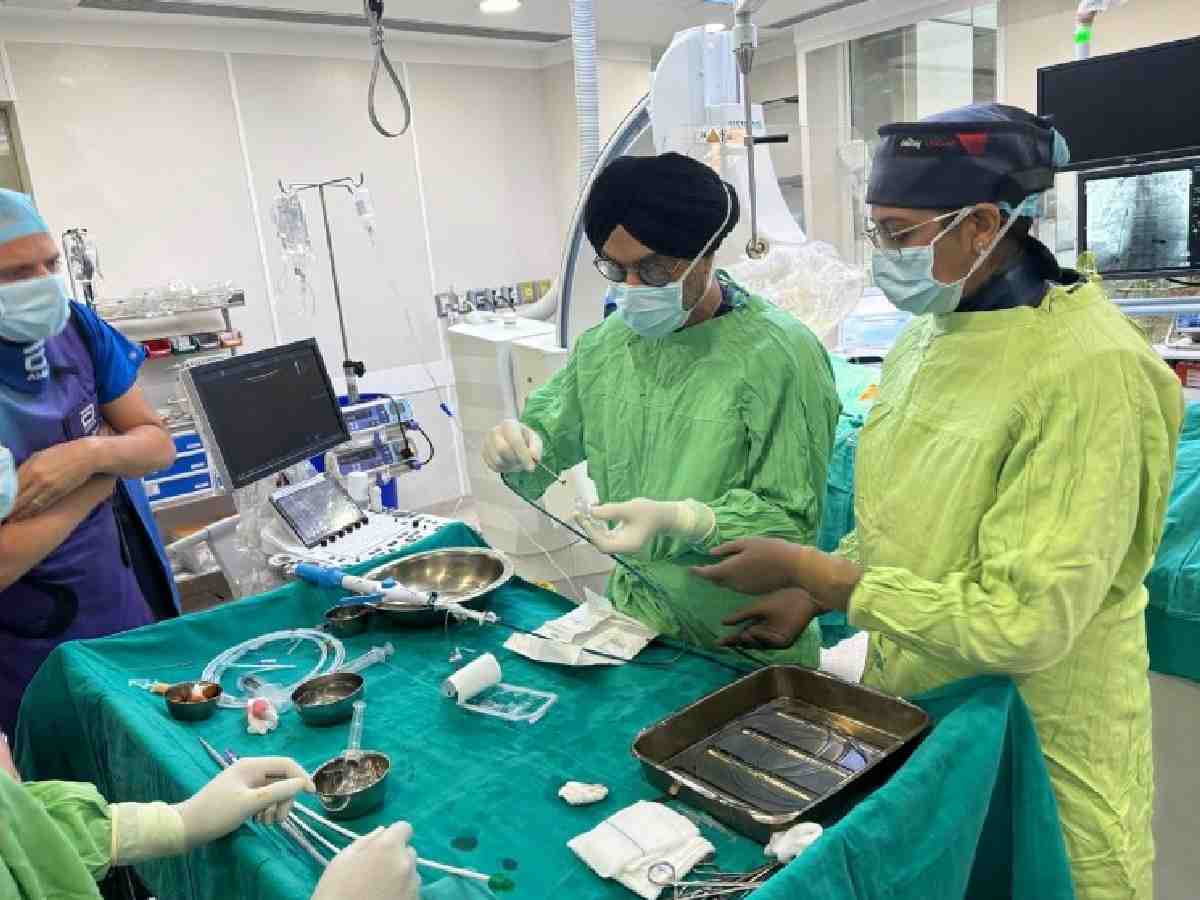
A pioneering cardiac procedure at Max Super Speciality Hospital, Saket, has seen India’s first dual-chamber leadless pacemaker successfully implanted in an 83-year-old patient, offering a minimally invasive solution for a complex heart condition.
The patient, who had chronic kidney disease, hypertension, and gout, had been experiencing repeated episodes of fainting. A detailed cardiac evaluation revealed a dangerously slow heartbeat caused by atrioventricular (AV) block, putting her life at significant risk.
The surgery was led by Dr Balbir Singh, Chairman of Cardiology at Max Hospital, Saket, along with a dedicated cardiology team. “This procedure marks a historic moment as we implanted the first dual-chamber leadless AVEIR DR pacemaker in India,” Dr Singh said. “The patient tolerated the surgery exceptionally well, with no complications. She was able to walk and move around within hours and was discharged just one day after the procedure.”
Unlike conventional pacemakers, which require chest incisions and wires connecting the device to the heart, the AVEIR DR pacemaker is implanted via a catheter. This minimally invasive approach eliminates surgical cuts or stitches and reduces risks associated with traditional pacemaker leads and pockets, such as infections or complications.
Dr Singh explained, “This leadless device works wirelessly, synchronising the heart’s atrial and ventricular chambers in real-time, closely mimicking natural heart rhythms. It provides a safer, more comfortable experience for patients, with no visible scars or long recovery periods.”
Also Read: 51% of Gen Z women seek fertility checks in routine tests: survey
The AVEIR DR represents a breakthrough in cardiac care. Its wireless communication between the atrial and ventricular devices, long-term retrievability, and modular upgrade capability make it a flexible and future-ready solution for managing cardiac rhythm disorders.
The patient is now recovering well and looking forward to resuming her normal activities. This successful procedure underscores India’s growing leadership in advanced, minimally invasive cardiac treatments and sets a new benchmark in personalised heart care.
Delhi inaugurates the 70th National School Games, hosting over 14,000 participants in 14 sports across…
Delhi High Court asked "Doosra" filmmakers to respond to Sourav Ganguly's plea over alleged violation…
Delhi L-G appointed Paralympian Suvarna Raj as State Commissioner for PwDs following her gold win…
DDA is planning Delhi's longest 24-km cycling track along the Yamuna floodplain, linking key eco-projects…
Police detained several anti-SIR protesters heading to the ECI headquarters in Delhi as mass gatherings…
An exhibition that revisits the significance of Indian Modernism through works from earlier and defining…
