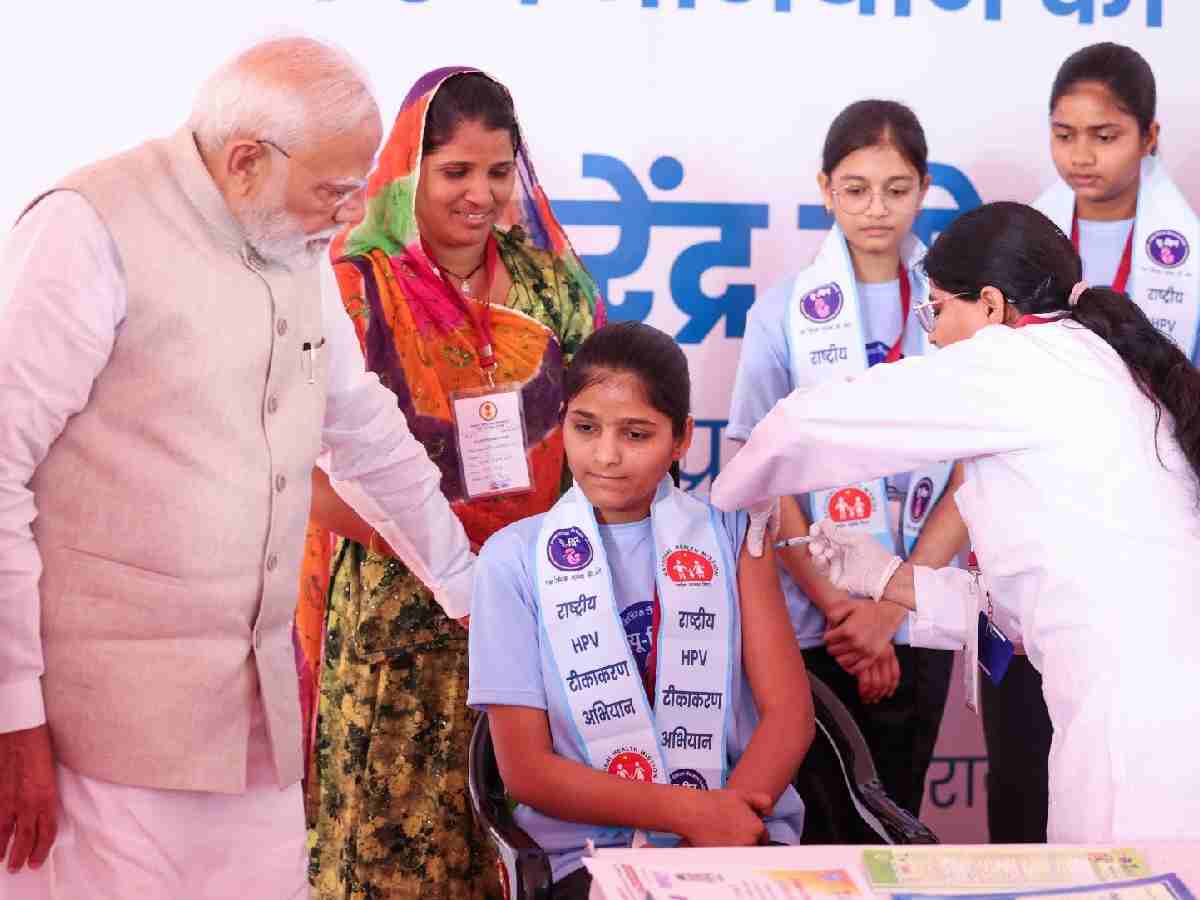
The Director of All India Institute of Medical Sciences (AIIMS), Delhi, Dr M Srinivas, has urged parents, teachers, community leaders and healthcare professionals across the country to actively support and promote the nationwide Human Papillomavirus (HPV) vaccination drive launched by Prime Minister Narendra Modi.
Prime Minister Modi launched the nationwide campaign for 14-year-old girls from Ajmer in Rajasthan, marking what experts have described as a decisive step towards eliminating cervical cancer in India.
Welcoming the initiative of the Union health ministry, Dr Srinivas said the campaign represents a transformative moment in India’s public health journey — one that has the potential to save countless lives in the decades ahead.
Cervical cancer remains the second most common cancer among women in India and one of the leading causes of cancer-related deaths, claiming nearly 75,000 lives annually. “What makes this burden particularly tragic is that it is largely preventable,” he underlined.
“The Human Papillomavirus (HPV) vaccine is safe, scientifically validated and highly effective,” Dr Srinivas said, emphasising that systematic administration to adolescent girls provides powerful protection against one of the most preventable cancers affecting women in the country.
“At AIIMS, Delhi, we have consistently championed preventive healthcare as the cornerstone of a resilient health system. Vaccination remains among the most cost-effective and impactful public health interventions,” he said.
Single-dose protection, long-term impact
Under the campaign, a single-shot quadrivalent vaccine such as Gardasil 4 is being administered. The vaccine protects against HPV types 16 and 18 — responsible for the majority of cervical cancer cases — as well as types 6 and 11.
Dr Mukurdipi Ray, Professor of Surgical Oncology at AIIMS Delhi, said Indian cohort studies involving 17,000 girls vaccinated between 2009 and 2010 showed single-dose efficacy of 92 per cent against persistent infections caused by HPV types 16 and 18 — the strains responsible for 83 per cent of cervical cancers in India — even 10 to 15 years later.
“This protection is comparable to two- or three-dose schedules,” Ray said, adding that no high-grade pre-cancers were detected in vaccinated groups.
He noted that projections suggest widespread vaccination could prevent up to one million lifetime cervical cancer cases nationally and potentially bring incidence below the elimination threshold set by the World Health Organization across all states.
Dr Srinivas said that by reaching girls at the recommended age, prior to potential exposure to the virus, “we are not only preventing disease but also easing the long-term emotional and financial burden on families, while strengthening our national healthcare system.”
Safety, misinformation and global targets
Experts also addressed concerns surrounding vaccine safety.
Dr Abhishek Shankar of AIIMS Delhi said cervical cancer is among the few cancers that can be largely prevented through vaccination, but misinformation continues to discourage uptake.
“Large clinical trials and population studies involving millions have demonstrated that HPV vaccines prevent 90 to 100 per cent of infections with high-risk types that cause cervical cancer,” he said.
According to Shankar, side effects are rare and typically mild, such as soreness at the injection site, low-grade fever or fatigue. “There is no evidence linking HPV vaccines to infertility or other long-term health issues,” he added.
The initiative aligns with the World Health Organization’s 90-70-90 framework, which aims to vaccinate 90 per cent of girls by age 15, screen 70 per cent of women with high-performance tests and ensure treatment for 90 per cent of those who test positive by 2030.
Countries such as Australia are already on track to eliminate cervical cancer, buoyed by early and high vaccine uptake alongside robust screening systems.
Dr Shankar said India contributes nearly one-fifth of the global cervical cancer burden, and achieving high coverage in this age group would substantially accelerate progress towards elimination thresholds — defined as incidence below four cases per 1,00,000 women-years.
Reiterating his appeal, Dr Srinivas said, “I urge parents, teachers, community leaders and healthcare professionals across the country to actively support and promote this drive. Let us work together to ensure that every eligible girl benefits from this life-saving intervention.
“We stand at a pivotal moment, with the opportunity to build a future where cervical cancer is no longer a public health threat in India.”
NDMC set up a panel to review employee transfers since January over alleged anomalies, freezing…
From rare vinyl and vintage Bollywood posters to Y2K fashion and reworked denim, discover five…
Psychology students providing mental health support navigate academic pressure, emotional demands, grief and the challenge…
Delhi Police busted a fake Apple call centre in Naraina targeting US citizens via gift-card…
Union Cabinet approves Rs 1,789.52-crore ITMS for Delhi, covering 42 traffic corridors with adaptive signals,…
The Delhi High Court dismissed the third bail pleas of Umar Khalid and Sharjeel Imam…
