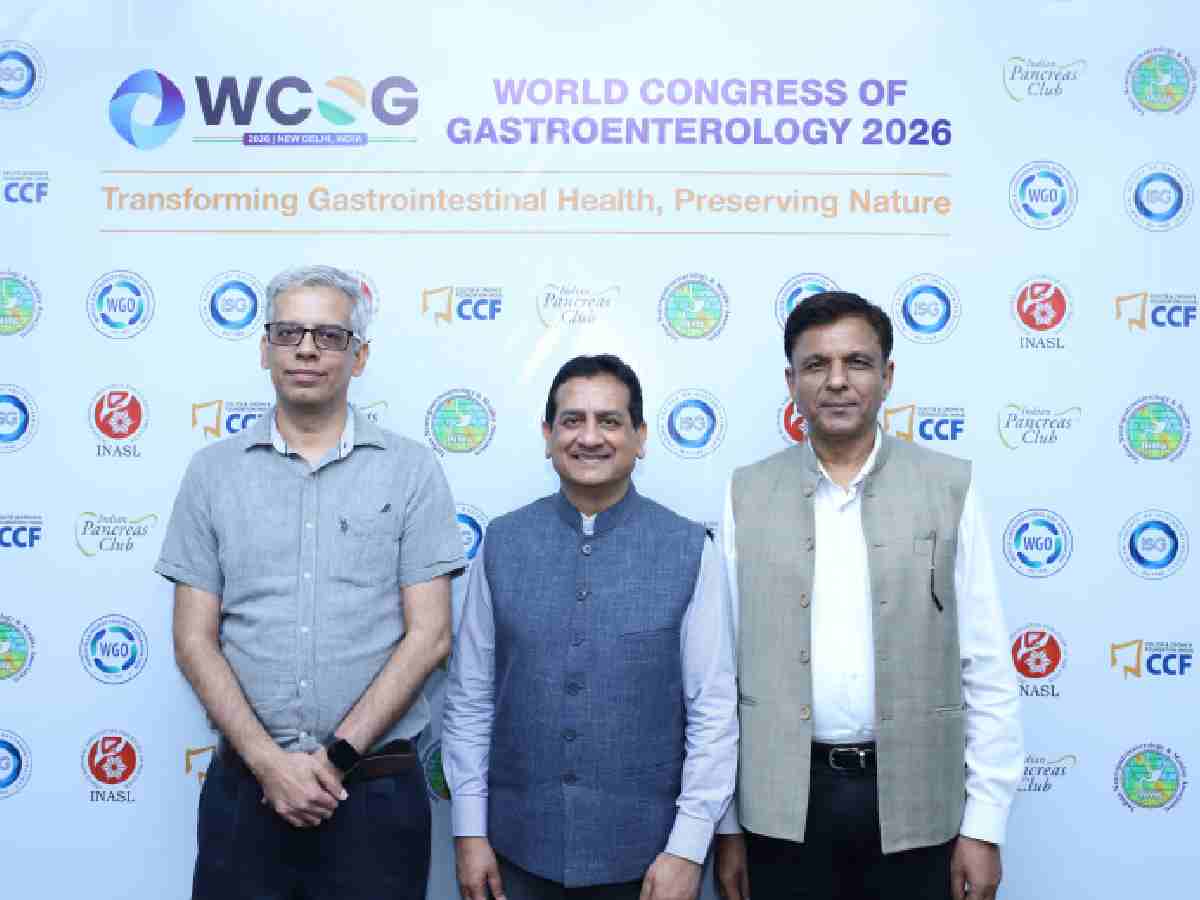
L to R - Dr Shalimar, Dr Govind Mahakaria, Dr Pramod Garg
India is witnessing a shift in its gastrointestinal disease burden, with metabolic conditions such as fatty liver increasingly emerging alongside persistent infections, gastrointestinal cancers and inflammatory bowel disease, doctors said ahead of the World Congress of Gastroenterology 2026.
Senior gastroenterologists at AIIMS said improving awareness, hygiene and preventive healthcare had helped reduce several communicable diseases, but the country was now facing a growing burden of lifestyle and metabolic disorders affecting the liver and digestive system.
“India is facing an epidemiological shift at this time. We have made significant strides in controlling preventable disease through awareness, vaccinations and improving quality of life; however, alongside these, we are now seeing metabolic disease on a scale we have never handled before,” said Dr Pramod Garg, Professor and Head, Department of Gastroenterology and Human Nutrition, AIIMS, New Delhi.
He said digestive diseases, including stomach, intestinal and liver disorders, affect nearly 25 to 30% of the population at some point, underlining the need for prevention and early detection.
“Fatty liver is the clearest example. The disease is easy to find if we look for it, and we become aware only after the patient falls ill,” Dr Garg said.
He stressed the importance of a balanced diet, physical activity and avoiding smoking and alcohol to reduce the risk of gastrointestinal and metabolic diseases.
Fatty liver a major concern
Fatty liver has emerged as one of the biggest concerns in India’s changing GI disease landscape.
An AIIMS-led systematic review and meta-analysis found that non-alcoholic fatty liver disease affected 38.6% of Indian adults and 35.4% of children. The condition is more common among people with obesity, diabetes and other metabolic risk factors.
Doctors said the disease can remain silent for years, with liver damage progressing before symptoms become apparent.
The concern is particularly high among people with type 2 diabetes. A recent multicentre study of 9,202 Indian adults with type 2 diabetes found that 26% had clinically significant liver fibrosis, while 14% had advanced fibrosis and 5% had liver stiffness measurements consistent with probable cirrhosis.
The study, published in The Lancet Regional Health – Southeast Asia, also found clinically significant fibrosis in 13% of participants who had no steatosis detected by controlled attenuation parameter measurements
This suggests that the absence of visible fatty liver does not necessarily mean the liver is healthy, doctors said.
“Fatty liver is the clearest example. The disease is easy to find if we look for it, and we become aware only after the patient falls ill. This is a greater challenge than before — we must move away from only treating diseases; we must now actively promote good health,” Dr Garg said.
Dr Shalimar, Professor, Department of Gastroenterology and Human Nutrition, AIIMS, said the rising burden of metabolic liver disease made early identification increasingly important.
“With fatty liver disease affecting around one in three adults and children in India, understanding its links with diabetes, hypertension, obesity and dyslipidaemia is increasingly important,” he said.
Silent liver damage
Doctors said liver fibrosis could develop without obvious symptoms in people with diabetes, making routine assessment important.
A study titled ‘DiaFib-Liver Study’ found that obesity, dyslipidaemia, reduced kidney function and longer duration of diabetes were independent predictors of clinically significant fibrosis.
Importantly, 19% of non-obese participants with type 2 diabetes had clinically significant fibrosis, highlighting that the problem is not restricted to people who are visibly overweight.
The researchers have called for fibrosis assessment using non-invasive tools such as transient elastography or validated blood-based markers to be incorporated into diabetes care.
The findings also indicate that doctors should not rely only on the presence of liver fat when assessing patients with diabetes.
Colorectal cancer concerns
Colorectal cancer is another concern, with doctors reporting cases in younger adults.
India recorded 40,430 new colorectal cancer cases among men and 24,433 among women in 2022, according to data cited by the AIIMS experts.
Dr Govind Makharia, Professor of Gastroenterology and Human Nutrition at AIIMS, said delayed evaluation of persistent symptoms remained a concern.
“India has never been short of gastroenterologists or technology. What we have lacked is the habit of taking early symptoms seriously,” he said.
“Any symptom that persists beyond two to three weeks should be evaluated,” Dr Makharia said.
Doctors advised people not to ignore blood in the stool, persistent changes in bowel habits, unexplained weight loss or continuing abdominal symptoms.
Infections add to burden
While metabolic diseases are increasing, persistent gastrointestinal infections continue to affect large sections of the population.
Helicobacter pylori remains widespread in India and is associated with peptic ulcer disease and gastric cancer. Intestinal worm infections continue to affect children and can contribute to anaemia and undernutrition.
Doctors said the country therefore faces a dual burden — persistent infections on one side and rapidly increasing metabolic and lifestyle-related diseases on the other.
Celiac disease and inflammatory bowel disease are also being increasingly recognised.
A community-based study led by AIIMS found the prevalence of celiac disease in northern India to be about 1.04%, or approximately one in 96 people.
Dr Makharia said diseases that were once considered uncommon in India were now being seen regularly in clinical practice.
Dr Vineet Ahuja, Professor, Department of Gastroenterology and Human Nutrition, AIIMS, said inflammatory bowel disease and celiac disease had become increasingly familiar conditions for gastroenterologists.
“Inflammatory bowel disease and celiac disease were textbook rarities in India when I trained, and we now see them every week,” Dr Ahuja said.
He said advances in endoscopy, artificial intelligence and microbiome research were improving diagnosis and treatment, but access to such technologies remained a challenge.
Endoscopy changing treatment
Doctors said advances in therapeutic endoscopy were also changing the management of gastrointestinal diseases.
At AIIMS, around 150 to 200 endoscopic procedures are performed every day, with endoscopy increasingly being used not only for diagnosis but also for minimally invasive treatment.
Bleeding ulcers, bile duct stones and certain polyps can be treated endoscopically, while selected early gastrointestinal cancers can also be removed through endoscopic procedures.
“Therapeutic endoscopy is minimally invasive endoscopic surgery,” one of the AIIMS experts explained.
The upcoming gastroenterology congress will feature live demonstrations and sessions on newer endoscopic procedures, with specialists from India and abroad expected to participate.
Caution over self-medication
Doctors also warned against taking medicines without medical supervision, particularly as patients increasingly use online platforms to diagnose symptoms and select treatments.
Experts said all medicines can have side effects and some drugs can cause liver injury when taken incorrectly or without appropriate monitoring.
They also cautioned against assuming that traditional or herbal medicines are automatically safe.
Dr Shalimar said traditional medicines should be evaluated using scientific methods and taken appropriately rather than being self-prescribed.
Doctors stressed that patients should consult qualified medical professionals before starting medicines for persistent gastrointestinal symptoms.
Diet and lifestyle matter
The experts also emphasised moderation in diet rather than completely eliminating individual foods.
Dr Makharia said there was no need to completely avoid ghee or other traditional foods, but excessive consumption of oily and calorie-dense foods could contribute to metabolic problems.
The broader message, he said, was balance.
“Everything should be in balance. Nothing is good in excess,” Makharia said.
Doctors advised people to prioritise a balanced diet, regular physical activity and adequate sleep while limiting highly processed foods, excessive sugar, smoking and alcohol.
Against this backdrop, India will host the World Congress of Gastroenterology 2026 from September 30 to October 3 at Yashobhoomi, the India International Convention and Expo Centre, Dwarka.
It will be the first time that the World Congress of Gastroenterology is being held in India.
More than 3,000 delegates are expected to attend, with participants from 51 countries. Around 1,150 research papers have been submitted for presentation, said Dr Garg.
The event is being jointly hosted by the Indian Society of Gastroenterology, Indian National Association for the Study of the Liver, Crohn’s and Colitis Foundation of India, Indian Pancreas Club and Indian Neurogastroenterology and Motility Association, in partnership with the World Gastroenterology Organisation.
The theme of the congress is ‘Transforming Gastrointestinal Health, Preserving Nature’.
The event will focus on advances in diagnostics, endoscopy, therapeutics, gut microbiome research and artificial intelligence-enabled healthcare, while examining the changing global burden of digestive diseases.
As India confronts a growing mix of metabolic, infectious and inflammatory gastrointestinal disorders, doctors say the focus must shift from treating advanced disease to identifying risk and symptoms much earlier.
The message from the experts is clear: persistent digestive symptoms should not be dismissed, and prevention, screening and timely medical evaluation will be crucial in dealing with the country’s changing GI disease burden.
After 12 years in theatre, the actor makes his international film debut with a role…
Protester alleges Delhi Police assaulted detainees, deleted phone videos, and detained minors during anti-CEC protest…
Shifting protests away from Jantar Mantar weakens democratic visibility and access to political power, an…
CM Rekha Gupta defends SIR and EC integrity, saying democracy can't be held hostage to…
AISA students march to Supreme Court over 'vote chori' claims against CEC, as police barricade…
DMRC extends closure of six central Delhi metro station gates until 5 pm citing security…
