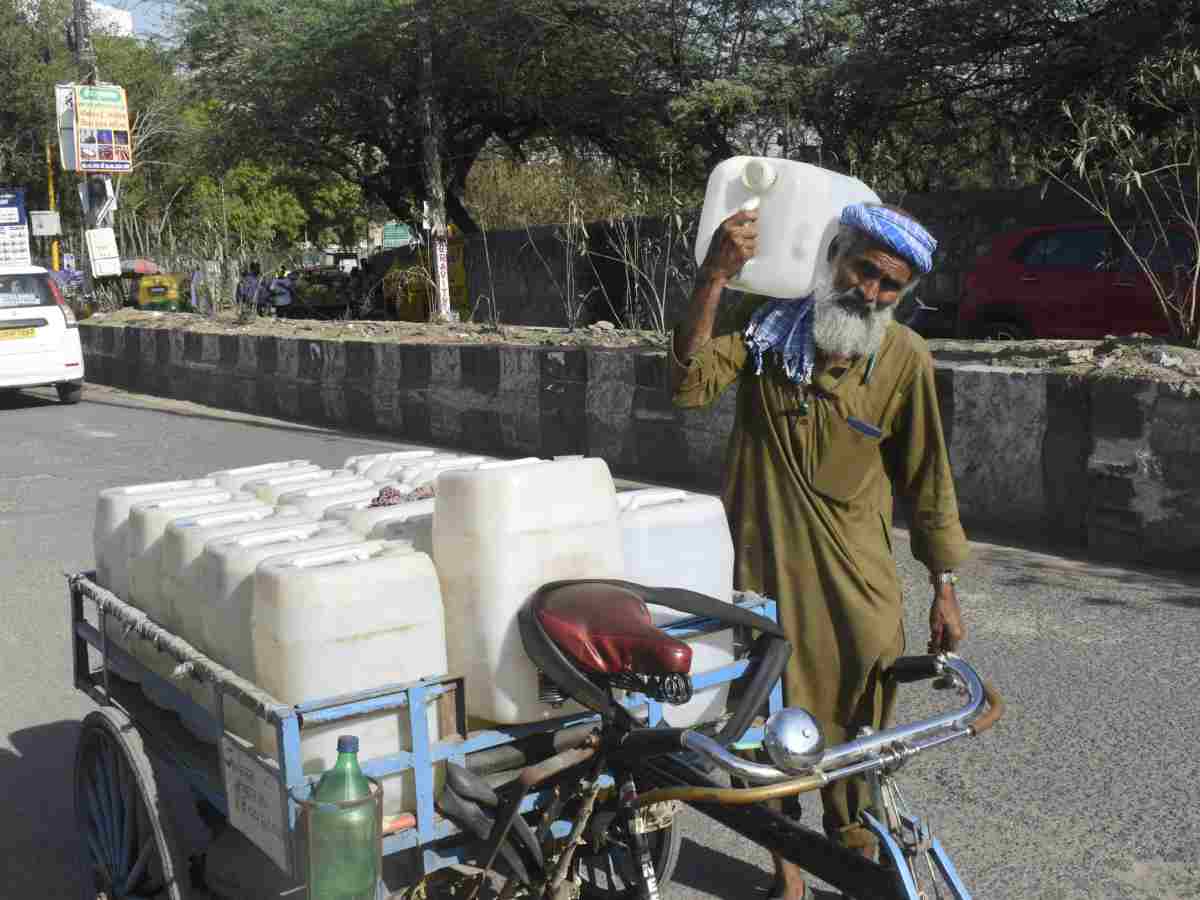
A porter transports water to shops in Delhi’s Okhla as the city faces record-breaking temperatures
As we observe World Health Day under the theme “My health, My right”, thousands of outdoor workers across the national capital — from auto-rickshaw drivers and rickshaw pullers to roadside vendors — are grappling with a growing health crisis due to extreme heat and air pollution.
The India Meteorological Department (IMD) has issued a yellow alert for the city, forecasting a heatwave to persist until Wednesday. Delhi’s maximum temperature settled at 38.2 degrees Celsius, 3.1 degrees above the seasonal average on Sunday. The minimum temperature was 18.5 degrees Celsius, and the Air Quality Index (AQI) remained in the ‘poor’ category at 209.
Highlighting the physical toll of the heatwave, auto-rickshaw driver Santosh Hazra said, “Skin gets burnt during a heatwave; loo also affects health. There’s ample availability of free water in Delhi but there’s a shortage of shaded areas to rest.”
Another auto driver, Prashant Kumar (24), complained of feeling drowsy during the hot season.
“I’ve been working for 8 years now, and summers have always been difficult, as it greatly affects health. We get tired quickly, which limits our working hours. Delhi pollution also impacts us; we can feel it even in summer.”
However, the scorching heat doesn’t only bring physical hardships but also financial distress.
Sarabjeet Singh, 45, who runs a fruit cart near Red Fort, complained of heatwave impacting his income. “Due to the scorching heat, we get tired very easily. It impacts our income. Also, there are no customers from 12 to 4 PM.”
On the other hand, 42-year-old Mohammad Haseem said the compounded effects of heat and humidity reduce work and increase costs. “There’s low income because people don’t step out. We also end up spending money on buying water and lemon juice.”
Highlighting the environmental factors contributing to rising temperatures, environmentalist Bhavreen Kandhari said, “The expansion of concrete landscapes at the expense of tree cover has intensified the urban heat island effect, aggravating temperature to extremes.”
Kandhari suggested that a comprehensive, long-term strategy is needed that includes the protection and expansion of tree cover to enhance biodiversity and sustainable urban planning to mitigate excessive concretisation.
Meanwhile, a report by the NGO Sustainable Futures Collaborative has warned that while cities are taking short-term emergency actions like distributing water and adjusting work hours, long-term heat resilience strategies remain weak or absent. These include occupational cooling, insurance for lost wages, heat mapping of urban hot spots and improving electricity reliability, their recently-released report suggested.
The IMD‘s yellow alert also signals moderate health concerns, particularly for vulnerable groups such as the elderly, infants, and those with chronic conditions.
Thirty-four-year-old Jaspreet Singh, who has been running a food cart in the Red Fort area for 11 years, said, “We are habituated to this heat now, but we witness people fainting now and then due to the weather.”
Narendra Shah, a 70-year-old rickshaw puller, is among the vulnerable populations most affected during heatwaves.
“This time, the weather has become worse very early. I’m the sole breadwinner in the family, and earnings get affected during this time. However, I must mention that there is ample availability of free water across the city,” Shah said.
Medical professionals have also warned that the impact of such heat exposure is often underestimated.
Dr Vivek Nangia, a senior pulmonologist, said, “First, the stage is heat cramps, second is heat exhaustion wherein people could develop dizziness, nausea, vomiting, and stage three is heat stroke, where people land up in hospitals and ICUs. It’s like a medical emergency. The overall impact is dehydration, loss of salt and minerals from the body.”
He added that extreme heat can worsen pre-existing heart, lung or kidney diseases, and, in severe cases, it may lead to confusion, organ failure or even death.
Also Read: Delhi: Anger mounts in Bawana over new Waste-to-Energy plant
Measures that can be taken to avoid heat include staying indoors during peak hours, wearing light-coloured clothing, keeping the head covered and consuming ample fluids.
However, as the income of daily-wage earners depends on street-based work, these measures are difficult to follow.
The Sustainable Futures report also highlighted that many Heat Action Plans (HAPs) rely heavily on directives issued during emergencies by disaster management and health authorities. The long-term institutionalisation of HAPs is weak across cities. Measures such as creating shaded rest areas, rooftop solar panels for cooling and increasing urban green cover are not consistently implemented in the most exposed communities.
Delhi has expanded access to free drinking water in many public areas, but workers say other infrastructure, like shaded zones or cooling shelters, remains scarce.
Delhi inaugurates the 70th National School Games, hosting over 14,000 participants in 14 sports across…
Delhi High Court asked "Doosra" filmmakers to respond to Sourav Ganguly's plea over alleged violation…
Delhi L-G appointed Paralympian Suvarna Raj as State Commissioner for PwDs following her gold win…
DDA is planning Delhi's longest 24-km cycling track along the Yamuna floodplain, linking key eco-projects…
Police detained several anti-SIR protesters heading to the ECI headquarters in Delhi as mass gatherings…
An exhibition that revisits the significance of Indian Modernism through works from earlier and defining…
