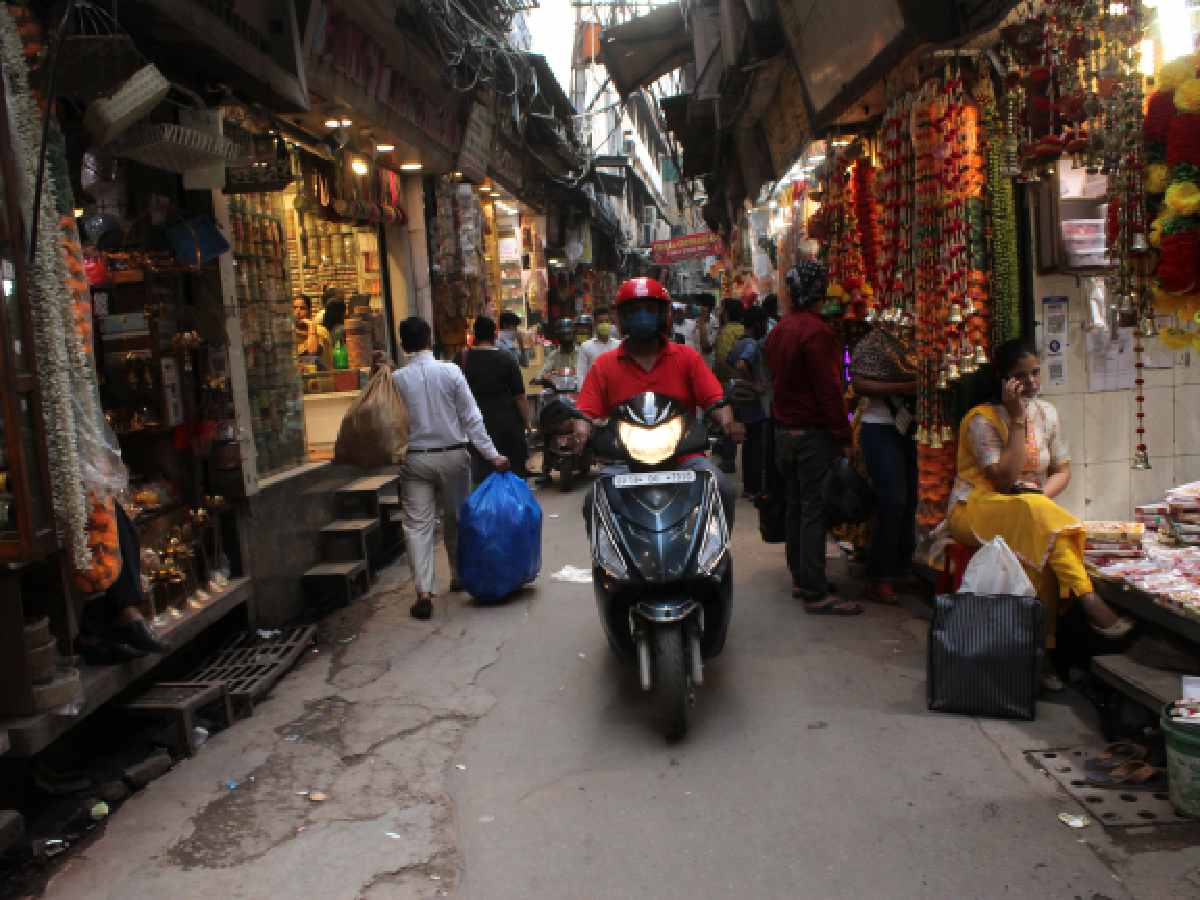
The bustling Chandni Chowk market
The Merchant Discount Rate (MDR) policy on certain UPI transactions above Rs 2,000 has left traders in Delhi considering a return to cash payments, with several saying they cannot afford to absorb another cost or easily recover it from customers.
From October 15, merchants will have to pay a 0.4% MDR on specified person-to-merchant UPI transactions above Rs 2,000. The charge will be capped at Rs 300 for transactions of Rs 75,000 and above.
For traders in markets where customers routinely negotiate over prices, even a small additional cost can become difficult to recover.
The concern is particularly pronounced among traders dealing in electronics, wholesale goods and other products where individual bills frequently cross the Rs 2,000 threshold.
In Kamla Nagar, retailer Shailesh Mathur said they have little room to recover additional transaction costs from customers, particularly in a market where many buyers are students and regularly make small purchases.
He said customers had become accustomed to UPI and often expected merchants to accept digital payments regardless of the size of the transaction.
Mathur said retailers are already dealing with taxes and other operating expenses, making it difficult to absorb another payment-related cost. Asking customers to pay extra, he added, could also drive them towards other shops.
Cash as alternative
New Delhi Traders’ Association general secretary Amit Gupta told Patriot over the phone that the MDR could make cash a more attractive option for traders handling higher-value transactions.
Gupta said traders had embraced UPI because it made payments easier for both businesses and customers, but the additional cost could force them to reconsider how they accepted larger payments.
He said traders were already operating with tight margins and would find it difficult to take on another recurring expense. The association, he added, was not opposed to digital payments but wanted the cost of accepting them to remain manageable for merchants.
Traders’ associations also pointed to the broader cost of digital transactions, saying businesses were already familiar with charges associated with card payments and were concerned that a similar burden could now emerge for UPI.
They said some traders could respond by encouraging customers to use cash, particularly for larger purchases. For business-to-business payments, traders could also consider cheques and other banking channels, they said.
Kamla Nagar Market Association President Nitin Gupta told Patriot that traders and customers had become so accustomed to UPI that returning to cash would not be straightforward.
He said many people now leave home without carrying sufficient cash because they rely on mobile payments for everyday purchases. At the same time, traders could begin encouraging cash transactions if they were required to bear the additional MDR.
Nitin Gupta said traders had already incurred various transaction-related expenses and questioned whether they could continue absorbing new costs while maintaining existing prices.
Existing concerns
Rajat Kapoor, who runs a camera shop, said the impact of the MDR would depend on the volume of UPI transactions handled by a business.
He said a charge that appeared small when applied to a single payment could become a significant expense when multiplied across hundreds of transactions over several months.
Kapoor said this could be particularly difficult for small and medium traders working with limited margins and increasingly dependent on digital payments.
The concern is not limited to general retail. Petrol pump dealers have also raised objections to the MDR on fuel transactions above Rs 2,000.
Under the revised UPI framework, fuel transactions above Rs 2,000 will attract an MDR of Rs 5, while transactions below Rs 2,000 at fuel stations will remain exempt.
The Federation of All India Petroleum Traders has warned that dealers could stop accepting UPI payments above the threshold if the charge is not withdrawn or the sector is exempted. Dealers in Delhi-NCR and several other states have raised similar concerns.
Petroleum dealers have argued that the additional cost could put pressure on their margins. The All India Petroleum Dealers Association has sought a complete exemption for petrol pumps, saying transactions above Rs 2,000 are common and digital payments have become a routine part of fuel purchases.
Cash-only demands
The debate over MDR comes as some Delhi customers say they are already encountering situations where businesses prefer cash.
For Delhi University student Adya Deogharia, the problem arose while travelling in an auto.
“I did not have cash, and the auto driver did not accept UPI. I had to ask another passenger to pay my fare. I then transferred the money to that person online. It was inconvenient because I was relying on UPI, but I had no other option,” she said.
Mohammad Ali, 44, said he faced a similar situation while visiting Jama Masjid with friends for lunch.
“We went to a restaurant for lunch, but the owner said they did not accept online payments. I did not have cash with me. I checked a nearby ATM, but it was not working. I had to leave my friends at the restaurant, take an auto to Chandni Chowk, withdraw cash and then come back to pay the bill,” he said.
“Just think, what bigger problem can there be than this? People are being encouraged to use digital payments, but when you actually need to make a payment, you can still end up running around looking for cash,” Ali said.
In Chandni Chowk, Shailesh Jha said he encountered a different form of cash-versus-UPI pricing while shopping.
“My bill was Rs 3,700. I asked the shopkeeper for a discount, and he agreed to take Rs 3,400 if I paid in cash. But when I said I would pay through UPI, he told me I would have to pay the full Rs 3,700. So there was a clear difference between the cash price and the UPI price,” Jha said.
Digital push vs new cost
The MDR will come into effect after years in which UPI merchant transactions operated under a zero-MDR regime.
The change has therefore created a particular concern among traders who say they spent years adapting their businesses to the government’s push towards digital payments.
At Chawri Bazar, wedding card dealer Kaushal Wasan said the proposed charge could encourage some businesses to rethink their reliance on digital payments.
“It will have a huge impact. If extra charges are introduced, customers may have to pay in cash or withdraw money from an ATM to avoid the charge. It will affect businesses too because people have become used to digital payments. Nowadays, people use UPI even for Rs 10 transactions,” he said.
Wasan said traders had been encouraged to move towards digital payments and questioned the introduction of a cost after customers and businesses had already adapted to the system.
“They promoted digital payments earlier, but now they are levying charges on them. That is not right. It feels like the system is being made free in the beginning and then charges are introduced later,” he said.
Amanpreet Kaur, 38, a Saket resident who runs an online clothing brand, said businesses that operate entirely through digital orders would have little scope to shift to cash.
‘Cash not an option’
“This will have an impact on our business because we do not have a cash option. We receive orders online and payments are also made online. The government needs to reconsider this because it will create a lot of problems for businesses like ours,” she said.
At a petrol pump in Connaught Place, manager Naresh Jain said the proposed charge was difficult to reconcile with the government’s earlier push for digital payments.
“First, the government pushed us towards digital payments through the ‘Digital India’ initiative. Now they are doing this. If we have to start charging or refusing UPI payments for larger transactions, customers will face problems,” he said.
Under the revised framework, payments between individuals are outside the charge, while merchant transactions up to Rs 2,000 will continue without the MDR.
Eligible small merchants receiving up to Rs 1 lakh a month through UPI QR codes will also remain exempt under the specified category.
Also Read: What November 1 means to Delhi
The MDR cannot be passed on to customers. The Finance Ministry has advised banks to ensure that merchants do not recover the charge from buyers, while UPI application providers have been prohibited from imposing platform fees or hidden charges.
The government has said the new framework is intended to support costs associated with maintaining digital payment infrastructure.
For Delhi traders, the issue is therefore not simply whether they prefer cash or digital payments.
They have already built their businesses around UPI, with customers increasingly expecting to pay through their phones rather than carry cash.
But with the proposed MDR applying to transactions above Rs 2,000, traders say they will have to reassess how they handle larger payments.
Some may continue accepting UPI and absorb the cost, while others could encourage cash or alternative banking channels.
The proposed change, traders said, has put them in an unusual position: after years of adapting to a digital payments economy, they are now considering whether some transactions may have to move back towards cash.
Supreme Court advocate Abhishek Pawar alleges women were denied washroom access for seven to eight…
Each day of closure costs shops in Khan Market and Connaught Place between Rs 60,000…
Delhi generates nearly 15,000 tonnes of waste daily, prompting the government to deploy 1,000 mechanical…
Delhi Police has issued an NOC for the Congress rally at Ramlila Maidan on November…
CJP chief Abhijeet Dipke received conditional bail following his arrest for participating in a Connaught…
The DPCC has floated ₹104 crore tenders to test pilot pollution-control technologies across 40 key…

