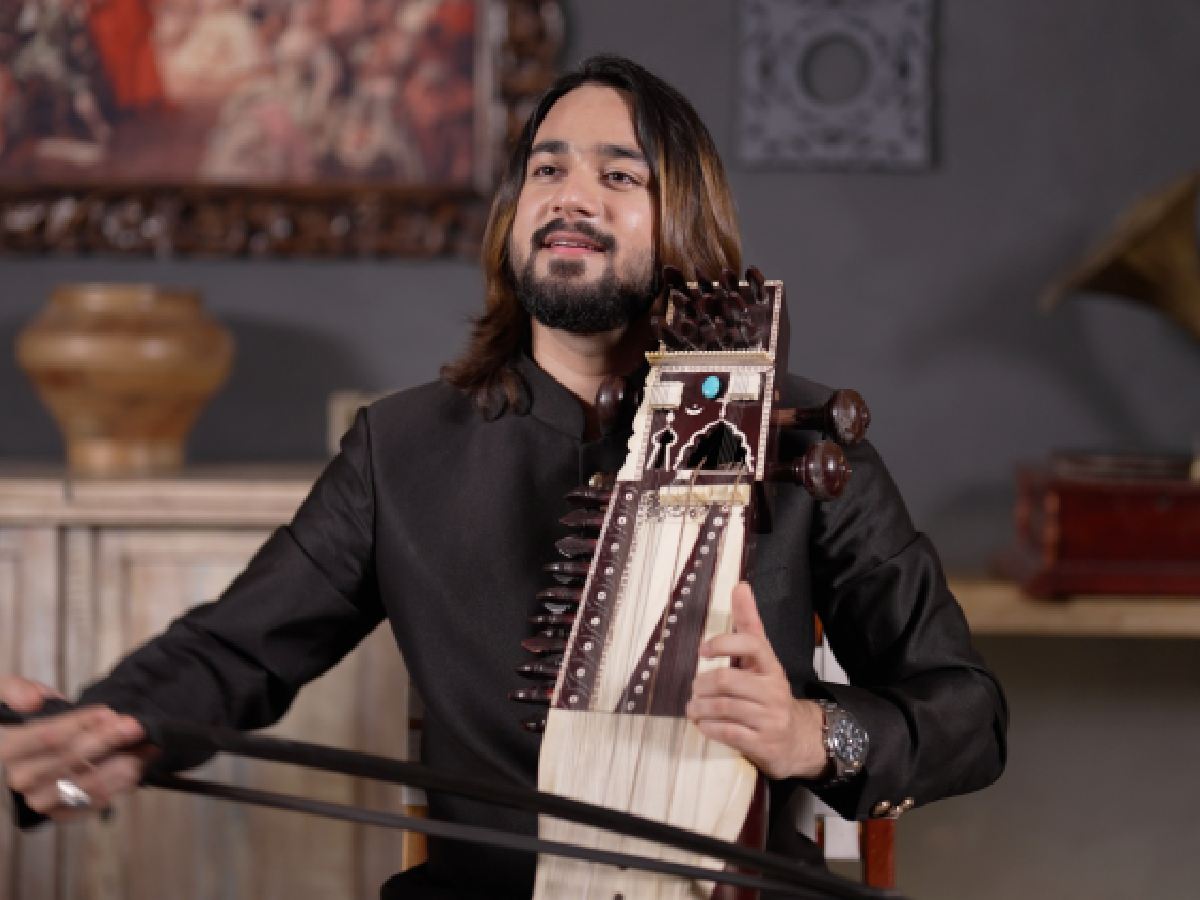
For Nabeel Khan, music was never merely a profession waiting to be discovered. It was the atmosphere he was born into. In a home in Delhi where the sounds of Sarangi, Tabla, Tanpura, Sitar, and Hindustani classical music echoed through every room, the young musician grew up surrounded by generations of artistry and discipline.
Today, at 26, the Delhi-born Sarangi player has emerged as one of the most recognisable young faces of Indian classical instrumental music globally. From intimate classical baithaks in Delhi to large international festivals, from Candlelight Concerts in Dubai to a Times Square billboard in New York City, Khan’s journey reflects both inheritance and reinvention.
“I was born into a distinguished Sarangi lineage that traces back nearly 400 years to the Mughal era and the tradition of Miyan Tansen,” Khan told Patriot in an interview. “Growing up in such a musical family in Delhi is truly a blessing.”
An eighth-generation Sarangi artist of the Moradabad Sainia Gharana, Khan began learning music at the age of seven under the guidance of his grandfather, legendary Padma Bhushan awardee Ustad Sabri Khan, at their ancestral home in Delhi. He later continued training under his father, Ustad Nasir Khan, and uncle, Ustad Kamal Sabri.
Drawn to rhythm
But before the Sarangi became his identity, rhythm first captivated him.
“Ever since I was a child in Delhi, I dreamt of becoming either a cricketer or a Tabla player,” he recalled. “I was deeply inspired by Zakir Hussain from the age of six. His artistry and emotional connection with rhythm fascinated me.”
Yet the Sarangi eventually became inseparable from his life.
“Over time, I realised that I did not choose the Sarangi. The Sarangi chose me,” he said.
For Khan, the instrument carries a personality of its own.
“I truly believe the Sarangi is not an instrument you can simply decide to play. You can only play it when the Sarangi accepts you,” he explained. “For me, the Sarangi is like a queen — the queen of Indian classical instruments. It demands care, sensitivity, patience, and complete surrender.”
Inheriting a legacy
At the centre of Khan’s musical foundation stands his grandfather, Ustad Sabri Khan, one of the greatest Sarangi maestros of the modern era.
“I feel extremely blessed that I trained under my grandfather for almost nine years in Delhi,” he said. “One of the most emotional things for me is that I started learning on the same small Sarangi on which he himself had begun learning — a nearly 200-year-old family instrument.”
The first raag he learnt was Bhairav, a memory he still carries with reverence.
“He personally placed my fingers on the Sarangi and guided me through it,” Khan recalled.
But the lessons extended far beyond technique.
“Even after becoming a Padma Bhushan awardee and being called ‘Sarangi Samrat’ around the world, he remained humble and grounded,” Khan said. “He always taught us that before becoming a great artist, one must become a good human being.”
The young musician remembers spending long periods caring for his grandfather during his later years in Delhi, listening to stories and teachings that now shape his artistic philosophy.
“Whenever I perform today, I carry his aesthetics, his teachings, and his blessings with me,” he said.
Delhi to the world
Khan studied at Universal Public School in Delhi and later graduated from the University of Delhi’s Zakir Husain College in 2021. Alongside academics, music remained central to his life.
His early performances in Delhi included concerts at Kamani Auditorium, Little Theatre Group, and SPIC MACAY events.
“Delhi gave me my first stage, my first audience, and my first confidence as a performer,” he said.
Over the past decade, Khan has steadily taken the Sarangi into spaces where Indian classical instrumental music is rarely heard. He has performed across Europe, the United Kingdom, West Asia, the United States, and South Asia, introducing the instrument to audiences unfamiliar with its sound and emotional depth.
“I’ve always wanted to take the Sarangi from Delhi to a global stage, especially in places where it is not widely known,” he said.
West Asia, particularly the UAE, became one of the defining regions in his journey. Khan became the first Sarangi player to receive the UAE Golden Visa under the talent category, and he has frequently performed at large-scale cultural events across Dubai and Abu Dhabi.
International audiences, he feels, often engage with Indian instrumental music differently.
“I’ve noticed that audiences abroad show great patience and deep interest in long forms like the alap,” he said. “Instrumental music often receives more recognition there, whereas in India, vocal music still dominates.”
That imbalance is something he hopes to gradually change.
“My aim is to establish the Sarangi as a strong solo concert instrument in India as well, similar to how the violin, cello, or piano are respected globally,” he said.
Times Square moment
One of the defining moments in Khan’s career came in April 2026, when he became the first Sarangi artist to feature on a Times Square billboard in New York City.
“When this moment came, I was overwhelmed with happiness,” he said. “It felt like the result of years of hard work, sacrifice, and belief in a dream that once felt far away.”
Seeing the Sarangi displayed in one of the world’s most visible public spaces carried symbolic importance beyond personal recognition.
“For many people who had never seen or heard the Sarangi before, this became an introduction to its sound, emotion, and heritage,” he said. “Millions of people passed by and connected with something deeply rooted in India’s musical tradition.”
Khan sees the moment as part of a larger cultural shift.
“I truly believe it reflects a growing global curiosity towards Indian classical music,” he said. “If even a few young musicians feel inspired to explore the Sarangi after seeing that, then that is the real achievement.”
Adapting to new platforms
While deeply rooted in classical training, Khan has consciously embraced newer performance spaces and formats. He has performed at digital art venues, Candlelight Concerts, large-scale fusion events, and international festivals alongside traditional classical concerts.
“For me, it is never about the size of the platform. It is always about the connection with the audience,” he said.
Khan believes adaptability is essential for contemporary classical musicians.
“I am a classical musician at heart, but I also see myself as an entertainer,” he explained. “Every audience is different. Sometimes I perform for pure classical listeners, sometimes for younger audiences, and sometimes for mixed global crowds.”
Whether performing Indian classical music, Sufi music, qawwali, Bollywood, or fusion, he said his classical foundation remains constant.
“Indian classical music is the root of all music. That’s what I believe,” he said. “Because my roots belong to classical music, it becomes easier for me to adapt to other genres without losing my identity.”
Healing through music
Alongside performance, Khan has also been working on Sarangi healing sessions centred on the emotional and meditative power of raagas.
“Music is not just entertainment. It is medicine for the mind and soul,” he said.
Years of classical training in Delhi, he believes, shaped his emotional resilience as much as his artistry.
“Classical music gave me patience, discipline, emotional stability, and inner peace,” he reflected.
He often encourages children to begin learning music at an early age.
“When music becomes part of your growth from childhood, it shapes your personality and emotional depth beautifully,” he said.
For Khan, the healing power of music exists beyond scientific explanation.
“Music is energy,” he said. “And that energy can heal, transform, and uplift human life.”
Carrying the weight of legacy
Belonging to a centuries-old gharana naturally brings expectations, but Khan said he no longer sees that as pressure.
“Earlier, I did feel the weight of expectations,” he admitted. “But now I see it as a blessed responsibility rather than a burden.”
Whenever he performs, he said he feels accompanied by generations before him.
“I don’t feel separated from my lineage. I feel as if my entire legacy is performing with me.”
He credited both his parents for shaping his discipline.
“My father introduced me to this art form, and my mother ensured I practised every day,” he said.
Looking back, Khan remembers moments during childhood in Delhi when he questioned why his life was so different from that of his friends.
“I used to wonder why I was learning Sarangi while others were playing games and enjoying a normal childhood,” he said.
The turning point came after his performances in Russia and Europe in 2015.
“That’s when I realised I was walking a very different and meaningful path,” he said. “Slowly, I understood that Sarangi was not just something I was learning. It was something that chose me.”
A larger dream
Khan’s ambitions today extend far beyond personal acclaim.
“My dream is for the Sarangi to stand confidently on the global stage as one of the world’s great classical instruments,” he said.
He hopes to expand the instrument’s presence through collaborations, digital platforms, education, and large-scale performances while preserving the soul of the tradition.
“I want someone sitting in New York, Paris, Tokyo, Dubai, or Delhi to feel emotionally connected through the sound of the Sarangi,” he said.
He also dreams of collaborating with global musicians like Hans Zimmer and Coldplay, while performing at venues such as Madison Square Garden and the Royal Albert Hall.
“I want to be remembered as someone who pioneered the Sarangi across the world,” he said.
A $780 million market built on pavements, where the pleasure of reading meets the price…
Supreme Court advocate Abhishek Pawar alleges women were denied washroom access for seven to eight…
Each day of closure costs shops in Khan Market and Connaught Place between Rs 60,000…
Delhi generates nearly 15,000 tonnes of waste daily, prompting the government to deploy 1,000 mechanical…
Delhi Police has issued an NOC for the Congress rally at Ramlila Maidan on November…
CJP chief Abhijeet Dipke received conditional bail following his arrest for participating in a Connaught…

