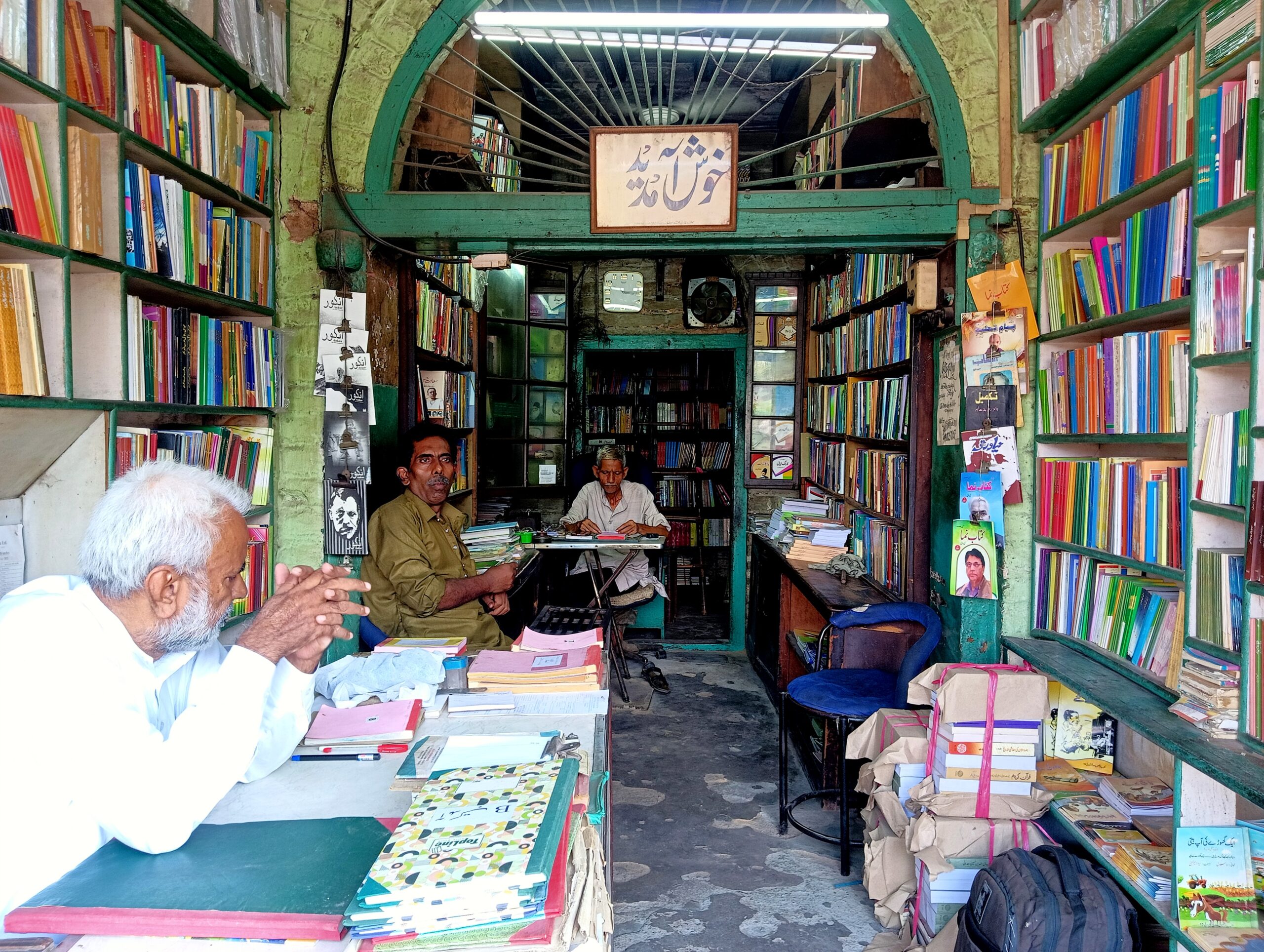
EMBRACING THE CHANGE: Ali Khusrow Zaidi, shopkeeper at Maktaba-e-Jamia on a regular day (All photos: Ali Fraz Rezvi)
Walking through the bylanes of Jama Masjid in the walled city of Delhi, one is quite familiar with the term — Urdu Bazaar. In a lane with multiple hotels, restaurants, guest houses, garment stores, makeshift stalls and several trolleys selling ‘sharbat-e-mohabbat, the name Urdu Bazaar becomes irrelevant for the visitors.
There were hundreds of bookstores, selling pieces of Urdu literature in multiple forms in the Urdu Bazaar. As time passed, most of these bookstores were replaced by big and small hotels while others were forced to shut down as the conditions turned unfavourable. A lot of these stores took a shift from Urdu literature to religious texts for their survival and a few were left to struggle with time.
“The religious texts were much profitable for the businessmen as compared to the books of Urdu literature with their prices starting from a mere amount of Rs 8-10 till date”, told Ali Khusrow Zaidi sitting in the oldest surviving memoirs of the Urdu Bazaar — Maktaba-e-Jamia.
In a conversation with the Patriot, he said that there was a time when the whole lane was filled with bookstores in a row. “Most of the bookstores have now been shifted to other locations while others were closed by their owners citing a huge loss.”
“One of the most important and famous bookstores, ‘Kutubkhana-e-Azeezia’ was closed a few years ago”, said Zaidi as he pointed out at a kebab shop that stands in its place. Zaidi continued, “There were several publications and bookstores, such as Ilmi Kutubkhana, Kutubkhana Hameedia, Kutubkhana Nazeeria, Lajpat Khan & Sons, which have been closed for a long time, while a few such as Zulfiqar Book Depot, Kutubkhana Anjuman Taraqqi-e-Urdu and Maktaba-e-Jamia are a few of the still surviving bookstores in the Urdu Bazaar.”
Urdu Bazaar traces its origin back to the Mughal Era, when it started at Chandni Chowk and ended in front of Jama Masjid. The actual market was destroyed in an aftermath of the rebellion of 1857. Mirza Ghalib, who is one of the legends of Urdu and Persian literature, had lamented about the destruction of Urdu Bazaar. He used to say that the British hadn’t just destroyed the Bazaar but the language as well.
Mohammad Alauddin, who is now the owner of Zulfiqar Book Depot, after the death of his son-in-law, told the Patriot that he has nothing to do with Urdu. “The shop now deals only in religious books and provides ticketing services for buses, flights and railways”, he said.
The other smaller bookstores have opted for the same pattern. “Jama Masjid is a major tourist destination, and thus the money changers and ticketing agents are in high demand”, said Alauddin. “This is what pays the bills”, he concluded.
Another surviving bookstore in the same lane is ‘Kutubkhana Anjuman Taraqqi-e-Urdu’. “Abba (Nizamuddin) who was the owner of this bookstore is no more”, said Naimuddin who is managing the bookstore along with his brothers. This bookstore, as the name suggests, belongs to Anjuman Taraqqi-e-Urdu (Hind) and was established by Sir Syed Ahmad Khan in order to protect and propagate Urdu in 1886 with the help of Nawab Mohsin-ul-Mulk. “Those were the days when the tussle between Hindi and Urdu was at its peak”, Naimuddin told the Patriot.
“This bookstore isn’t just a representative of the Urdu Bazaar, but of a long struggle to protect Urdu from eradication”, said an old man sitting inside the shop.
It is apt to say that, ‘Maktaba-e-Jamia’ and ‘Kutubkhana Anjuman Taraqqi-e-Urdu’ are the sole survivors as the bookstores, still dealing in Urdu literature.
Zaidi, who has been sitting at Maktaba-e-Jamia for the past 44 years, is of the opinion that change is a matter of fact. “There was a time when all the notable poets and writers of the city used to visit this bookstore. The situation isn’t the same but there are professors and teachers from Zakir Husain Delhi College and Jamia Millia Islamia who are still frequent in the bookstore.”
He strongly believes that Urdu is not a dying language, but is infact murdered by those who believe the same. “Once the famous poet Malikzada Manzoor was sitting at my shop and said that Urdu has now turned into a dead language”, he told the Patriot. Zaidi said that he was a young chap in those days and thus became furious. “I told him that it’s you and your ilks who have been trying to kill this language. Neither you nor any of your children have ever bought a book, and you’re here crying as if Urdu is on its deathbed”, told Zaidi.
“I told him that writing a few ghazals isn’t of any help, in case you believe that you have served the language by doing this”, finished Zaidi with a spark in his eyes.
“No matter whoever is in the government and whatever jealousy he has with Urdu, he has never stopped someone from reading it”, he shared his opinion when asked about the people responsible for Urdu’s decline. “It is you and me who have parted ways with Urdu. He believes that Urdu speakers are themselves responsible for Urdu’s worsening conditions. “We have stopped passing on the legacy that has been passed on to us”, he concluded.
Zaidi emphasized, “Urdu is a language of charm and love. God forbid, even if the last of these bookstores fail to survive, Urdu will remain alive until there’s love in this world. Urdu is struggling to survive, even in a city where it blossomed and bloomed. It is important to recognize the culprits, but it is a must to play our part in its conservation rather than passing on the blame.”
Send comments to feedback@thepatriot.in
For more stories that cover the ongoings of Delhi NCR, follow us on:
Instagram: https://www.instagram.com/thepatriot_in/
Twitter: https://twitter.com/Patriot_Delhi
Facebook: https://www.facebook.com/Thepatriotnewsindia
At least 50 cases have already been reported this month; NCPCR guidelines mandate help desks,…
DMRC says zero reduction in train trips, attributes decline to security measures and public apprehension…
A Delhi court denied bail to a former DU professor accused of raping a student,…
Delhi Police charged seven dhaba workers in the fatal beating of a Manipuri musician who…
Seven Delhi STPs failed DPCC standards in September, dumping high levels of faecal coliform and…
AISA chief Neha Bora petitioned the Delhi HC against a police notice requiring a peace…



