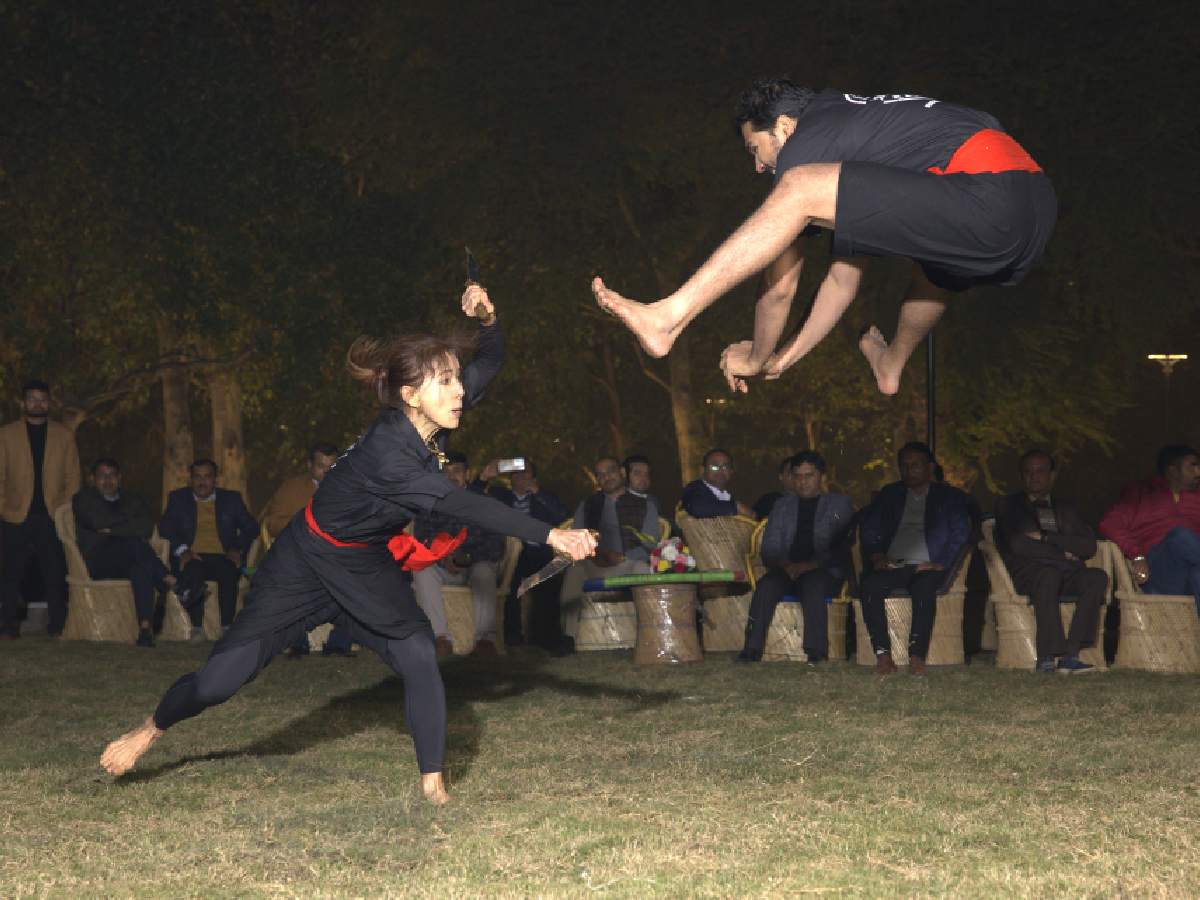
“Yato hastaḥ tato drshtih; Yato drshtih tato manah…” — where the hand goes, the eyes follow. Where the eyes go, the mind follows. This Sanskrit shloka resonates deeply with every Kalarippayattu enthusiast.
Believed to have been founded by Lord Parashurama over 3,000 years ago in Kerala, Kalarippayattu (Kalari) is more than a martial art; it is a sacred practice rooted in divine energy and spiritual discipline, earning it the title ‘Mother of Martial Arts’. Recognised by Indian and international bodies such as the Ministry of Youth Affairs and Sports (Government of India), School Games Federation of India, Khelo India Youth Games, and UNESCO’s Intangible Cultural Heritage list, Kalarippayattu has spread globally and is now acknowledged as a legitimate national-level sport. It is also said to have influenced various other fighting styles, including Shaolin Kung Fu, Muay Thai, and Kendo.
The Delhi scene
Over decades, transcending regional boundaries within India, especially in Delhi-NCR, Kalarippayattu is witnessing a quiet yet powerful revival. Recognised by the Indian Council for Cultural Relations (ICCR), Kalari Kendram Delhi is among the first and most actively functioning gurukuls in the Capital, teaching this native warfare in its most authentic form.
Amulya Chintakana has been learning Kalarippayattu online for the past year and recently joined offline classes — a sign of the growing interest this martial art has garnered.
Upon entering the Kendram, one sees a traditional kalari (training ground) facing east, surrounded by lush greenery. The Bhadrakali deity, or in some cases a Shivling, is placed southwest on a seven-tiered platform called the Poothara, representing the seven chakras — the wheels of energy in the human body. This also symbolises the seven stages to attain neutrality.
To the right are three pillars called Tharas: Naga Thara, Ganapati Thara, and Guru Thara. At the extreme right stands the deity Veerbhadra, while adjacent to the Poothara are two other goddesses. The central space is believed to resonate with the energy of Lord Hanuman. Students begin their day by worshipping the deities and seeking blessings from their gurukkal (guru/asan).
Also read: How Nikhil Kumar Gupta helped build India’s wheelchair rugby movement
Growing interest
Kalarippayattu has become a subject of deep interest among Delhi’s diverse population, with people from different walks of life eager to learn this ancient Kerala art, now recognised as an important part of India’s heritage. What started with no students has now grown to hundreds training at Kalari Kendram and other centres.
Kailash Nath, a Delhi-based engineer, continues his practice at Kalari Kendram and now trains junior students, drawing on his experience. In Kalarippayattu, a senior or teacher is called a munkol, and a junior or student a pinkol.
“We teach using the original Malayalam script of Kalarippayattu commands to guide the students. Through these commands, students must follow the rhythm of the combat. They must reach a stage where they can catch the rhythm,” said Nath.
The commands are translated into Hindi for non-Malayali students to understand and follow smoothly. While beginners may struggle initially, with practice, they learn to move fluidly, like water, through the sequences.
Besides warfare, Kalarippayattu also serves as a mechanism for self-defence and performance. “I chose to practise Kalarippayattu because it involves physical activity and is a great form of self-defence,” said Shrishti Jaiswal (name changed), a Delhi-based enthusiast who has been training for the past one and a half years.
The gurukkal behind the movement
Shinto Matthew, a renowned veteran Kalarippayattu master and founder of Kalari Kendram Delhi, is the gurukkal (teacher) to many aspiring practitioners at the Kendram. He holds a Government of India fellowship in Kalarippayattu and is a sessional professor at Ashoka University.
Fluent in both Northern (Vadakkan) and Southern (Thekkan) styles, Matthew has represented Kalarippayattu at numerous national and international platforms, including the United States, Israel, China, Indonesia, South Korea, and Palestine. In 2024, he was felicitated with the ‘Best in Kalarippayattu and Revival’ Action Hero Fitness Award by actor Vidyut Jammwal.
In addition to daily classes for all age groups — from five-year-olds to adults in their fifties, and from Indians to foreigners — Kalari Kendram Delhi also runs Kalari Marma Chikitsa, an ancient system of musculoskeletal and orthopaedic treatment based on Ayurvedic principles. This therapy targets marma (vital points) to relieve pain and balance body energy.
Women take the lead
Commenting on women’s participation, Gurukkal Shinto said, “There is equal participation of both men and women. In fact, I believe women outnumber men. Parents are more focused on training their daughters.”
Kajal Srivastava, a senior student, shared how Kalarippayattu changed her life. “I was a UPSC aspirant. After eight years of failed attempts, I fell into depression. One day, a question on Kalarippayattu in a paper piqued my interest. I joined the Kendram, and within three months, I reversed my thyroid and PCOD without any medicine. It healed me physically and emotionally. That’s when I realised Kalarippayattu is my ikigai.”
Four stages of training
Authentic Kalarippayattu training involves four sequential stages:
Meipayattu (body training): The foundational stage builds strength, flexibility, balance, and agility through stretches, jumps, and basic movement sequences.
Kolthari (wooden weapons): Students train with wooden weapons like long staffs, learning to attack, defend, and develop timing and coordination.
Angathari (metal weapons): The third stage introduces real weapons such as swords, shields, spears, and knives. This phase requires precision and control.
Verumkai (empty-hand techniques): The final stage focuses on unarmed combat — kicks, punches, grappling, throws, joint locks, and marma point techniques.
“Kalarippayattu starts with unarmed training, moves to weapons, and ends with empty-hand combat — making one fully aware, balanced, and in control,” explained Nath.
Speaking to Patriot, Gurukkal Matthew stressed the importance of following the proper training sequence. “If a child hasn’t completed the earlier stages and we hand them an urumi (a flexible sword), it can lead to fatal consequences. A small mistake can cost someone an eye or cause serious injury,” he said.
Also read: Women wrestlers’ recent good show raises hopes for 2028 Olympic Games
Currently, national sports guidelines do not necessarily mandate stage-wise training for tournament participation. Matthew believes this gap makes it even more essential to advocate for authentic learning methods.
“Kalarippayattu is a divine creation — meant to strengthen and uplift humanity,” he said. Kalari Kendram has also established a branch in Kerala, Kalari Kendram Ashramam/Gurukulam, with plans to launch a residential training programme for students from across the world.
From showcasing Kalari combats globally to establishing one of Delhi’s first fully functional Kalari centres, Gurukkal Shinto Matthew has played a vital role in reviving this traditional art form in a region few imagined it could flourish.
When he first conceived the idea of transplanting Kalarippayattu to North India, his student Kajal recalled, “Everybody used to tell him that it was absolutely impossible to bring an art of Kerala, with the language of Malayalam, to North India. People really challenged him. But I think we owe it to him and his passion that Kalarippayattu has sustained in its most authentic manner in North India.”
After 12 years in theatre, the actor makes his international film debut with a role…
Protester alleges Delhi Police assaulted detainees, deleted phone videos, and detained minors during anti-CEC protest…
Shifting protests away from Jantar Mantar weakens democratic visibility and access to political power, an…
CM Rekha Gupta defends SIR and EC integrity, saying democracy can't be held hostage to…
AISA students march to Supreme Court over 'vote chori' claims against CEC, as police barricade…
DMRC extends closure of six central Delhi metro station gates until 5 pm citing security…
