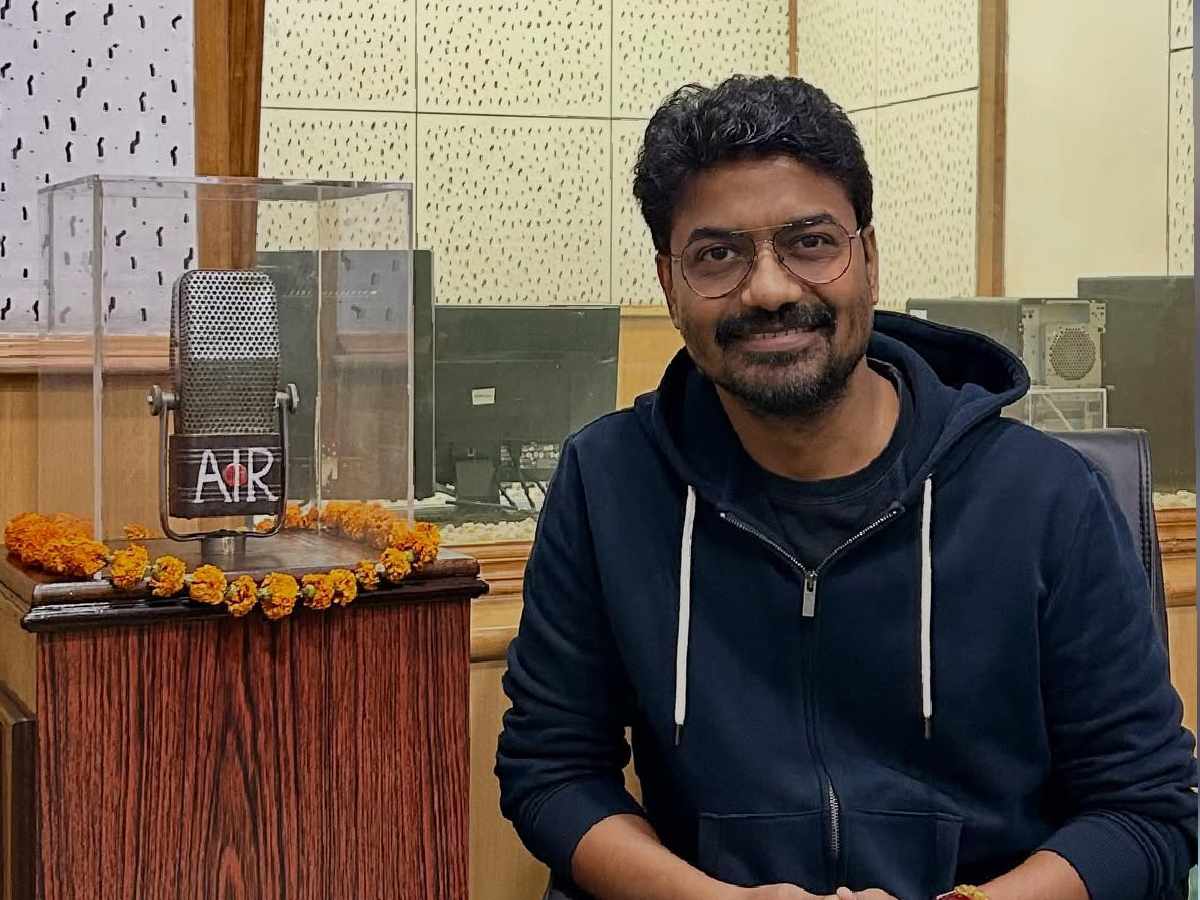
Vikas Kumar
Vikas Kumar has spent over two decades learning how to listen — to text, to breathe, to silences and to people. The skill has been shaped as much by theatre rehearsals in Delhi as by years of working on television sets, film locations and now an audio-only digital platform called Velvet, which he co-founded.
“In visual media, the creative work has already been done for you. You’re told what to see,” Kumar says. “With audio, the listener becomes a creator.”
For Kumar, this idea is rooted in lived experience. Some of the most enduring stories of Indian life, he says, do not come from cinema but from bedtime tales narrated by grandparents, from qisse-kahaaniyan shared during family gatherings, or from people sitting around a fire in villages, simply talking. “Those stories stay with you because you built them in your own head.”
India, he says, has long been a culture shaped by listening. Its epics — Ramayana and Mahabharata — travelled orally across generations, not as spectacle but as shared imagination. Cinema, Kumar admits, can create scale, but audio restores intimacy. “When you listen, the story unfolds inside you. Your own memories, fears and experiences complete it.”
Velvet, he says, comes from this belief — not as nostalgia, but as a contemporary space for immersive, cinematic sound.
From actor to entrepreneur
Kumar’s move into entrepreneurship has altered how he thinks about storytelling. As an actor, he explains, one often inhabits a single story for months or even years, only for it to reach an audience much later. When Velvet was conceived, the response was immediate.
“I shared just one Facebook post and more than a hundred writers and actors got in touch,” he recalls. “That’s when I realised there is no shortage of stories at all.”
Stories exist everywhere — in cities and villages, among farmers, taxi drivers and teenagers. Velvet, Kumar says, creates access: for storytellers to be heard and for listeners to encounter voices they may never come across otherwise. While the platform has listeners outside India, its stories remain rooted in Indian experiences. “A farmer in Bihar or a taxi driver in Mumbai has an inner world that is instantly recognisable anywhere in the world.”
Roots and rupture
Born in Nalanda, Bihar, Kumar grew up in an environment where becoming a doctor was considered the natural path. His father was a respected surgeon, and Kumar himself showed an aptitude for science. “In Nalanda, there’s a doctor in almost every gully,” he says.
The shift came after he completed Class 12. Watching actors such as Aditya Srivastava, Manoj Bajpayee and Shah Rukh Khan sparked a desire to pursue acting. Learning that Bajpayee and Khan had trained under theatre teacher Barry John prompted Kumar to enrol in one of John’s workshops — a decision he later recognised as pivotal.
By his own admission, Kumar was shy. Acting, he says, allowed him to step outside himself, even if briefly. “There’s a contradiction there,” he admits. “It’s hard to overcome shyness, but I seem to enjoy the process.”
He completed an MBA and even secured a job offer, which he declined. The decision, he says, was partly to reassure his parents, his girlfriend (now his wife), and himself that he had a safety net. Ultimately, however, he found the performing arts more truthful.
Delhi as education
If Nalanda shaped Kumar’s beginnings, Delhi shaped his adult life. He spent his early years in the capital doing theatre, watching films, slipping into international film festivals and encountering diverse cultures. “A lot of the learning that usually happens in college happened for me on the streets of Delhi,” he says.
Also Read: Shammi Narang: The voice that shaped Indian television — and still guides the city
Living alone for the first time, he travelled on buses, returned to Patna on overcrowded trains during Holi, walked long distances to save money and experienced both scarcity and privilege. “It was neither home nor a hostel,” he says. “I was living on my own for the first time.”
Delhi’s cultural layering left a deep impression. In a single day, Kumar recalls, he could listen to Urdu poetry, negotiate in street Hindi and rehearse for an English-language play. “Voices overlap. Contradictions coexist. You learn to listen more than you speak.”
That sensibility, he says, shapes Velvet’s approach, where dialects, silences and emotional textures are allowed to exist without being flattened or over-polished.
Lessons from theatre
Theatre taught Kumar discipline and attentiveness — lessons that continue to guide his work on screen. Showing up on time, knowing one’s lines and respecting the process, he believes, are essential. More than anything, theatre teaches actors to listen.
“On stage, there’s nowhere to hide,” he says. “If you fake a moment, the audience knows. If you stop listening to your co-actor, the scene collapses.”
Training under Barry John and later working with theatre director Aamir Raza Husain and actor-director Virat Husain shaped this approach. Even on camera, Kumar says he listens for breath, pauses and what remains unsaid.
A night to remember
A defining moment in Kumar’s early career came on May 1, 2004. The cast of the stage production The Legend of Ram – Prince of India was scheduled to perform for then President APJ Abdul Kalam in the Mehrauli area of Delhi. Heavy rain flooded the outdoor venue, and a power cut plunged the performance into darkness.
“The President sat there patiently in the dark while we scrambled to fix things,” Kumar recalls. The show eventually continued for nearly three hours. Afterwards, Dr Kalam felicitated the cast and sanctioned a Rashtrapati Bhawan-sponsored performance for underprivileged children.
“That recognition felt earned,” Kumar says. A photograph with Dr Kalam, he adds, remains a personal keepsake.
Television fame
Television brought Kumar widespread recognition through his role as Senior Inspector Rajat in the long-running television series CID. Though his time on the show was brief, its reach was significant. He continues to be recognised for the role, particularly in small towns and villages.
“With television, you enter people’s homes almost every day,” he says. “Over time, viewers stop seeing you as an actor and start seeing you as someone familiar.”
Beyond the uniform
Kumar has portrayed several law-enforcement officers, but he says he approaches the person, not the uniform. Each character, he explains, carries a distinct past, fear and moral pressure.
This philosophy shaped his portrayal of ACP Younus Khan in the crime drama series Aarya. Over three seasons, the character shifted between restraint, vulnerability and aggression, reflecting personal and professional turmoil.
From the outset, Kumar avoided exaggeration. “He could just as easily have been a diligent IT professional,” he says. Costuming choices such as spectacles and sweaters, and the decision not to sensationalise the character’s sexuality, were deliberate. “It was simply part of who he was.”
Working opposite actor Sushmita Sen across three seasons kept the confrontations dynamic, though Kumar says the first season remains closest to his heart.
Language as identity
As a dialogue and dialect coach, Kumar believes language is often underestimated. Accent, rhythm and pauses, he says, reveal background and psychology. “Language isn’t decoration; it’s behaviour.”
Actors such as Kate Winslet, who begin character work with dialect, illustrate how language can differentiate one role from another.
Producing and believing
Along with childhood friend Sharib Khan, Kumar founded Khan & Kumar Media to produce personal stories. Their first project, the feature film Sonsi, directed by Savita Singh and based on her childhood experiences, reflected that intent.
The film went on to win a National Award and qualified for Oscar consideration, reaffirming Kumar’s belief in backing intimate, truthful voices. Subsequent projects, including the film Songs of Forgotten Trees, which received recognition at the Venice Film Festival, further strengthened that confidence.
Changing landscapes
Kumar believes Indian storytelling is gradually shifting away from star-driven narratives towards story-led ones. Audiences, he says, are more open to moral ambiguity. At the same time, screen fatigue is drawing listeners back to audio.
Velvet continues to expand, introducing formats such as Bedtime Stories and VelveTeens, a section written and narrated by teenagers.
Balancing acting, coaching, producing and entrepreneurship remains demanding, particularly alongside family life. Technology keeps work constantly accessible, Kumar admits, and learning to disconnect is ongoing. His wife, Raavi, is closely involved in parts of his work.
Looking ahead, Kumar remains open to new collaborations. Velvet is growing, and he is waiting for a challenging acting role. “It’s been a while since the series Kaala Paani,” he says.
For someone who has spent a lifetime listening, the next story, it seems, is already taking shape.
Elected to the Delhi Golf Club general committee, Mansher Singh says he wants to build…
A $780 million market built on pavements, where the pleasure of reading meets the price…
Supreme Court advocate Abhishek Pawar alleges women were denied washroom access for seven to eight…
Each day of closure costs shops in Khan Market and Connaught Place between Rs 60,000…
Delhi generates nearly 15,000 tonnes of waste daily, prompting the government to deploy 1,000 mechanical…
Delhi Police has issued an NOC for the Congress rally at Ramlila Maidan on November…
