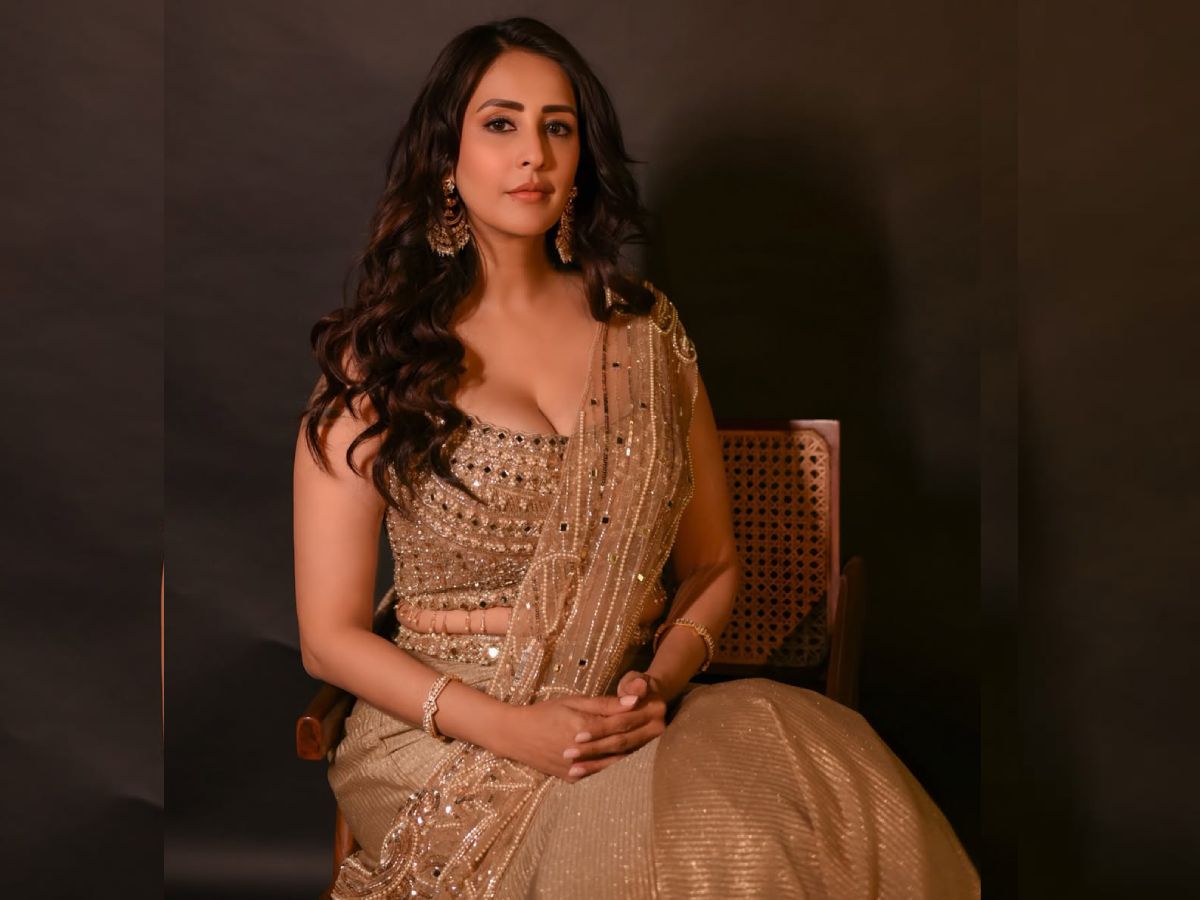
Chahatt Khanna
In an industry where visibility often masks vulnerability, Chahatt Khanna’s journey stands as a study in resilience, reinvention, and quiet strength. From entering the world of acting as a teenager to navigating personal upheavals in the public eye, her trajectory reflects not just survival, but evolution.
Born and raised in Mumbai, Khanna stepped into the entertainment industry at just 16, beginning with advertising before transitioning to television and films. What began as an early brush with glamour soon revealed a far more demanding reality.
“Starting young made me grow up much faster than most people around me,” she says. “When you enter this industry early, you learn very quickly that glamour is only one side of it. The other side is discipline, rejection, patience, and emotional strength.”
That early exposure, she notes, became the foundation of her resilience. “It taught me how to show up even when things are uncertain, how to keep going when things don’t happen on your timeline,” she says, adding, “most importantly, I learned how to rebuild myself again and again.”
The turning point within
Khanna became a familiar face with roles in shows such as Bade Achhe Lagte Hain and Qubool Hai, both of which expanded her reach and connected her deeply with audiences. Yet, she resists the idea of a single defining breakthrough.
“Every important show in an actor’s life gives something different,” she says. “But the real turning point was when I realised that I was not here just to be seen, I was here to leave an impact.”
That internal shift, from chasing opportunities to recognising her own value, marked a deeper transformation. “There comes a moment where you stop chasing only opportunities and start understanding your own individuality,” she says. “That shift, for me, was the real turning point.”
Balancing strength and vulnerability
Off screen, Khanna’s life has been marked by challenges that rarely surface in public narratives. As a single mother, she describes an ongoing balancing act between personal responsibility and professional commitment.
“One of the biggest unseen challenges is emotional duality,” she says. “You have to be strong for your children, and at the same time, you’re also carrying your own battles privately.”
The pressure, she explains, is constant. “There is no switch-off mode. Even when you’re working, a part of you is always parenting,” she says. “And even when you’re parenting, a part of you is still thinking about work, future, stability, and responsibility.”
Motherhood, however, has also reshaped her priorities. “It has made me more purposeful, more selective, and more fearless,” she adds.
Industry realities and changing spaces
While the industry has evolved, Khanna believes it still carries expectations that limit women’s freedom to reinvent themselves fully.
“Women are still often expected to fit into boxes, whether it’s age, image, personal life, or the kind of roles they choose,” she says. “Reinvention is celebrated in theory, but in reality, women still have to fight harder for it.”
At the same time, she acknowledges a gradual shift. “Audiences are evolving, storytelling is evolving, and women are no longer interested in being one-dimensional,” she says. “The doors are opening, but true freedom will come when a woman can evolve and not be questioned for it.”
The OTT evolution
For Khanna, the digital space offers a creative reset. With storytelling becoming more layered and character-driven, she finds herself drawn to roles that carry emotional depth and complexity.
“At this stage of my career, I’m drawn to roles that have emotional depth, complexity, and truth,” she says. “I’m not looking for characters that are just glamorous or decorative.”
She expresses a keen interest in exploring new shades. “I would love to explore intense drama, psychological characters, and even grey-shaded roles because those are often the most interesting to perform,” she adds.
“This phase of my career is an evolution,” she continues. “I’m no longer trying to prove I can be on screen—I want to choose work that reflects who I am becoming as an artist.”
Navigating public life and mental health
Living in the public eye, Khanna says, brings a unique kind of pressure, one where perception often replaces reality.
“People often assume that visibility means strength all the time, but that’s not true,” she says. “There have definitely been phases where the pressure has felt overwhelming, emotionally, mentally, and personally.”
Her journey has been about learning to create boundaries. “I’ve become much more aware of what I consume, who I allow around me, and what truly deserves my energy,” she says. “For me, mental health is also about creating a life that feels internally safe.”
She also addresses public perception. “People often think they know your story from headlines or social media, but they only know fragments,” she says. “Real life is always much deeper than perception.”
Redefining success
Today, Khanna’s understanding of success has shifted dramatically from external validation to internal alignment.
“Earlier, success looked more external, recognition, visibility, achievement,” she says. “But today, success is peace. Success is being able to sleep with a calm mind.”
It is also rooted in personal growth. “Success is raising my children well. Success is being financially, emotionally, and spiritually stronger than I was yesterday,” she adds.
While ambition remains, it is no longer tied solely to applause. “If your outer life looks impressive but your inner life is in chaos, that is not success to me anymore.”
Lessons and looking ahead
Reflecting on her journey, Khanna speaks of the lessons she would pass on to her younger self.
“I would tell her: don’t rush to prove yourself to everyone,” she says. “Trust your intuition more, protect your energy more.”
She is equally clear about how she views setbacks. “Rejection is not failure. Delay is not failure. Reinvention is not failure,” she says.
With films such as Prassthanam and Yaatris behind her, she now looks ahead to a phase defined by meaningful, performance-led cinema.
“Moving forward, I want to be part of films that are emotionally rich, performance-led, and impactful,” she says. “I want to do strong, layered, women-centric stories.”
Also Read: From television to OTT, Rohan Gandotra navigates an evolving industry
Having worked alongside actors such as Akshay Kumar and Sanjay Dutt, she credits such experiences for reinforcing the importance of discipline.
“What stood out to me most was their command over themselves, their discipline, timing, and professionalism,” she says. “You realise that longevity in this industry is not accidental.”
In an industry that often prioritises reinvention, Khanna’s journey reflects something deeper, a steady process of self-definition.
“I’m not just a public image,” she says. “I’m a woman who has lived, learned, fallen, risen, and kept moving with dignity.”
For Khanna, the road ahead is not about chasing visibility, but about reinventing herself, a role at a time.
Two terror attacks, eight years apart, struck ordinary shoppers and changed festive celebrations in the…
NDMC to build a larger tulip garden with parking at Nehru Park, featuring seasonal blooms,…
A 17-year-old student was found burnt at an east Delhi school, with police probing a…
Delhi's temperature fell to 17°C following overnight rain and thunderstorms, with an AQI of 167…
Coforge opened its first library in Noida in February 2024; it now claims a combined…
Of the 237 spa centres across 10 zones with valid MCD licences, the South East…
