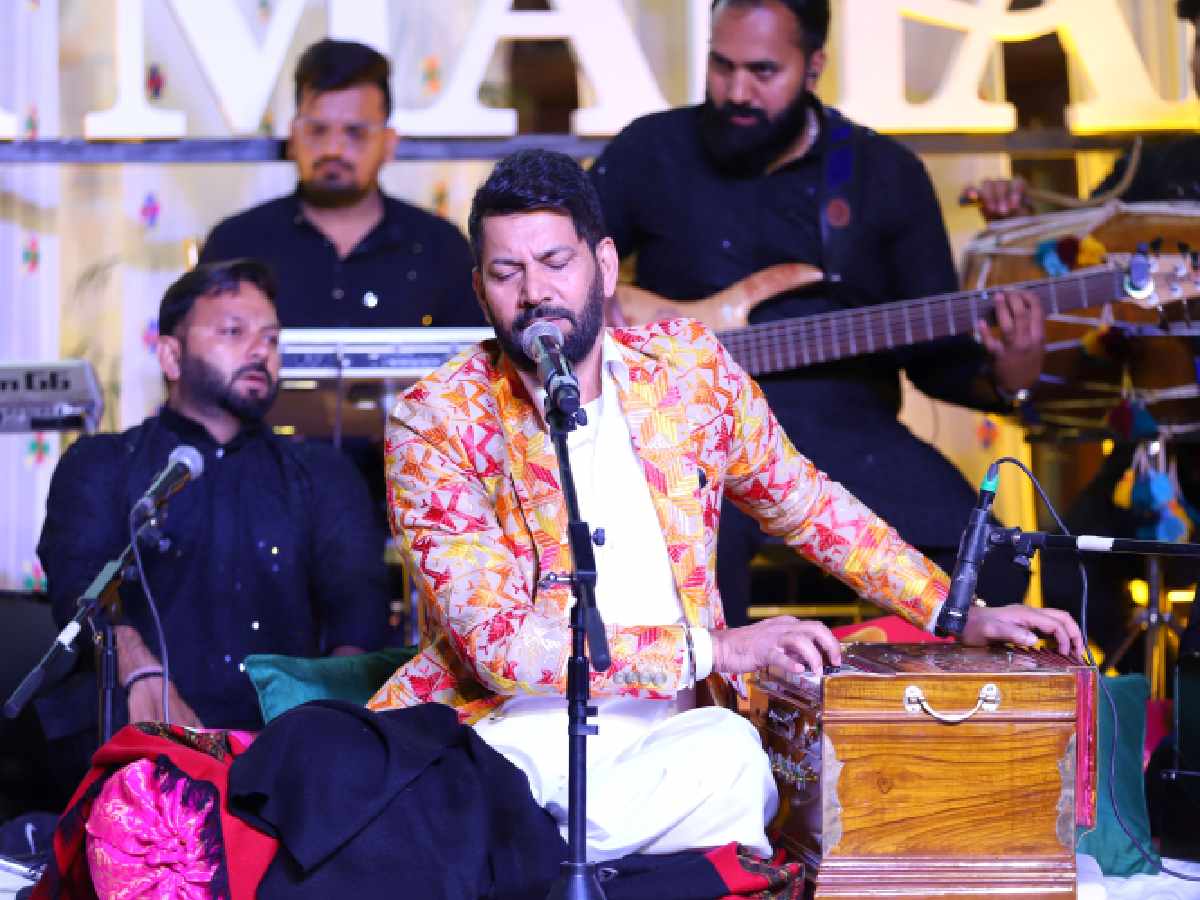
Delhi has been a hub of the arts for centuries. From the 13th century onwards, its royal courts patronised artists and nurtured new traditions. Qawwali, a genre of devotional singing, was created in Delhi by Amir Khusrau (1253–1325). Mian Tansen (d 1589), the fountainhead of the Senia gharana of instrumentalists, flourished in the Delhi court of Emperor Akbar.
As music evolved over the decades, Delhi remained a crucible of innovation. The roots of several styles can be traced here — from the khayal gharanas of Agra and Gwalior, from which other vocal traditions emerged, to the original tabla gharana.
From baithaks to residencies
Delhi-based Mala Sekhri grew up immersed in culture — music, dance, theatre, and literature. Naturally, she made the arts her career. For her personal enjoyment, she began hosting baithaks in 2006 at her South Delhi home, presenting artists she knew to a carefully selected audience of music lovers.
“Some of my friends would complain they had not been invited,” she laughed, “but I reminded them they were not music lovers.”
The baithaks soon fuelled her ambition to create a more lasting musical experience. In 2019, she held her first music residency in Jaipur. For three days, artists lived under one roof, interacting with each other and with an in-house audience that had booked their stay. Outsiders were not permitted, lending the event an air of exclusivity. Mornings featured meditative music, while evenings brought energetic concerts.
According to Sekhri, music must be allowed to seep in and be experienced through memory. It is counter-productive, she said, to host two or three concerts in quick succession — one should be allowed to savour.
Also Read: Delhi: Clinics rebranded, but the spirit remains the same
Expanding the experience
Sekhri enhanced her residencies by adding talks, artist interviews, and lecture-demonstrations. Realising that her listeners were committed but not always erudite, she introduced knowledge sessions on process and historical context to deepen their appreciation.
Equally important was her decision to blend genres rather than remain confined to one form. Thus, audiences encountered Carnatic classical, Hindustani classical, Sufi music, folk traditions, ghazals, Western jazz, and even Indi pop. Noteworthy performers included Usha Uthup and Asha Bhosle.
Residencies as a cultural movement
Today, residencies have become eagerly awaited events, with bookings often made well in advance. The venues are diverse — from an unostentatious ashram in Lonavla (Khandala Sangeet Samaroh) to the opulence of a five-star hotel such as ITC Grand Goa (Malhar and the Sea), or even a wildlife resort like Ragas by the River in Jim Corbett National Park.
The essential element is a captive audience, fully receptive and free from distraction. Kavita Butalia, a regular attendee who travels from Singapore for these events, said, “It’s a unique way of disconnecting from your life, and savouring your culture in a meaningful way. I would put it this way — it’s a lovely way of connecting with the silence in our lives.”
Artists find joy in the format
For artists, too, the residencies have proved deeply satisfying. Legendary sitarist Ustad Shujaat Khan said, “It’s great to be among like-minded people, connected with each other through music. It’s also wonderful to have the opportunity to be with other artists.”
He explained that these residencies evoke an earlier era when performers travelled to a venue, stayed several days, mingled with fellow artists and music lovers, exchanged ideas, and had fun. “All that has stopped now; we just arrive, perform, and fly back,” he reflected. He added that he was looking forward to playing again at Sekhri’s event: “Everything is done so elegantly.”
Innovation and future plans
Constantly innovating, Sekhri has also hosted residencies on a barge on the Ganga and at a yoga retreat in the Himalayas. “After Covid, everyone wanted a safe place to be together and interact. What started off as an idea borne out of necessity became a mainstay of my experiential series — exploring the region and marrying music with the stunning spaces in different areas. I am planning something in the Delhi region later,” she shared.
The next chapter
The next MusicMuse residency will be held at the Fairmont Hotel, Jaipur, from September 19 to 22. The line-up includes classical diva Kaushiki Chakraborty, US-based jazz saxophonist George Brooks, pop icon Jasbir Jassi, veteran Carnatic vocalist Aruna Sairam, and the incomparable Ustad Shujaat Khan.
Knowledge sessions will complement performances — with Aruna Sairam speaking on the next generation of Carnatic maestros, and a special discussion on accompanists and their vital role in concerts. The retreat promises to be an immersive and memorable experience.
Elected to the Delhi Golf Club general committee, Mansher Singh says he wants to build…
A $780 million market built on pavements, where the pleasure of reading meets the price…
Supreme Court advocate Abhishek Pawar alleges women were denied washroom access for seven to eight…
Each day of closure costs shops in Khan Market and Connaught Place between Rs 60,000…
Delhi generates nearly 15,000 tonnes of waste daily, prompting the government to deploy 1,000 mechanical…
Delhi Police has issued an NOC for the Congress rally at Ramlila Maidan on November…

