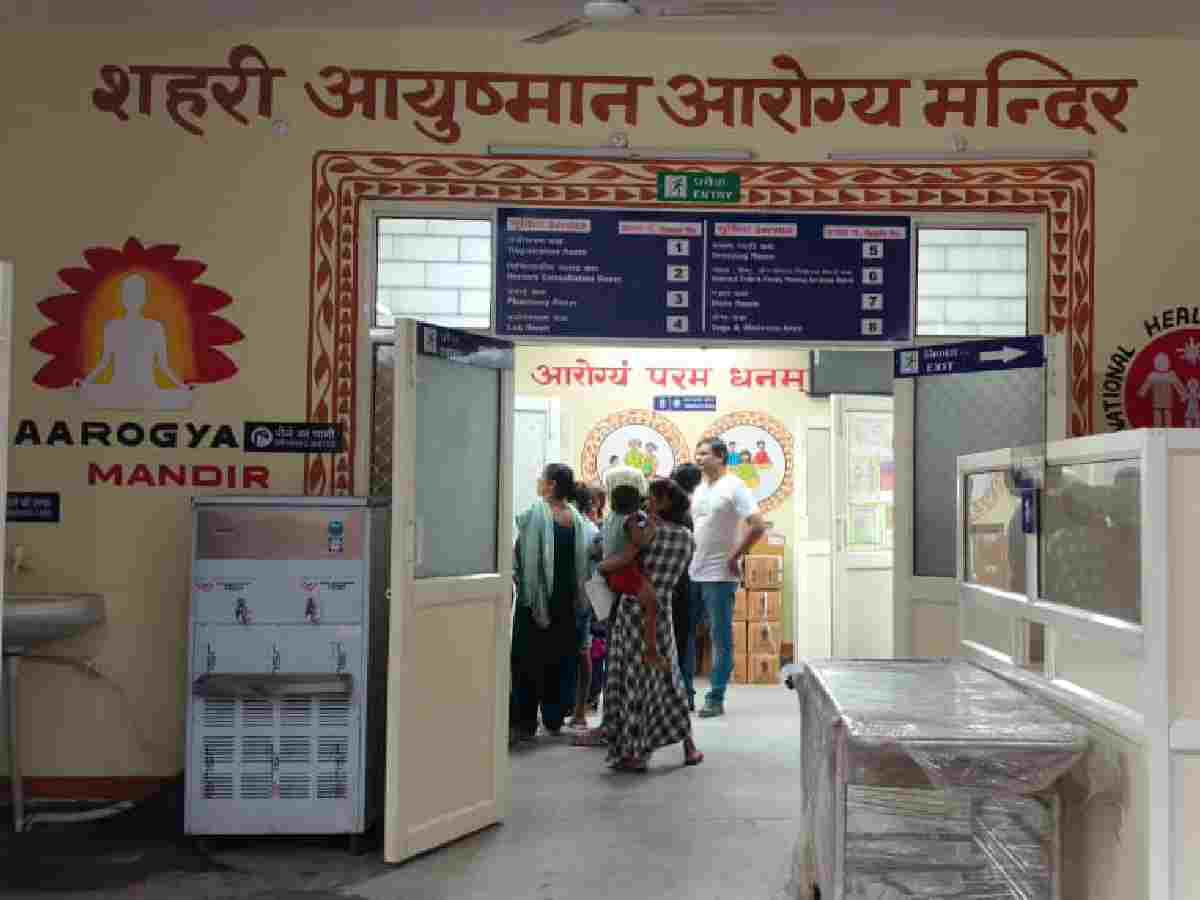
Dressing rooms, laboratories, and dedicated yoga and wellness spaces are among the facilities now offered by the newly opened 166 Urban Ayushman Arogya Mandirs (UAAMs) across several locations in Delhi. These centres, considered an upgraded version of the Mohalla Clinics, provide in-house diagnostic services and other treatments free of cost to residents.
The freshly painted yellow walls display graffiti of doctors treating patients, a smiling family holding hands, and health workers assisting pregnant women. Until recently, these facilities functioned as Mohalla Clinics.
The posters of former Chief Minister Arvind Kejriwal and former Health Minister Satyendar Jain are gone, but for most residents, the clinics remain synonymous with their original name.
“These clinics were started by Arvind Kejriwal, and they remain one of his best works,” said Meena Devi, 60, a resident of Burari Village, visiting the Takia Chowk UAAM for leg pain. For her, having such centres close by has been invaluable: “For people like us, who cannot always travel to big hospitals, having free healthcare nearby has been a blessing.”
Expanded scope of care
While Mohalla Clinics initially offered free consultations, medicines, and basic diagnostics, the UAAMs are designed to provide a wider range of services. The Takia Chowk facility in Burari, which opened on June 25, reflects this shift.
Patients now have access to a laboratory for routine tests, a dressing room for injuries, a maternal and child health room with family planning services, and a dedicated yoga and wellness area. Officials say the centre sees 130–170 patients daily, many of them women and the elderly.
Another major addition is the presence of auxiliary nurse midwives (ANMs). At Takia Chowk, five ANMs assist pregnant women, provide counselling, and conduct immunisation drives every Wednesday.
“I have been coming here for years,” said Sakshi Kashyap, a resident of Burari Village. She added that the new services, especially lab tests and maternity care, “have made things easier for us. We no longer have to go elsewhere for small but important needs.”
For others, the trust developed over years is what keeps them returning. Rakesh Sharma, visiting with his daughter Sneha for fever treatment, said, “This has become our go-to place. The doctors are well qualified, and we get all the medicines free.”
Staffing and professionalisation
Medical officers at the Burari UAAM point out that the upgrades are not just about infrastructure. One doctor explained: “Earlier, doctors in Mohalla Clinics were paid on a commission basis. Now, we are appointed by the Delhi government on fixed salaries. It gives more stability to the system.”
Diagnostic capacity has also improved. More than 18 in-house tests are available, including blood, urine, malaria, dengue, haemoglobin, blood sugar, and pregnancy tests. Previously, most of these were outsourced. “This change ensures quicker results and builds confidence among patients,” the doctor added.
Digital registration, first introduced in Mohalla Clinics, continues in UAAMs. Officials upload daily outpatient records after hours, ensuring central monitoring and accountability.
Each facility is required to stock 256 essential medicines, according to health officials. While several common diagnostic tests are available in-house, around 90 advanced tests continue to be outsourced to Agilus Lab, the authorised partner.
Politics and public health
The conversion of Mohalla Clinics into Ayushman Arogya Mandirs also reflects Delhi’s shifting political landscape. After winning the state elections, the BJP government announced that 250 Mohalla Clinics — many operating from rented premises — would be upgraded into UAAMs.
“We will establish these centres near JJ clusters to ensure free healthcare for residents in vulnerable areas,” State Health Minister Pankaj Singh said earlier this year.
The Health Department directed the Public Works Department (PWD) to complete construction of 70 UAAMs by May 31. Chief Minister Rekha Gupta later announced a larger plan: 1,139 Ayushman Arogya Mandirs across the city, with about 15 in each assembly constituency.
“These centres will offer consultations, preventive care, maternal and child health services, and wellness activities,” Gupta said. She urged public representatives and district magistrates to identify sites quickly to ensure the rollout remains on track.
Balancing continuity with change
Despite the new name and services, many residents continue to view the centres as extensions of the Mohalla Clinic model. “Names may change, governments may change, but what matters is that these facilities remain open and effective,” said Kashyap.
For health workers, the UAAMs represent a chance to institutionalise improvements. With salaried staff, broader diagnostics, and structured maternal and child health units, the centres aim to fill long-standing gaps in primary healthcare.
Yet challenges persist — ensuring adequate staffing across all centres, maintaining drug stocks, and sustaining public trust through reliable services. As one senior doctor said, “The promise of these facilities lies not in their inauguration, but in their ability to deliver consistently over time.”
A model under watch
Delhi’s Mohalla Clinics once drew global attention as a pioneering model of neighbourhood healthcare. With UAAMs, the city seeks to modernise and scale up that approach. Whether they can preserve grassroots accessibility while meeting higher medical standards will be closely observed.
Also Read: Closure of mohalla clinics sparks fear and anger in Delhi
For residents like Meena Devi, however, the matter is simpler. “For us, it is not about politics. It is about whether the doctor is here when we need them, whether the medicines are available, and whether the care is good. If that continues, the name does not matter.