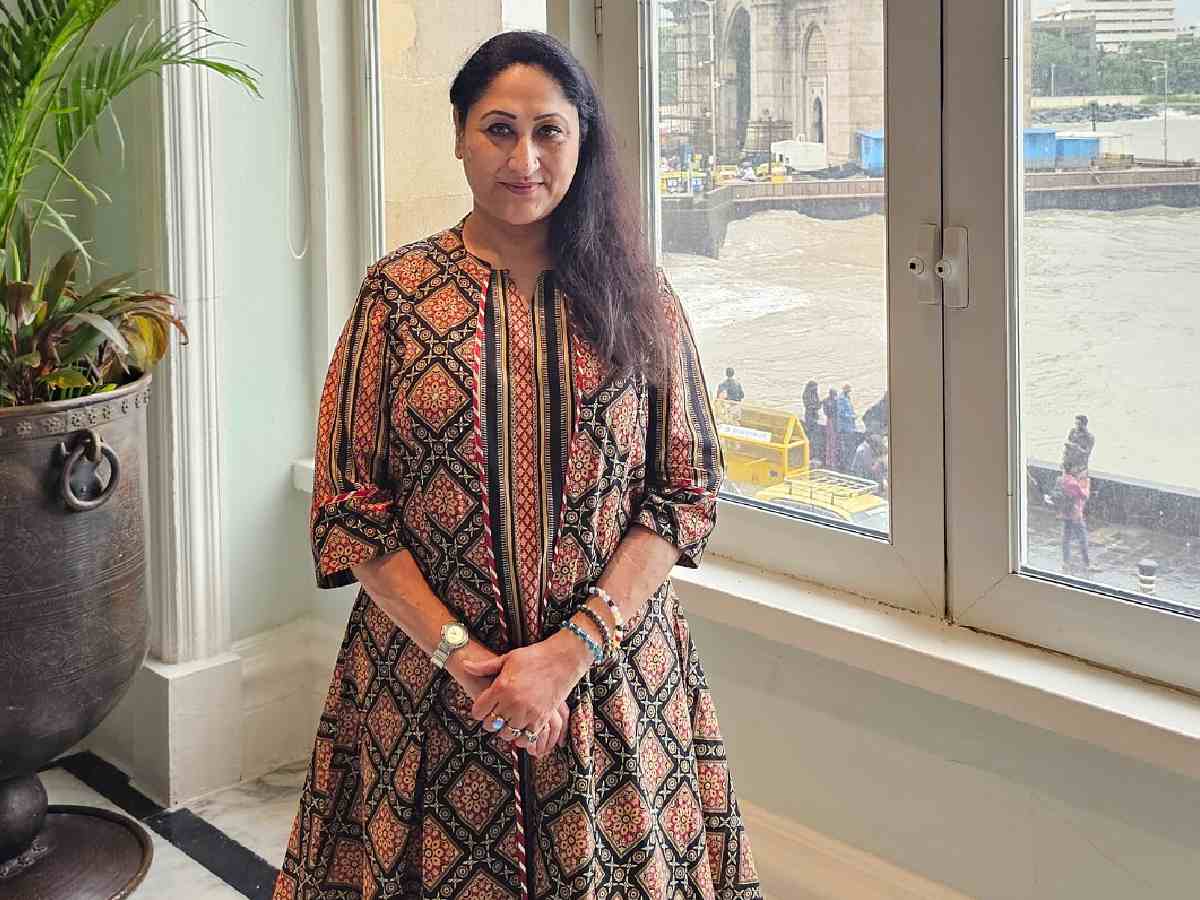
Jayati Bhatia
For nearly three decades, Bhatia has been a familiar presence on Indian television. Best known for playing ‘Mataji’ in Sasural Simar Ka, Bhatia’s journey from Delhi to Mumbai highlights her steady dedication to her work.
She has lived many lives — from the sharp-tongued matriarch on television to the fiercely independent woman on the stage. Her journey, which began in Delhi and found its rhythm in Mumbai’s studios, reflects both the evolution of Indian storytelling and her own undimmed love for the craft.
“I have been involved in theatre as well as in television for the past 28 years. This is my 28th year; I came to Mumbai in 1996,” she says, recalling a time when the medium itself was in transition. “We started with weeklies, and then daily soaps happened. Storytelling on television has always been like a lesson — but a sugar-coated one.”
That “sugar-coated pill”, as she calls it, remains her favourite metaphor for the way Indian television brings social change into living rooms — gently, but persistently. “We tell people about women empowerment, about women coming on their own, having a voice, not being pushed back — but it is always done in a sugar-coated way,” she explains.
Television, for her, is not regressive — a criticism she hears too often. “Just because women wear sarees and mangalsutras doesn’t mean the stories are outdated. These are stories of today,” she insists. “Women have come out of their houses, started studying, working, doing things that were taboo earlier — and television has reflected that.”
Her belief in the medium comes from experience. “Many actors say men don’t have much to do on TV, but the husbands we show, unless they’re negative, have always been supportive. The family remains the big unit — and within that, women find their voice.”
A creative beginning in Delhi
Bhatia grew up in Delhi in a Bengali family where art and culture were a big part of her life. “In our family, everyone had to do something creative — dance, music, painting, or sports,” she says.
She studied at Cambridge School, Srinivaspuri, and graduated from Delhi University. Bhatia’s love for performance began when she learned Odissi dance and later trained under theatre legend Ibrahim Alkazi at the Little Theatre Group (LTG).
“I saw many great performances at Kamani Auditorium,” she recalls. “We couldn’t always afford tickets, but the artists would let students sit in the aisles and watch. That was my classroom.”
Before the bright lights of Mumbai came the soft glow of Delhi’s theatre halls. Her dance training and theatre work under Ibrahim Alkazi at LTG shaped her craft. “We couldn’t always afford tickets to Kamani Auditorium, but artists let students sit in the aisles and watch. That was my classroom,” she recalls.
Like many dreamers, she began as an eager spectator. “I couldn’t afford tickets to Kamani Auditorium, so I’d sit in the aisles. But those legends — Indian and international performers — were kind enough to let students watch. I grew up watching the best.”
The Mumbai saga
Initially, Bhatia was inclined towards dance. “At one point, I was thinking of taking up dance as a profession because I’d seen wonderful things happening on the dance front,” she says. “And then when I came into the theatre, I thought of coming to Mumbai and making a living as an actor.”
In 1996, she moved to Mumbai, and television soon became her second home. “When I started, TV shows were weekly. Then came the daily soaps. The medium kept changing, and so did we as actors.”
Also read: Dharmendra discharged, family decides to take him home: doctor
Theatre and the soul
Theatre, Bhatia says, remains her truest love. “It gives me instant gratification — but that comes after months of preparation,” she says. “Every show feels like a first show.”
Her stage career includes iconic productions — The Vagina Monologues (500 shows), Blame It on Yashraj (119 shows), Khatija Bai of Karmalites (75 shows), and Salaam Noni Aapa (80 shows and counting). “Anything can go beautifully or go wrong — that’s the beauty of live performance,” she smiles. “It’s exhilarating.”
Even after working for nearly three decades in the television industry, Bhatia’s eyes light up the moment she speaks about theatre. “Television pays for my rent and my car,” she says with honesty. “But theatre is what cleanses my soul.”
Television, OTT, and films are my bread, jam, and cheese — they pay for the rent, the car, the luxuries. But theatre is for my soul. It’s spiritual. It’s cleansing.”
Crossing mediums gracefully
Having worked across television, film, and digital platforms, Bhatia has no desire to choose between them. “I never made a complete shift between mediums, whether it’s TV, films or OTT. I’ve not given up on anything, and no platform is small for me,” she says. “I was shooting for Sasural Simar Ka 2 when I had signed for web shows Heeramandi, Girls Hostel, and Dahaad. I was continuously working on television when I did all these OTT shows. If the actor is willing, they will make things work by hook or by crook. Also, I want to live a comfortable life, pay my bills, and have sufficient funds for my medical expenses, so I am happy to do good work in all mediums.”
For her, OTT represents a more structured form of storytelling. “Television doesn’t have bound scripts — stories change with TRPs. But OTT and film work with bound scripts, where you can read the graph of a scene,” she notes. “It’s organised, the technical expertise is brilliant, and most actors come from theatre. The hard work is the same, but OTT allows more clarity.”
Becoming ‘Mataji’
Among her many characters, one stands out: ‘Mataji’ from Sasural Simar Ka. The role, she says, is iconic for more than its popularity. “People still call me Mataji wherever they meet me,” she laughs. “She was justice-oriented and a flag-bearer of feminism — a strong woman who faced challenges but always ensured justice.
‘Mataji’, or ‘Nirmala Devi Bharadwaj’, remains memorable because of her evolution. “She started orthodox but became traditional — and that’s different. Orthodox is rigid; traditional means holding on to values while embracing change,” Bhatia explains. “She saw different perspectives and accepted what was good.”
New roles and challenges
Even after such a rich body of work, Bhatia’s hunger for novelty is intact. “The next role should be different from the last,” she says. “Or if it’s similar, it should have a new challenge — maybe a new dialect, region, or mindset.”
Her current project, Jaane Anjaane Hum Mile, has just completed its first year. “I said yes because it’s the opposite of Mataji,” she says. “This woman is greedy, narcissistic, and only thinks about herself. Sometimes, it’s fun to explore the other side of morality.”
Love, compassion, and equality
Off-screen, Bhatia has been an outspoken supporter of LGBTQ rights. “I think we’re doing better now with OTT and films — there’s inclusivity and acceptance,” she says. “But more can be done. I’m a big supporter of the Kashish Film Festival because I believe love is not gender-specific. Love is love — it’s about compassion.”
“I feel there is a place for everybody in this whole world. The one emotion that should rule the world is love. And love is not gender specific,” she adds. “If love happens between two people of the same sex, or transgender people, I’m absolutely okay with it. I believe in love. Everything can be solved with understanding and compassion.”
She credits television’s vast reach as a potential tool for social change. “Television reaches two-tier and three-tier cities — it has changed how women think. It can do the same for LGBTQ acceptance,” she asserts. “Let’s not fear TRPs or backlash. The media’s role is to educate and open minds. The world is becoming smaller with technology, but our minds are moving farther apart — we must stay open.”
Five arrested, including bouncers, after a man was brutally thrashed to death at a Delhi…
MCD rolled out 12 multi-purpose anti-smog vehicles to suppress dust, wash roads, and tackle rising…
NSUI staged a dharna outside CP police station, alleging Delhi Police assaulted and detained women…
Delhi HC will hear a PIL on Oct 16 seeking to allow peaceful protests at…
DU has approved a ₹5,889 crore plan to build and reconstruct hostels, creating residential accommodation…
Delhi LG said the capital’s development priorities are interconnected, stressing that PPPs must be chosen…
