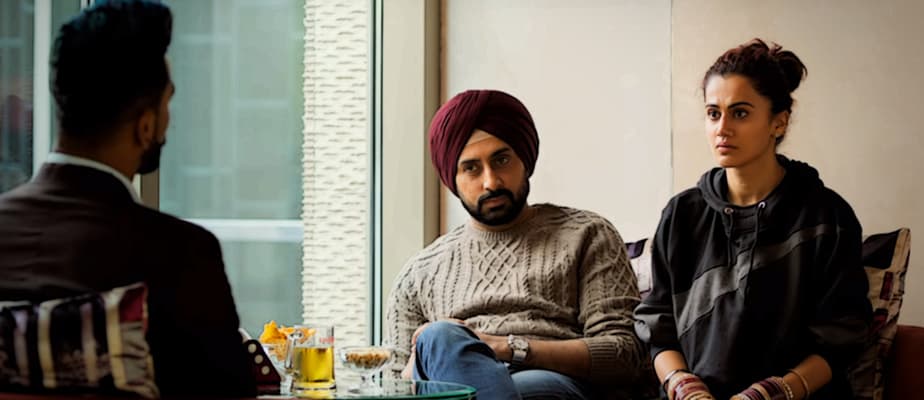
The feeling that Anurag Kashyap’s latest release, Manmarziyaan, leaves you with is déjà vu. Here we see an egotistical, sex-charged young romance à la Dev D; a manic pixie dream girl like in Tanu Weds Manu; a pair of synchronised dancers adding no direction to the narrative again borrowed from Dev D; and Amit Trivedi’s fun and likeable, but all too familiar music composition.
While we have seen the slow, but sure, softening of Kashyap’s storytelling, Bombay Velvet and Lust Stories being cases in point, one does expect his films to, if nothing else, push the boundaries of tried and tested storytelling formula. Which is why when you watch a Kashyap romance, you hope that it will reach in and crush your heart.
Boring love triangle
What you most definitely do not expect from Kashyap is a 2018 remake of Hum Dil De Chuke Sanam. Manmarziyaan does not even budge from the “artist versus regular bloke” dichotomy of such love triangles that we also saw in the 1983 Anil Kapoor-Padmini Kohlapure-Naseeruddin Shah starrer Woh Saat Din.
Far from testing waters of social acceptability, Kashyap’s Manmarziyaan re-establishes long-established tropes that true love equals marriage; good guys make the best husbands; and that a girl might smoke, drink, and swear, but when truly in love, she will do what is needed to express that intense new feeling – make pakodas.
Given that Kashyap, unfortunately, chooses to settle for romance, over grit and truth-telling, here are a few questions I wish Manmarziyaan had made some attempt at answering. Spoliers ahead.
Can wild girls be tamed only with marriage?
The male fantasy of taming the manic pixie dream girl in films has been called out often in the past. How I crave to see a female protagonist who would remain faithful to her character, not because of, but despite being in love. I truly enjoyed watching Rumi stomp around trying to cool her temper by eating spicy gol gappas, and when she gives herself time to mourn the untimely death of her relationship with no care about her new husband’s feelings on their honeymoon; and her fiery confrontations with Vicky before and after she gets married to Robbie.
But all this conviction fizzles out when she “truly” starts falling in love with Robbie. Cut to pakodas, waiting up with a ready meal when Robbie comes home late, and learning how to make achaar from her mother-in-law. Though life for a woman should not be slotted into binaries of achaar-making and whisky drinking, if true love makes her passively accept life as it is dished out to her, then true love is undoubtedly dangerous for young women. The fact that she feels her choice is limited to her passionate romance with Vicky or a mellow domestic life with Robbie is highly questionable. That Kashyap chooses to endorse, rather than challenge this, is highly disappointing.
Aren’t we ready to have Bollywood romances that don’t end with marriage?
It is 2018, and we are still equating love with marriage. We saw a fleeting glimpse of deviating from this kind of storytelling in Ek Main Aur Ek Tu and Shuddh Desi Romance (ironically produced by Karan Johan and Aditya Chopra, the flag bearers of hetro-normative romances).
Contrary to the lyrics of the opening song, Grey Walla Shade, the film works in blacks and whites. It most definitely does not update the ghisa-pita Bollywood version of love. In Manmarziyaan, we have a firebrand of a woman who seems to do as she pleases when it comes to love and sex, with no care or fear of consequences, but a dead-end life of mundane domesticity post marriage does not make her scream bloody murder.
What exactly makes an independent woman?
So then, what exactly makes an independent woman? Bollywood seems to push the case that an independent woman is one who wears what she wants, drinks, smokes, has sex before marriage, swears, and in some cases, like in Manmarziyaan, can also be egotistical and self-destructive.
While all of this may be true to some extent, this once again sheds light on what is popularly misunderstood as being the feminist agenda. How many times have feminists been accused of selfishness with the counter-argument: Feminists only want independence without responsibility.
And, unfortunately, this is the rather unimpressive trajectory of Rumi’s character as she moves from Vicky to Robbie. For all her hotheadedness and fearlessness, Rumi is not able to take any decision for herself that is not connected to the men in her life (bye bye Bechdel Test).
When Rumi convinces Vicky to run away with her, she blames him for being irresponsible and unprepared. She entirely misses the point that she pushed him into the decision, while she herself is clueless about what they are planning for their future. Later, she seems to be satisfied with a nice guy husband who lets her drink, be foul-mouthed, and forgives her sexual escapades before marriage. That Kashyap’s manic pixie dream girl begins and ends at juvenile drinking and swearing only to transform into a calmer, ‘grown-up’ is, of course, regressive and problematic, but also mighty boring from a storytelling point of view, especially given Kashyap’s filmography.
Is “husband material” still a thing?
The English title of Manmarziyaan is Husband Material. No kidding. One can’t ignore the fact that Abhishek Bachan did almost precisely the same role in Sooraj Barjatya’s Mein Prem Ki Diwani Hoon (2003).
Imagine, if Kashyap had added a “grey waala shade” to Robbie’s “Ramji type” character. That would have made the film the messy and complicated affair that it pretends to be.
Instead what we get is a Robbie who is subdued, restrained, and hopelessly in love with a loud, extroverted woman, who would never have noticed him if their parents hadn’t forcefully put them in a room together. When he is not intensely staring at her antiques, Robbie and Rumi seem to have nothing much in common, so they ask each other random questions about pakodas and jalebis. They seem to feel the need to be drunk to have any fun hanging out with each other.
In fact, for a UK-returned banker, he is easily bewildered (though silently, with the slight raising of an impressed eyebrow) by a woman who openly drinks and smokes.
On the contrary, Vicky and Rumi have the same energy and language, physically and otherwise. Vicky is caring, sexy, funny, and totally into her. But he doesn’t have a stable job, thus not ‘husband material’. He loves Rumi and is honest enough to tell her that he does not want to marry her. She blames him for not growing up and decides to get married to a dependable, albeit boring, husband-material man. So yes, husband-material is still a thing. Several women will still tell you that ‘settling down’ means marrying a subdued man with a stable income, and that the young, passionate Vickys are only good for your hormone-induced carefree 20s. But when these are the lead characters from the teller of Bollywood’s darkest stories, an involuntary gag reflex cannot be blamed.
www.newslaundry.com
BNSS caps custody at 24 hours and requires production before a Magistrate; force permitted only…
An SEM court reserved its order on extending the judicial custody of CJP leaders Saurav…
Delhi recorded its first 'poor' air day of the season on Wednesday as AQI hit…
Stage I of GRAP was invoked later this year in Delhi due to govt's preventive…
DDA plans to resume tethered hot air balloon rides at Baanseera park from Nov 14,…
NDMC is consulting RWAs and traders on draft 2026 property tax bye-laws, seeking feedback on…
