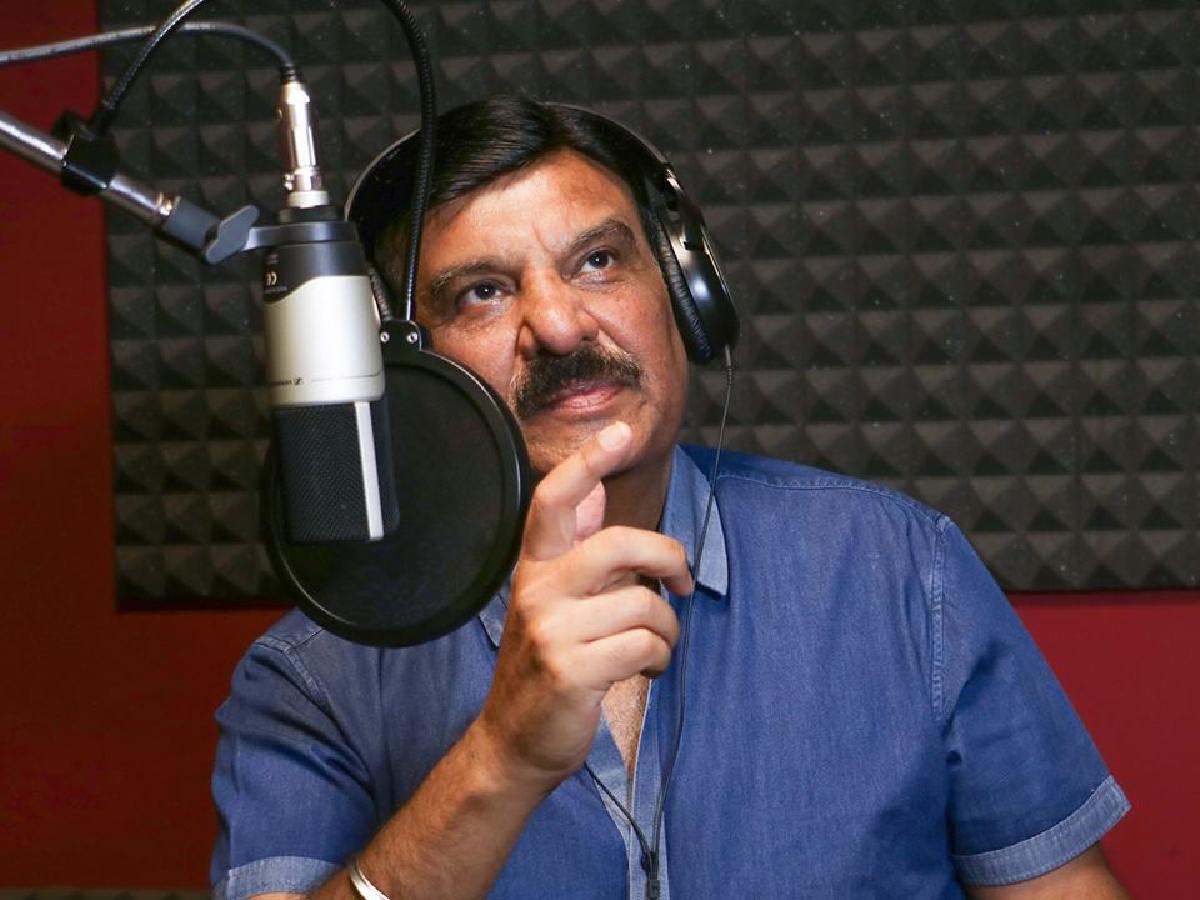
For generations of Indians, authority once arrived not through images but through sound, measured, calm and unmistakably credible. Shammi Narang was that sound. A former Doordarshan newsreader, voice-over artist and media entrepreneur, Narang became the voice of Indian television in the 1970s and 1980s, at a time when words mattered more than visuals. Decades later, his baritone continues to guide millions through metro stations, heritage monuments and public spaces, forming a quiet, emotional presence in everyday life.
“Firstly, the title ‘The Golden Voice of India’ is one I truly cherish,” Narang says. “It has been coined by my fans and members of the fraternity, and with it comes a deep sense of gratitude and an equally great sense of responsibility.”
Where the voice began
Narang’s journey into sound was accidental rather than planned. A final-year Metallurgical Engineering student at the time, he found himself on a college stage during a routine sound check at IIT Delhi’s auditorium. What followed would alter the course of his life.
“An American gentleman named Mr Flanagan… asked me to say something into the microphone for a sound check,” Narang recalls. “Instead of the usual ‘Hello, hello… mic check one-two-three,’ I began speaking playfully and improvising a bit.”
The response surprised him. “He looked at me very seriously and asked, ‘Have you heard your amplified voice? Don’t you think you’re wasting your time?’” Soon after came an invitation to Voice of America’s studio on Curzon Road. “Somewhat half-heartedly, I went there… where I was given a one-page Hindi script to read.”
Recognition followed quickly. “A renowned Hindi scholar, Shastri ji… appreciated my voice, offered me guidance, and opened doors to possibilities I had never imagined. And the rest, as they say, is history.”
Lessons from Doordarshan
Selected from among nearly 10,000 aspirants, Narang joined Doordarshan in 1982, at a time when it was India’s only television channel. His years there shaped not just his career, but his philosophy of communication.
“My years at Doordarshan were foundational,” he says. “It was an institution that taught you respect for the language, for the viewer, and for the responsibility that comes with being on air.”
There was no space for theatricality. “There was no room for casualness; every word, pause and pronunciation mattered,” he adds. “Credibility was built not through dramatics, but through restraint and clarity.”
That restraint turned him into what many described as the face of Doordarshan news reading, a voice trusted enough that viewers believed newsreaders could influence governments themselves.
Authority without loudness
For Narang, a powerful voice is not about force. “Authority in a voice does not come from volume or heaviness,” he explains. “It comes from conviction and sincerity.”
Equally important is empathy. “One has to speak to people, not at them,” he says. “When your intention is honest and your understanding of the listener is deep, the voice naturally finds the right balance.”
This philosophy would later define his work beyond television, from heritage audio guides to mass public announcements.
The Delhi Metro voice
Today, Narang’s voice is inseparable from urban life, particularly for commuters. From Delhi to Mumbai, Bengaluru to Hyderabad, millions hear him every day.
“It is deeply humbling and rewarding,” he says. “Delhi Metro is not just a transport system; it is a part of the city’s rhythm… the lifeline of Delhi.”
For Narang, this is not performance but service. “I see it as a service, where clarity, calmness, trust and reassurance are paramount.”
Delhi, change and continuity
Having lived and worked in Delhi for decades, Narang has watched the city transform. “Public spaces have become more inclusive and structured, media has grown more dynamic and immediate,” he observes.
Yet, he believes Delhi has retained its core. “What impresses me most is how Delhi has learned to modernise without completely losing its soul.”
Even amid challenges like pollution, he remains hopeful. “I remain quietly optimistic that this phase, too, shall pass,” he says, pointing to “sustained and sincere initiatives by the government”.
Heritage as emotional responsibility
Narang’s association with heritage projects is deeply personal. “Projects connected to national heritage are never just professional assignments for me,” he says. “They are emotional responsibilities.”
He reminds himself constantly of the weight such work carries. “I am speaking on behalf of India’s history and heritage, not merely narrating it.”
From news to cinema
Though best known for news and voice work, Narang has appeared in films including Maqbool, No One Killed Jessica, Sultan and Sarbjit. Yet he insists the core remains unchanged.
“At the core, storytelling remains the same,” he says. “The intent is to communicate truth and emotion. What changes is the medium.”
Cinema, he notes, allows what news cannot. “It offers space for nuance, silence and vulnerability.”
Voice in the digital age
Despite the visual overload of today’s media, Narang believes voice has only grown in importance. “In a cluttered digital space, a credible and emotionally resonant voice cuts through noise.”
But with reach comes responsibility. “What has changed is the need for adaptability, authenticity and ethical responsibility.”
Building Pindrop and the future of audio
Founded in 1998, Pindrop Media Group began as Delhi’s first digital recording studio. “The motivation was simple yet ambitious: to create a truly world-class recording facility in the capital,” Narang says.
Today, the company spans branding, filmmaking, AI-driven solutions and public service innovation. “Much of the credit for this transformation goes to my son and his team,” he adds, describing his own role as Director and Patron.
On the industry’s future, he is clear. “India’s audio industry is entering a golden phase.”
The quiet power of sound
In an age obsessed with speed and spectacle, Shammi Narang remains committed to clarity, restraint and responsibility. His belief remains unchanged, that sound, when guided by sincerity, carries its own authority.
As he puts it simply: “Voice is the biggest asset of communication.”
Elected to the Delhi Golf Club general committee, Mansher Singh says he wants to build…
A $780 million market built on pavements, where the pleasure of reading meets the price…
Supreme Court advocate Abhishek Pawar alleges women were denied washroom access for seven to eight…
Each day of closure costs shops in Khan Market and Connaught Place between Rs 60,000…
Delhi generates nearly 15,000 tonnes of waste daily, prompting the government to deploy 1,000 mechanical…
Delhi Police has issued an NOC for the Congress rally at Ramlila Maidan on November…
