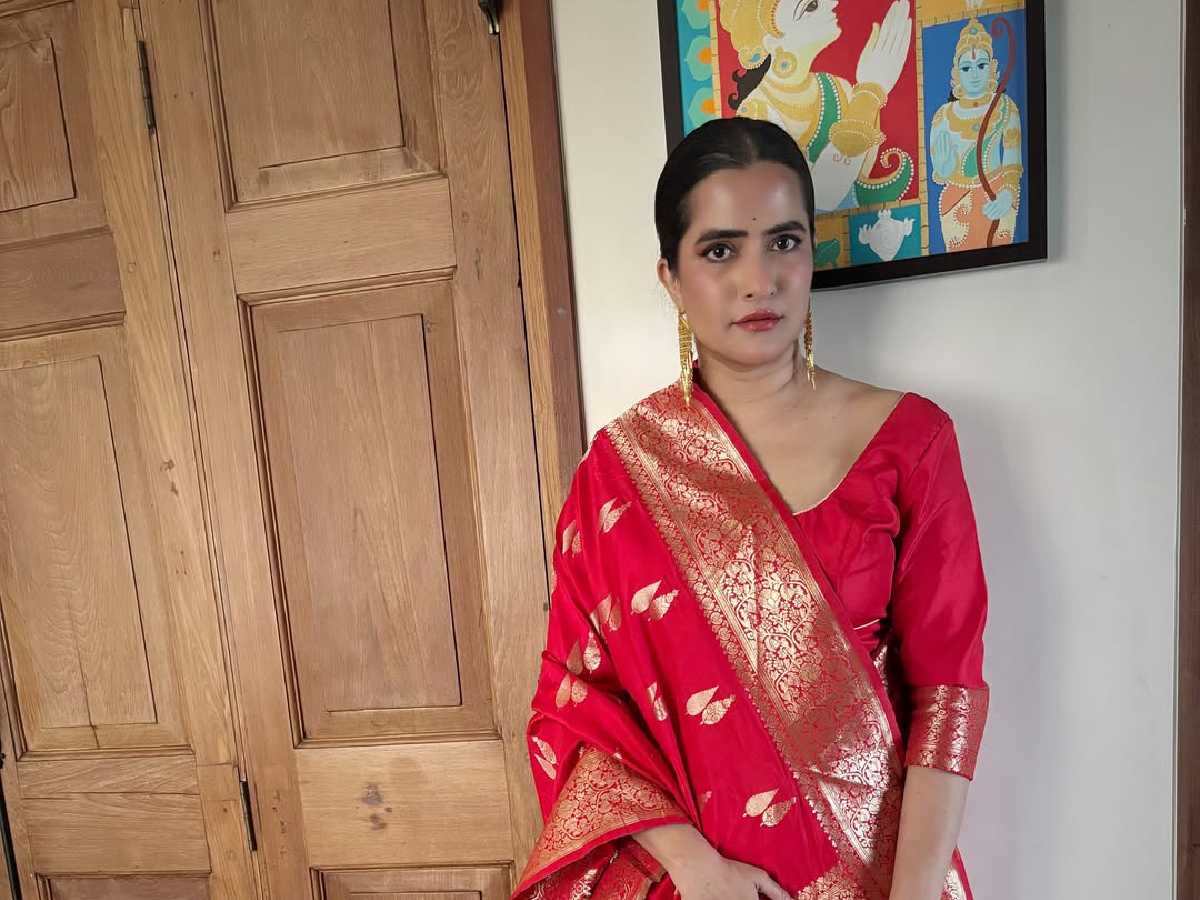
Singer Sona Mohapatra
For singer Sona Mohapatra, Sufism is neither aesthetic nor genre. It is, as she describes it, “a state of longing. A rebellion of love.” As she prepares to debut her new show Untamed Beloved at the Sufi Heritage Festival in Delhi’s Sunder Nursery, Mohapatra sees the performance less as spectacle and more as a spiritual return, an intimate reckoning between devotion, rebellion and artistic evolution.
“Performing at a Sufi Heritage Festival feels like coming home to my own inner fire,” she says. “Devotion is not submissive, but ecstatic and questioning.”
Her interpretation resists passive reverence. Instead, it seeks intensity, agency and transformation. “My idea of the Untamed Beloved is that the beloved is not always soft. Sometimes she is wild, demanding union, breaking ego.”
Central to this new work is her deliberate weaving together of Sufi and Bhakti traditions, two spiritual streams she sees as philosophically inseparable. “I am bringing the music of the Bhakti movement into the festival to showcase the common thread between both rivers of music,” she explains. “Both speak of a connection with the divine without intermediaries or institutions. It is intimate, one on one, interchangeable with your beloved.”
For Mohapatra, the performance is also an assertion of artistic originality in an increasingly homogenised cultural landscape. “This is one of the rarest platforms that allows original expression,” she says. “Just presenting music that is familiar is my idea of cultural stagnation in society. Cultural evolution requires risk, honesty and new interpretation.”
Festivals rooted in spiritual traditions, she believes, fundamentally alter the relationship between artist and audience. In contrast to algorithm-driven listening and fleeting digital engagement, such gatherings create a shared emotional and philosophical space.
“When audiences gather in a historic, open-air setting like this, they are not consuming content cut down to catch your attention in three seconds,” she says. “They are not there to perform their presence or collect moments for display. They are participating in a shared spiritual experience.”
That distinction changes everything. “Music and love for it existed long before streaming numbers and spectacle,” she says. “When I sing in that space, I’m not performing. I’m invoking.”
Delhi itself, she adds, brings its own historical resonance. “This city carries centuries of poetry, politics, and power struggles,” she reflects. “Architecture that has witnessed empires now holds music of devotion and longing. Bringing Untamed Beloved into that space feels deeply symbolic.”
Long before she became one of India’s most recognisable independent voices, Mohapatra lived a life defined by corporate structure and professional predictability. Armed with degrees in engineering and management, she worked in brand management while quietly nurturing her artistic instincts.
Music, however, was never secondary in spirit. “The live stage was always my first love,” she says. “But I wanted to build my own artistic expression, not chase validation through Bollywood or reality shows. Keeping a day job gave me independence.”
The turning point came at the height of professional stability. “I was ahead of my peers, promoted and on top of my game,” she recalls. “That was the moment I chose uncertainty.”
She sold her car, still under EMI, and invested in creating her debut album. “I wanted to remove the escape button from my keyboard,” she says. “That leap was my first act of disobedience.”
It was, in many ways, the beginning of Untamed Beloved, not just as performance, but as identity.
Mohapatra’s rise unfolded gradually, shaped less by institutional endorsement than by audience recognition. The moment she truly felt seen arrived not in an awards ceremony, but during a college performance.
“The audience knew every word of my songs,” she recalls. “That’s when I felt seen. Not by the industry. By the people.”
Songs such as Ambarsariya revealed her emotional vulnerability, while Mujhe Kya Bechega Rupaiya emerged as an anthem of protest and resistance. The contrast between the two, she says, defined her artistic essence.
“One was softness and romance people didn’t expect from me,” she says of Ambarsariya. “The other was fire. Protest wrapped in melody. It reminded me that music can be a mirror, a healer and a weapon.”
Her work on the television programme Satyamev Jayate further established her as an artist capable of channelling both empathy and dissent, reinforcing her belief that music must serve emotional and social truth.
Mohapatra has long resisted the pressures of conformity that define much of the commercial music ecosystem. She speaks candidly about the personal and professional costs of maintaining artistic independence.
“The industry rewards conformity and speed,” she says. “But integrity is slow-burning. I’ve had to say no many times. I’ve paid a price for speaking up. Yet every time I stayed true, I grew stronger.”
There were moments when silence might have preserved comfort and acceptance. Instead, she chose authenticity. “Sometimes you lose applause and gain cultural currency,” she reflects. “I chose the latter.”
Her creative process itself reflects that commitment to truth. “In the studio, I surrender first,” she explains. “I sit with the lyrics until they start breathing. I don’t just sing a song. I locate myself inside it, where it hurts, where it heals. Only when it feels lived-in do I record it.”
Mohapatra’s artistic philosophy remains deeply rooted in her upbringing in Odisha, whose devotional traditions continue to shape her understanding of music and spirituality. She speaks with particular reverence of Lord Jagannath, the presiding deity of Jagannath Temple, whose symbolism reflects intimacy rather than distance between divine and human.
“He has animalistic eyes, a child’s body, carved out of wood,” she says. “He symbolises the best of humanity. People speak to him like family, not a god to be feared.”
She plans to honour that connection through her performance. “I do plan to sing a song for him at the festival,” she says. “India’s soul lives in its diversity. Regional cultures are not footnotes. Representation is truth.”
Despite her formidable stage persona, Mohapatra describes herself as introspective and observant in private life. The intensity remains constant, but its form evolves.
“On stage, I’m amplified. The energy is volcanic,” she says. “In private life, I’m introspective. But the core intensity is the same.”
Her motivations, too, have shifted over time. Where ambition once defined success, purpose now does.
“When you have a voice that people listen to, it carries responsibility,” she says. “My drive now is not fame. It’s impact.”
Today, Mohapatra no longer views music as a career alone. It has become ritual, resistance and refuge all at once.
“Music is my spiritual practice,” she says. “It’s how I pray, protest, heal, and love. It has become less about career and more about communion.”
At the Sufi Heritage Festival, Untamed Beloved will bring together Bhakti poetry, Sufi longing and contemporary soundscapes, not as nostalgic revival, but as living, evolving expression.
“Expect intensity. Expect surrender,” she says. “Expect music that doesn’t just entertain but unsettles, awakens, consoles and uplifts.”
For Mohapatra, that awakening is both personal and collective, a reminder that devotion, like art itself, remains most powerful when it refuses to be tamed.
Elected to the Delhi Golf Club general committee, Mansher Singh says he wants to build…
A $780 million market built on pavements, where the pleasure of reading meets the price…
Supreme Court advocate Abhishek Pawar alleges women were denied washroom access for seven to eight…
Each day of closure costs shops in Khan Market and Connaught Place between Rs 60,000…
Delhi generates nearly 15,000 tonnes of waste daily, prompting the government to deploy 1,000 mechanical…
Delhi Police has issued an NOC for the Congress rally at Ramlila Maidan on November…
