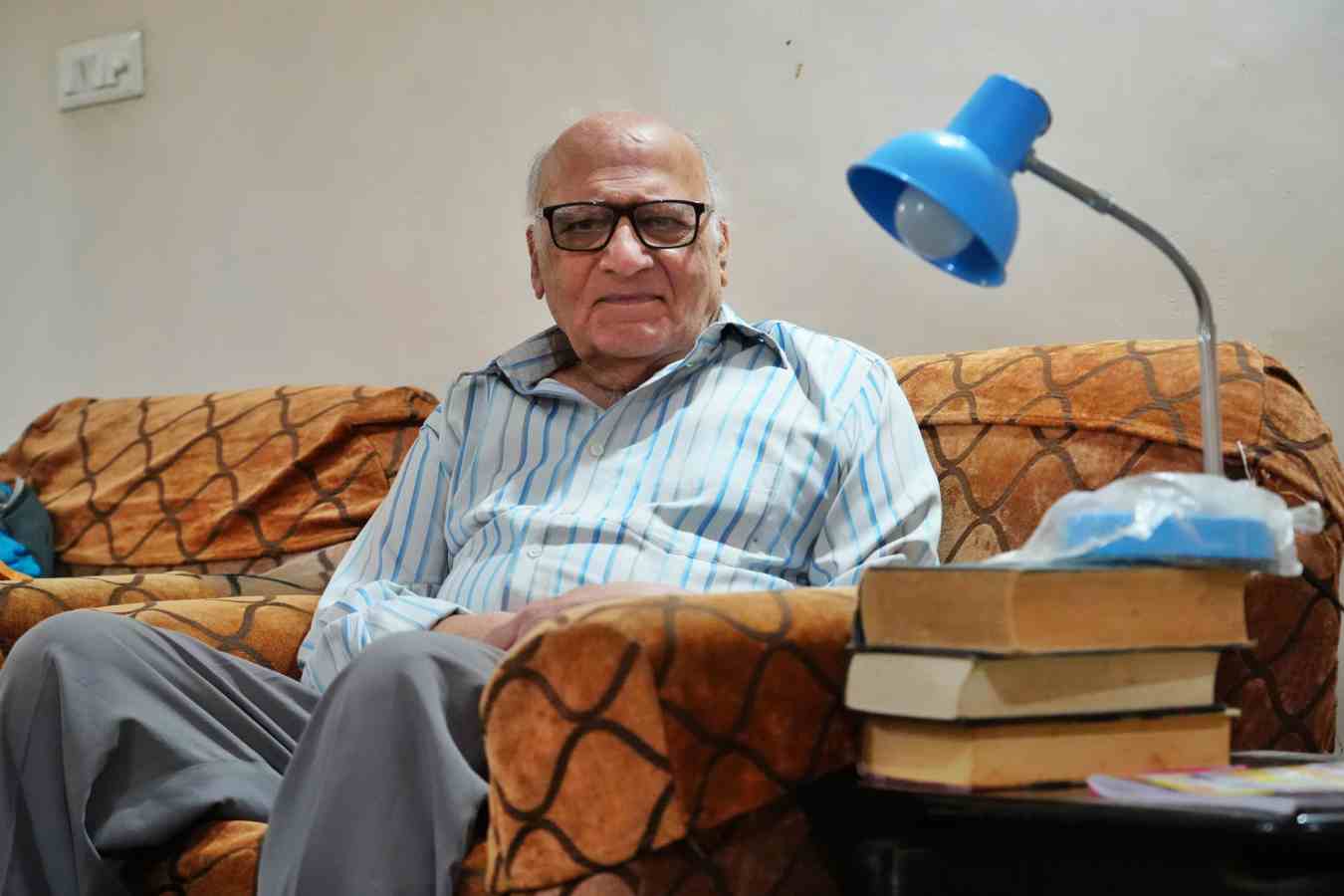
Akash Lal
Former Delhi and North Zone captain Akash Lal was an accomplished batsman and fine fielder, as well as one of the most cultured and articulate cricketers of his generation.
The son of a diplomat, Lal studied in Australia and the United States before graduating from Delhi’s Hindu College. He was also a trained journalist.
Even after his parents were murdered during a burglary in 1990, Lal continued as a national selector at the specific request of Raj Singh Dungarpur, then Chairman of the selection committee. He was an all-rounder on and off the field.
Lal died of prostate cancer in New Delhi on August 10 at the age of 85. He had been ailing for a long time and had suffered multiple heart attacks. A cardiac resynchronisation therapy defibrillator (CRTD) had been implanted in his body. His wife had passed away long ago and their son is not contactable, said Arun Lal, a cousin of Akash Lal and former India Test batsman.
After his playing career ended, Lal became a television and radio commentator and wrote extensively on cricket. He also represented the North Zone on the national selection committee for two seasons, 1989–90 and 1990–91.
He lived in Vasant Kunj, where a young family looked after him for several years.
A distinguished cricketing lineage
Born in Kapurthala, Punjab, on October 6, 1940, Lal came from a family of cricketers. His father Muni Lal, a diplomat, represented Northern India and Southern Punjab, teams that have since ceased to exist, in first-class cricket from 1934–35 to 1945–46.
After a two-year break, Muni Lal represented the North Zone against the visiting West Indies in a one-off, four-day match in Patiala in November 1948.
Muni Lal’s brother Jagdish Lal represented six teams — Hindus, Northern India, Hyderabad, Services, Patiala and Railways — during his eight-season first-class career between 1938–39 and 1958–59.
Akash Lal and Jagdish Lal played together for Patiala in the Ranji Trophy on at least three occasions.
Jagdish Lal’s son Arun Lal played first-class cricket for 22 consecutive seasons. He began with Delhi in 1974–75, switched to Bengal in 1981–82 and ended his distinguished career in 1995–96.
An opening batsman like his cousin Akash Lal, Arun Lal played 16 Tests and 13 One-Day Internationals.
“We had a stint of over 50 years when somebody or the other in the family was playing first-class cricket,” Akash Lal said during a nostalgic conversation with Patriot at his Vasant Kunj flat.
Growing up in a family of cricketers, Lal naturally gravitated towards the game.
“I took up cricket because my father was so engrossed in it. My love for cricket began when I was five years old in Lahore [in undivided India],” he recalled.
He remembered watching an Australian Services team comprising players such as Keith Miller and Lindsay Hassett during its visit to India in 1945-46. The team played a match against North Zone in Lahore, with Muni Lal representing the zonal side.
“My father also brought out the first annual chronicle on Indian cricket, called Crickinia. He published and edited it,” Lal said.
The publication contained reports on domestic competitions such as the Pentangular, Quadrangular and Ranji Trophy tournaments.
“But someone took one volume and never returned it. Several of my books disappeared in the same manner. The publication stopped with the Partition of the country in 1947,” he rued.
Early encounters with cricketing greats
Lal spent part of his childhood in Australia, where his father was posted at the Indian High Commission, before being posted to the United States and later becoming Indian High Commissioner to Trinidad and Tobago. His early exposure to players such as Don Bradman helped cement his love for cricket.
While in Australia, Lal received cricket coaching and, as a child, developed a warm relationship with Indian cricketing great Kumar Shri Duleepsinhji, then the Indian High Commissioner to Australia.
“I studied in Australia from 1950 to 1954. I was around 14 when I left Australia for the USA with my father,” Lal said.
He said the Australian education system was different and that he never completed matriculation.
“I can tell you that my Hindi was so poor that I would never have passed matric. I knew Urdu. I did my high school education at Woodrow Wilson Senior High School in Washington, DC, before returning to Delhi for graduation,” he said.
Lal graduated with an honours degree in English, with philosophy as his principal subsidiary subject.
“Duleepsinhji used to come and watch my school matches in Sydney. I was in Sydney for four years and in Canberra for six months,” Lal recalled.
When Duleepsinhji invited the 1948 Australian team, popularly known as the Invincibles, to the High Commission, he asked Muni Lal to bring his son along.
“I was looking with awe at all these players… Bradman was chatting with Duleepsinhji,” Lal recalled.
“What a charming man Duleepsinhji was. He was very humble and hardly looked up even while talking.”
During the gathering, Duleepsinhji asked Bradman about the most difficult captain he had played against.
“Don, said Lala Amarnath. I was 11 or 12 years old at the time, but I remember this,” Lal said.
According to Lal, Bradman said Amarnath had fooled him by sending a tailender to open the innings in a Test and “used to fool everybody on the field”.
“Bradman said that if India had a stronger bowling attack, they would have beaten the Aussies,” Lal said, referring to the five-Test series in 1947–48 that hosts Australia won 4–0.
Lal’s first cricket coach was former Australian first-class cricketer Alan Kippax.
“We were taught by Kippax that the most precious part of the pitch for a batsman is the depth of the crease. ‘Mr Lal, use it,’ he said to me,” Lal recalled.
“I was predominantly — 90% — a back-foot player.”
Commentary and journalism
Lal, himself a perceptive commentator, often criticised the imprecise terminology used by modern commentators.
“Today’s so-called commentators call it ‘playing with soft hands’. There is nothing like playing with ‘soft hands’,” he said.
The correct expression, he argued, was “playing with a slackened or loosened grip”.
“That way, when the ball hits the bat, it doesn’t bounce off but pushes the bat back,” he explained.
Lal also worked as a journalist and later taught journalism. With a strong command of English, he wrote frequently about cricket in addition to working as a television commentator.
He said his father wanted him to return to India, complete his graduation and then go to England to study journalism.
After graduating from Hindu College, Lal studied at the London School of Journalism. “It was a brilliant course,” he said.
He subsequently worked for The Times of India for about seven months while based in London. Later, he delivered lectures at the newspaper’s Times School of Journalism in Delhi.
Cricketers he admired
Duleepsinhji, who played all 12 of his Tests for England, had a profound influence on Lal. Lal counted the Jamnagar-born cricketer among the people he admired most.
Others included Lala Amarnath, Vijay Hazare and Bishan Singh Bedi. Lal forged an especially enduring friendship with Bedi, who had played under his captaincy for north zone in the Duleep Trophy.
Lal praised Bedi, who was six years younger than him, for being a true friend.
“Bishan had run-ins with the administration. But I have yet to come across anybody — well, there may be more — who had such spontaneity, love and affection,” he said.
“He was a very sociable man and a very helpful man — mind you, a very helpful man.”
Lal recalled turning to Bedi when he needed to have the CRTD implanted.
“When I was to have the CRTD put in my body, I asked Bishan if he could talk to somebody at the All India Institute of Medical Sciences (AIIMS),” he said.
Bedi spoke to someone at the institute and asked Lal to reach the office of Professor Yadav, a renowned cardiologist known particularly for implanting the device, at 9 am.
“Bishan got that done,” Lal said.
Bedi passed away in October 2023. Less than three years later, Lal, whom his friends fondly called “Diwan ji”, also died.
Delhi inaugurates the 70th National School Games, hosting over 14,000 participants in 14 sports across…
Delhi High Court asked "Doosra" filmmakers to respond to Sourav Ganguly's plea over alleged violation…
Delhi L-G appointed Paralympian Suvarna Raj as State Commissioner for PwDs following her gold win…
DDA is planning Delhi's longest 24-km cycling track along the Yamuna floodplain, linking key eco-projects…
Police detained several anti-SIR protesters heading to the ECI headquarters in Delhi as mass gatherings…
An exhibition that revisits the significance of Indian Modernism through works from earlier and defining…

