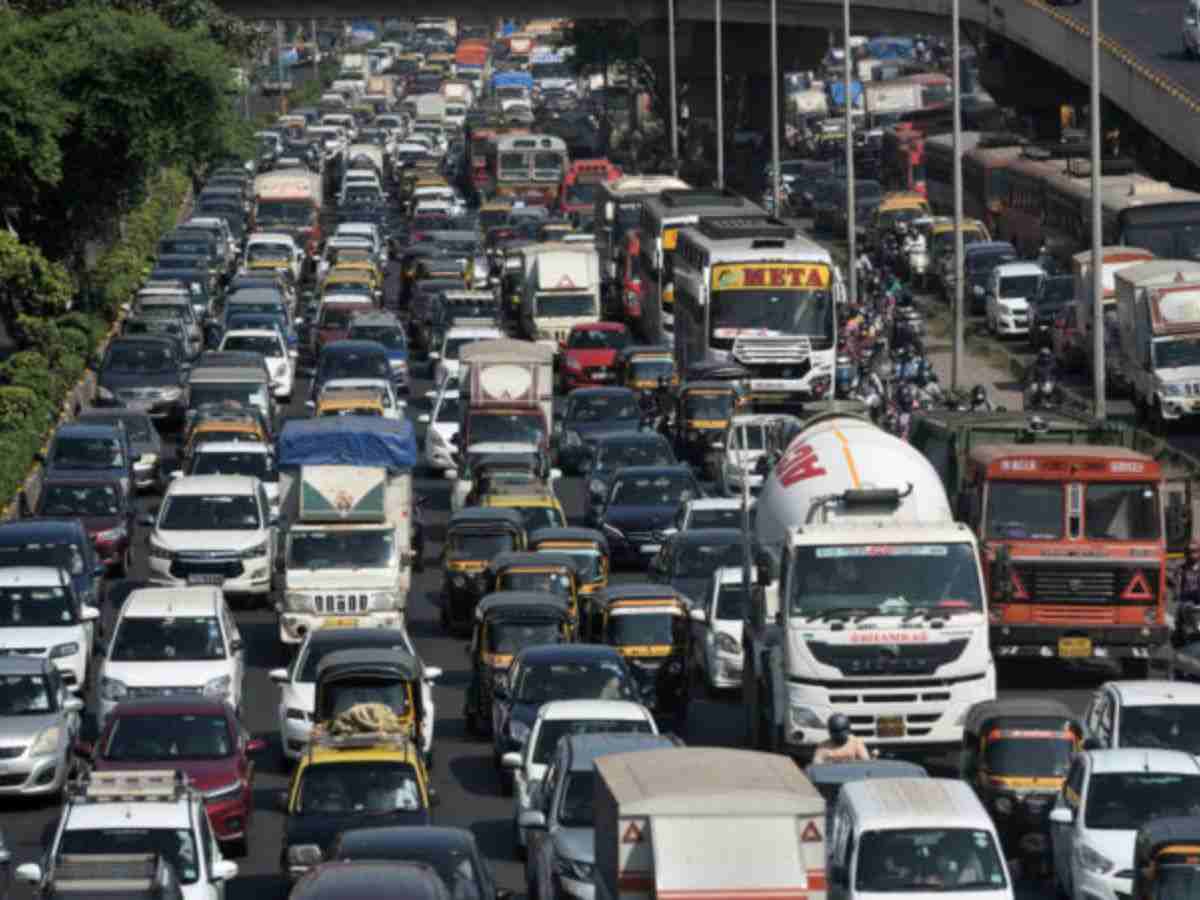
Delhi Traffic Police issued 48.4 lakh challans in the first six months of 2026 as it expanded technology-based enforcement and took measures to ease congestion at key bottlenecks across the city.
The number rose from 47.5 lakh during the corresponding period in 2025. Of the challans issued this year, 17.2 lakh were generated through automated red-light violation and speed-detection systems. The police also registered 2,187 FIRs for dangerous driving.
Special Commissioner of Police (Traffic) Manish Kumar Agrawal said eight signal-free stretches had been developed across Delhi by “closing redundant traffic signals, providing U-turn facilities, removing unauthorised median cuts and rationalising intersections”.
Another 25 stretches have been identified to determine whether similar measures can be introduced.
Measures to ease congestion
Several measures have been undertaken in coordination with other agencies. These include creating additional bus bays and pedestrian facilities at ISBT Kashmere Gate, diverting DTC buses, relocating bus stands at Adhchini village and Ashram Chowk, and designating pick-up and drop-off zones at Anand Vihar ISBT.
A flyover has also been proposed at Kalindi Kunj.
Joint Commissioner of Police (Traffic) Sanjay Tyagi said around 1,200 DTC personnel and 300 Home Guards provided by the Delhi Government had been deployed across the city to assist with traffic management.
Of the 62 identified congestion hotspots, remedial work has been completed at 30. Work at another 16 locations is expected to be completed by October.
Agrawal said the police had engaged a private firm to identify routes that had experienced heavy congestion in recent years.
“We empanelled a private firm to help us identify routes that have seen the most congestion in the past couple of years,” he said. “Essentially, we pinpointed areas that have seen the most traffic bottlenecks in the past three or four years.”
Archival satellite data and live GPS updates were also used to identify congested points and determine where interventions could be made.
“During office hours, some areas see a lot of congestion owing to chokepoints,” Agrawal said. “So, we tried to decongest these areas by creating U-turn points, while in other areas we have removed traffic signals to ensure that there is a steady flow of traffic.”
He added that other civic agencies had been informed about the congestion points so that further measures could be planned.
Travel time improves marginally
Agrawal acknowledged that although the measures had reduced travel time, the improvement remained marginal.
“The public is right to question our decongestion activities,” he said. “The problem is that when a person sees that a 10 km stretch, which should ideally take no more than 15 minutes to cross, is taking 25 minutes, they complain about congestion. However, they do not see that earlier it would take them 30 minutes.”
Congestion remains severe around the ITO crossing, particularly during office hours.
“Each day, the situation remains the same, with people going to or returning from their offices,” said Hartej Sibal, who commutes through the ITO-Link Road area. “There is barely ever any space for cars to manoeuvre through.”
Similar conditions persist in several parts of Delhi, where the traffic police are relying on localised measures and additional deployment at chokepoints.
“This is all that we can do,” an official said. “We are also deploying a lot more personnel at chokepoints to ensure smooth traffic.”
According to the global traffic index cited by the police, Delhi recorded an average reading of 37.83 and a maximum of 85.86 between July 6 and July 13.
The index compares cities based on congestion levels, journey times and traffic speeds, using worldwide trip data covering more than 3.65 trillion km.
Earlier this year, congestion at several key bottlenecks across Delhi was reported to have fallen by nearly one-third over three months following enforcement and infrastructure measures, including the deployment of artificial intelligence-based traffic management systems.
The average length of traffic congestion across the city, tracked through Google Maps at 15-minute intervals, declined from 48.25 km between January and March to 32.43 km between April 1 and June 25.
Monsoon preparedness
Referring to recent heavy rain, Agrawal said congestion between 12:30 pm and 8 pm was lower than the average recorded during the previous three months.
To address monsoon waterlogging, the traffic police have shared a list of 169 waterlogging-prone locations with road-owning agencies. Six disaster-management vehicles equipped with motor pumps and tree-cutting machines have also been deployed.
Public outreach
Under Project Sangam, launched in April to involve residents and market welfare associations, the police held 309 stakeholder meetings and received 514 suggestions. Of these, 368 have been implemented.
The police also launched Traffic Pathshala and expanded road-safety awareness campaigns, reaching 15.4 lakh people, including 2.8 lakh schoolchildren.
At least 50 cases have already been reported this month; NCPCR guidelines mandate help desks,…
DMRC says zero reduction in train trips, attributes decline to security measures and public apprehension…
A Delhi court denied bail to a former DU professor accused of raping a student,…
Delhi Police charged seven dhaba workers in the fatal beating of a Manipuri musician who…
Seven Delhi STPs failed DPCC standards in September, dumping high levels of faecal coliform and…
AISA chief Neha Bora petitioned the Delhi HC against a police notice requiring a peace…
