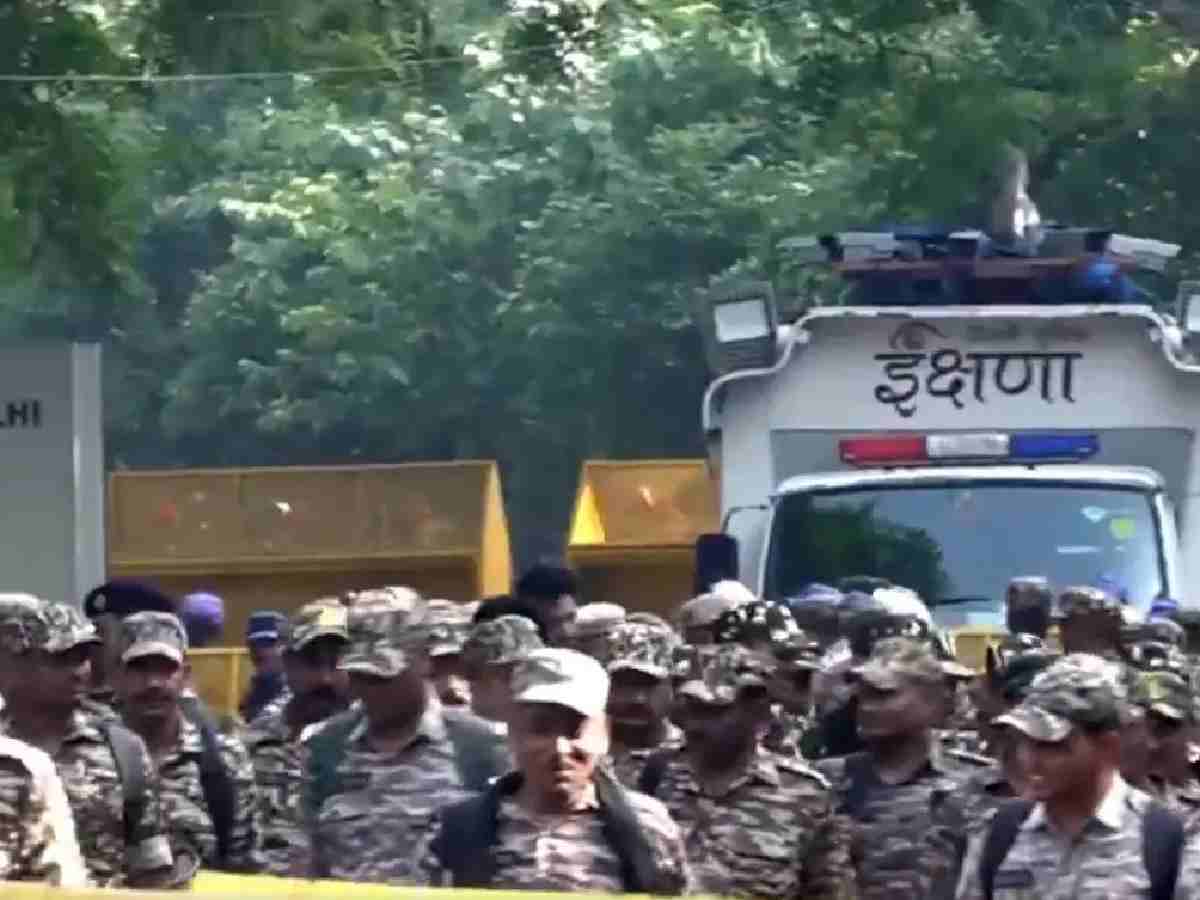
Ikshana and Mobile Control Room police vehicles were deployed to surveil the protest
On August 20, 2026, the Supreme Court constituted a five-member High-Powered Enquiry Committee to investigate allegations of excessive force by the police, paramilitary forces and other security personnel during a student protest at Jantar Mantar on July 20, 2026.
The committee is chaired by former Supreme Court judge Justice R Subhash Reddy. Its other members are former Punjab and Haryana High Court Chief Justice Ravi Shankar Jha, former Delhi High Court judge Justice Shalinder Kaur, former Central Bureau of Investigation Director Rishi Kumar Shukla and retired Meghalaya Director General of Police LR Bishnoi.
The panel will investigate allegations involving the use of pellet guns, electric batons, lathi charges and tear gas. It will also examine alleged violence against women protesters, police surveillance, the proportionality of crowd-control measures, and the provision of medical aid and compensation to victims.
At the same time, the committee will consider allegations by the authorities that protesters attacked police personnel and damaged public property.
FRS under scanner
At an earlier hearing on August 18, 2026, the Supreme Court observed that it would examine the “proportionality” of the Delhi Police’s use of facial recognition systems during the protest.
The petitioners argued that facial recognition constituted unlawful surveillance and exposed personal data to private entities. Solicitor General Tushar Mehta defended its use, saying the technology had been deployed solely to identify “hardened criminals” and not peaceful protesters.
In an affidavit, the Delhi Police maintained that its crowd-control measures were proportionate, graded and lawful. It denied allegations that officers had manhandled women or used modified “nail lathis”. The force said tear gas and limited lathi charges had been used only as a last resort.
The police also defended the deployment of plainclothes officers, describing it as a standard practice used worldwide to identify antisocial elements and maintain security at public gatherings.
Addressing concerns over surveillance, the police said its facial recognition system did not indiscriminately capture or store the biometric data of the general public. It said the system compared images with existing records of people linked to serious crimes and had matched images of 2,873 people at the protest site with records in police databases. The figure does not, by itself, establish that those identified committed offences during the protest or had been convicted.
The Delhi Police also rejected allegations that citizens had been summoned and asked to produce their Aadhaar cards or that their data had been commercialised, describing the claims as false and maliciously motivated. It maintained that operational decisions taken in volatile situations should not be judged on the basis of isolated media clips.
While the committee will examine the facts surrounding the monitoring of protesters, the Supreme Court will decide the broader constitutional questions concerning facial recognition, surveillance and privacy.
Four new national policing systems
The court’s scrutiny comes as the Delhi Police and law enforcement agencies across India expand their use of artificial intelligence (AI) and biometric surveillance.
On June 19, 2026, the Ministry of Home Affairs launched four applications designed to connect criminal identification, investigation, forensic examination and prosecution: NCRB-Abhigyan, the Criminal Procedure Identification (CrPI) Application, e-Prosecution 2.0 and e-Forensics 2.0.
The National Crime Records Bureau’s Abhigyan mobile application enables police personnel in the field to search the National Fingerprint Database from any location. Officers can use a certified scanner to compare a suspect’s fingerprints with stored records in real time.
The CrPI Application combines facial recognition, iris matching and DNA matching in a multimodal biometric system. According to the Ministry, the technology is intended to improve the reliability of identification, reduce manual errors and increase transparency. Its principal uses include identifying repeat offenders and suspects captured on closed-circuit television. A total of 2,190 CrPI units had been distributed and more than 5.53 lakh enrolments had been completed by the time of the launch.
The e-Forensics 2.0 platform digitally connects forensic laboratories and investigating agencies across the country. Its functions include receiving cases, registering samples, digitally tracking forensic examinations, managing laboratory workflows, generating reports, providing digital access to them and strengthening the chain of custody.
The e-Prosecution 2.0 platform coordinates police, prosecution and judicial processes digitally. It is intended to facilitate timely prosecution and punishment once an offender has been identified.
“Together, these four applications integrate policing, forensic investigation, prosecution management, and criminal identification into a seamless digital chain of the Integrated Criminal Justice System (ICJS). They will transform data into informed decision-making and fingerprints into justice,” a Ministry statement said.
Delhi Police’s surveillance network, however, began taking shape more than a decade ago. The force has since expanded its use of such technology.
Network built over a decade
In 2015, the Delhi Police and the Advanced Data Processing Research Institute of the Indian Space Research Organisation began developing the Crime Mapping, Analytics and Predictive System (CMAPS).
The web-based application was designed to enable police stations across Delhi to map crime hotspots in real time, analyse patterns in criminal behaviour and examine information about suspects. It draws on data from the Dial 100 emergency call centre, the Crime and Criminal Tracking Network and Systems (CCTNS), and archived visual crime records. CCTNS is a nationwide platform connecting police stations for real-time data sharing.
In 2018, the Delhi High Court authorised the Delhi Police to deploy an Automated Facial Recognition System (AFRS) to trace and reunite missing children with their families. The force later used the software to monitor and screen crowds at political rallies, protests against the Citizenship Amendment Act and farmers’ protests. Most recently, it was used at the Jantar Mantar protest.
This expansion is an example of function creep, whereby technology approved to trace missing children is subsequently used for substantially different policing purposes.
Despite the widespread operational use of facial recognition, the legal framework and standard operating procedures governing the implementation of the National Automated Facial Recognition System have not been made public.
One of the databases available to the Delhi Police is the Criminal Dossier System, a web-based application developed and maintained by the Computer Centre of Crime and Railways. The application allows officers to prepare dossiers on people booked in criminal cases and update existing records. These dossiers contain details such as names, aliases, physical features, modus operandi and criminal history.
Fingerprint checks in the field
Through the National Automated Fingerprint Identification System (NAFIS), the Delhi Police can also compare fingerprints with a central database to determine whether an accused person is a repeat offender. The Abhigyan application now allows this process to be carried out in real time.
NAFIS stores the fingerprints of accused persons, convicts and prison inmates on a centralised platform. A demonstration of Abhigyan showed that fingerprints could be matched with the database in 35 seconds.
Police say the application could allow officers conducting routine vehicle checks to scan the fingerprints of someone suspected of an offence and establish within seconds whether that person is wanted in connection with a crime or has a recorded criminal history.
Before Abhigyan was introduced, access to the NAFIS database was available only through 1,556 workstations installed at police stations and district headquarters across the country. An individual had to be taken to one of these workstations for fingerprints to be matched.
According to a senior official, the NAFIS database includes records of around 9.91 lakh narcotics offenders, information relating to 3.65 lakh human-trafficking cases and data drawn from prison databases.
The system connecting police records
The CCTNS connects the various databases and applications used by the Delhi Police. It has been implemented in all Delhi Police stations.
On September 1, 2018, the system was upgraded to Core Application Software (CAS) version 4.5 and integrated with existing Delhi Police applications, including Dial 100, e-MV Theft, First Information Reports, e-Property Theft, the Crime and Criminal Information System, the Criminal Dossier System, and the Automatic Finger and Palm Print Identification System.
The Delhi Police claims that it may be the only state force, even among those that have adopted CAS or are classified as advanced, to digitally timestamp documents using real-time information from its main server. Seamless connectivity has also been established among the Data Centre, Data Recovery Centre and National Data Centre.
The force has conducted several rounds of training programmes and workshops for data entry operators, record and malkhana moharrirs, duty officers, investigating officers, station house officers and supervisory officers.
The Ministry of Home Affairs mandates the provision of nine basic citizen services through the CCTNS National Citizens Portal. These include checking the status of complaints, obtaining copies of First Information Reports, and finding details of arrested people or wanted criminals.
The portal also allows citizens to access information about missing or kidnapped people and compare it with records of arrested people, unidentified people and unidentified bodies. It provides details of stolen or recovered vehicles, arms and other property.
Other services include submitting requests for the issue or renewal of no-objection certificates, seeking verification of domestic workers and employees, applying for passport verification, registering senior citizens, sharing information with the police and downloading forms.
The Delhi Police offers a total of 25 citizen services, including the nine mandatory services available through the CCTNS National Citizens Portal across all states.
The additional services include reporting lost or found articles; filing online complaints concerning economic and cyber offences; registering motor vehicle and property theft electronically; obtaining police clearance certificates and character verification reports; reporting missing or stolen mobile phones; and accessing the Sexual Offender List.
They also include Right to Information services, assistance for senior citizens, the Himmat safety application for women, Traffic Sentinel, tracking proclaimed offenders, searching for unclaimed or seized vehicles, and reporting found children or adults whose identities are unknown.
The Safe City control room
The Delhi Police’s surveillance network is also being expanded under the Safe City Project at its headquarters.
In February 2026, Union Home Minister Amit Shah said the project would strengthen security in the national capital. He inaugurated an Integrated Command Control Communication and Computer Centre built at a cost of approximately Rs 857 crore.
“In the first phase of the programme to connect Delhi with 10,000 cameras, 2,100 cameras have already been connected live,” he said.
At the centre of this network is a control room at the Delhi Police headquarters. Spread across 9,000 sq ft, it serves as a hub for monitoring public safety, traffic and emergency responses across the city.
The double-height central section contains large video screens that display live footage and data from across Delhi. Operators use these feeds to monitor conditions and make operational decisions.
The facility is designed for continuous operation and coordination among multiple agencies. Panelling and glass partitions divide its functional areas while preserving clear lines of sight and reducing noise. Neutral paint, false flooring that conceals electrical cables, and acoustic flooring reduce visual clutter and background noise. Ergonomic desks and chairs are intended to support personnel working extended shifts.
The control room provides the physical and technical infrastructure needed to bring together information collected through surveillance systems across Delhi.
From traffic monitoring to investigations
Facial recognition is only one part of the Delhi Police’s broader use of automated surveillance. Some of the infrastructure was initially developed to track vehicle movement through Automatic Number Plate Recognition (ANPR) systems.
According to video-analytics company Intozi, footage captured by surveillance cameras across Delhi is processed through its proprietary software. Although introduced primarily for traffic management, the technology is now also used in police investigations.
An Intozi case study states that the system can recognise the registration plates of two-wheelers, auto rickshaws and other vehicles, including custom-formatted plates. It is designed to operate at night and in conditions of low visibility.
Devices mounted on police barricades scan registration plates and transmit the information to a central command-and-control dashboard. The details are then automatically cross-checked against databases and portals containing information about stolen or suspect vehicles, including ZipNet and portals operated by the National Informatics Centre and the Goods and Services Tax authorities.
When the system detects a possible match, it generates alerts through on-screen pop-ups and audible signals, as well as SMS and WhatsApp messages sent to officers in the field.
The system can trace a vehicle’s previous movements across checkpoints. It also provides customisable real-time alerts, manual hotlisting and compatibility with third-party cameras.
According to the company, these functions help the police trace suspect vehicles, investigate incidents, curb vehicle-related crime and improve operational efficiency.
As the Supreme Court considers whether the use of facial recognition at a protest was proportionate, it is therefore examining one part of a much wider surveillance architecture that now spans faces, fingerprints, vehicles, crime records and live camera feeds.
Families displaced by the Seemapuri building collapse spend another night on the streets as damaged…
Camera-based enforcement in Delhi generated around 40.6 lakh notices till September, but only about 2…
Delhi government to fast-track Rs 7,000-crore elevated Ring Road project, with two new Yamuna bridges…
Yamuna water quality deteriorated at three locations in Delhi in September, with BOD levels remaining…
Delhi liquor stores will remain shut on October 9 and 10 following police inputs to…
Strike began September 15; ESMA invoked by month-end has barred strikes for six months; drivers…
