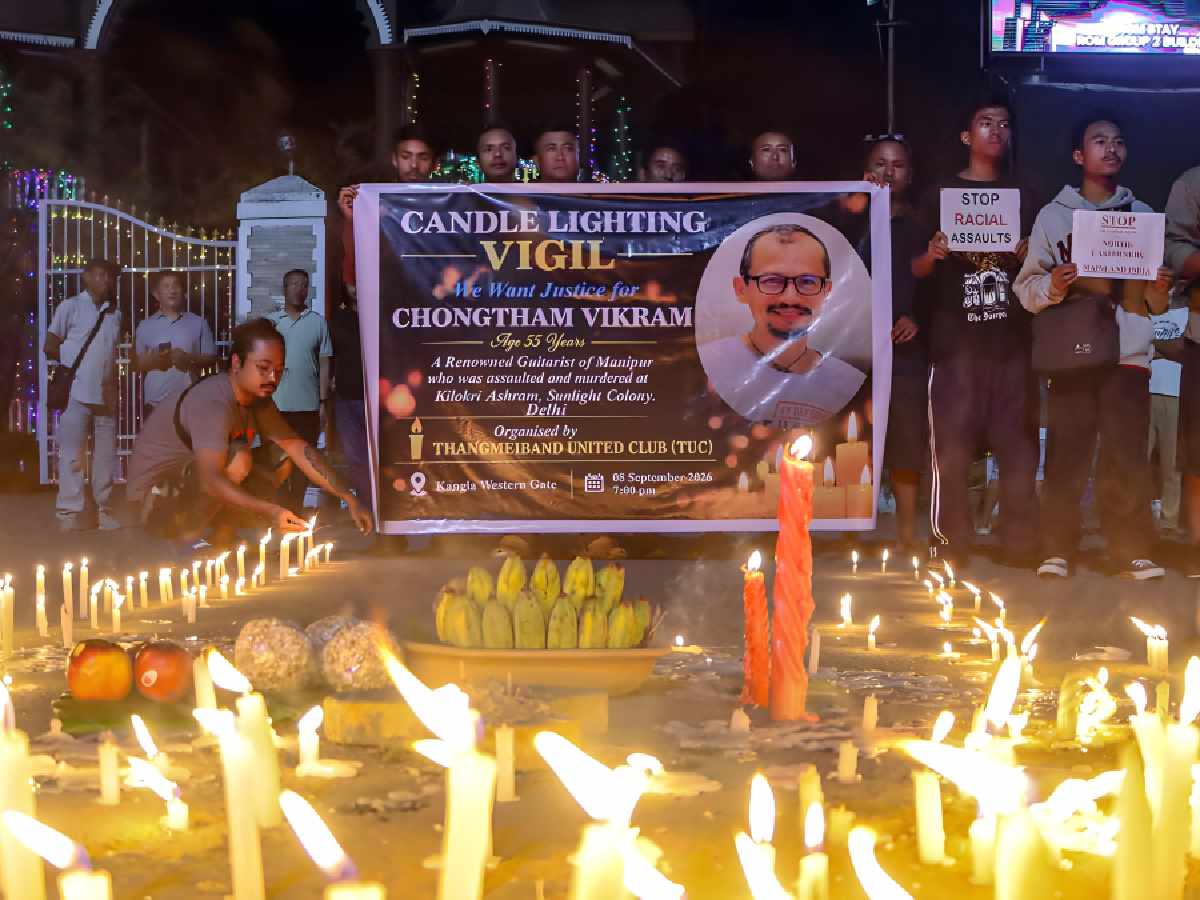
Candel light protest against the killing of musician Chongtham Vikram
The killing of Manipuri musician Chongtham Vikram Singh in Delhi has once again brought the safety of northeastern people into focus.
Singh, a well-known guitarist and music teacher who had lived in Delhi for years, was allegedly beaten by a group of men in Kilokari, South East Delhi, after he objected to noise outside his home. Police have arrested seven individuals and apprehended a juvenile in connection with the case. A post-mortem report found severe blunt-force injuries, including more than 10 fractured ribs and internal bleeding. Police are investigating the case, but have not established a racial motive for the killing.
For Northeastern students living in Delhi, the incident has reignited concerns over racial discrimination and hate crime.
Lack of understanding
Yumnam Paikhomba (name changed), a Manipuri student at Ramjas College, said one of the biggest problems is a lack of understanding of the region.
“People think that the North East is a uniform region while failing to understand that it has many communities with different histories, cultures, languages and traditions,” said Paikhomba.
“They think everything is the same, the food is the same, the culture is the same, the tradition is the same,” Paikhomba said.
He said such attitudes are particularly visible during college festivals, where Northeastern students perform traditional dances and wear traditional attire.
“When the fest happens, people want to attend those events, but they don’t respect the traditions,” he said.
“When they see students dancing in traditional attire, people can be judgmental rather than curious.”
Paikhomba stressed that this does not describe everyone at Delhi University.
“It is not all over DU,” he said. “But some people do it, and sometimes they do it intentionally.”
Paikhomba said Northeastern people are welcoming towards other cultures and believes other communities should also make an effort to understand and accept Northeastern cultures.
Regarding Singh’s death, he said, “Of course it scared me when the incident happened.”
He added that the incident affected him mentally, but he is trying to cope with it. At the same time, he knows that not everyone in the city is prone to hate crime.
‘Treat us as aliens’
For Taibanganba, a fourth-year Manipuri student at Shivaji College, the experience has been quite unsavoury.
“I would not call my experience extreme,” Taibanganba said, but recalled incidents where people used derogatory terms or behaved in ways that showed bigotry and racism.
During his first year, he recalled a group of North Indian students standing near the college gate. As he passed them, they questioned him and made comments.
Taibanganba said, “I was quite aghast at how insensitive people could be towards Northeastern people because they tend to look a certain way”.
For him, such behaviour is a form of “othering”, treating people as outsiders because they do not fit an idea of what is considered normal.
He said, “Northeastern people are treated as aliens”
Taibanganba believes this behaviour also has a psychological aspect. People can respond to things outside their idea of normalcy by distancing themselves from them or from people they see as different.
But he stressed that this is not a justification for racism.
Taibanganba also recalled another disturbing experience from last year after his phone was stolen at a market near the Red Fort-Jama Masjid area. He went to a police outpost to seek help. There, he said, a middle-aged police constable behaved inappropriately towards him.
The constable touched his hands and hair, commented on his hands and asked personal questions about whether he had a boyfriend or girlfriend, Taibanganba alleged.
Taibanganba did not report the incident.
He also made clear that he could not say the incident happened because he was Northeastern. He felt the constable may have considered him naive or foreign-looking and assumed he would not object.
Patriot reached out to Deputy Commissioner of Police (Central District) Rohit Rajbir Singh for a response but he declined to comment.
‘Terrifying experience’
Dhakeshor Sarangthem, 20, a third-year, fifth-semester student at Atma Ram Sanatan Dharma College, said he had heard about discrimination faced by Northeastern people before coming to Delhi.
Experiencing it himself, however, was different.
“I had heard about incidents faced by North East people back home, but experiencing them myself was very uncomfortable and terrifying,” he said.
During his early interactions, people asked him, “Are you from China?”
He also recalled hearing people whisper a racial slur about him.
“There’s always an indifference towards the notion that I don’t look like them,” he said.
Language became another difficulty.
During his first year, Sarangthem said he could not speak much Hindi and asked professors to use both Hindi and English.
“For the first five minutes they did that, and then Hindi took over,” he said.
He said he then struggled to understand what was being taught.
He also spoke about travelling by autorickshaw and public transport.
“Northeastern people can be charged more because they think we are not Indian,” he said.
For Sarangthem, these experiences have also raised questions about his safety. His parents have advised him to ignore mocking and teasing because they fear Northeastern people may be more vulnerable to harassment.
Yet he came to Delhi with ambitions and hopes of finding opportunities in the Capital.
Also Read: Umpires’ pay freeze a travesty of justice: Vinod Rai
“The racial discrimination and the abuse that we faced on an everyday basis shouldn’t be tolerated,” he said.
“I wish they thought that we are as Indian as they are.”
For Prachi, 27, a student from Assam, stereotypes about Northeastern people often centre on food, appearance and clothing.
She said people make comments that Northeastern communities eat “dogs, cockroaches or worms”.
The questions become particularly uncomfortable for her when she helps friends around Hornbill Festival events.
Prachi said people ask intrusive questions about Nagaland’s food culture.
“They really ask sometimes, ‘Do you eat dogs?’” she said.
She finds this surprising because different communities across India have their own food practices.
As a woman, she also encounters the stereotype that Northeastern women wear revealing clothes.
As someone from Assam living in Delhi, she said she has come to understand how people here think and behave, but the discrimination still affects her.
For her, the answer lies in accepting different cultures rather than judging them.
Being a woman from NE
Lanchenbi Urungpurel has worked closely with Northeastern student organisations in Delhi.
She completed her bachelor’s degree in Political Science from Ramjas College and her master’s in Political Science from the Department of Political Science, University of Delhi (DU). She served as General Secretary of the Northeast Students Society, Delhi University and President of the Manipur Students Association Delhi (MSAD) for 2025-26. She is currently the Vice President of the Northeast Association for Social Welfare.
“Saying someone is from the Northeast is not racist in itself,” Urungpurel said.
“The problem is when that identity becomes the basis for assumptions about appearance, speech, behaviour or whether they belong in the country.”
She said students face racial jokes, comments about their eyes and appearance, and questions about whether they are Chinese, Korean or “from outside India”.
“It happens inside and outside university including classrooms, hostels, public transport, markets, rented accommodation, tourist spots, roadsides,” she said.
“First-time Delhi students are especially vulnerable because they’re adjusting to a new city and away from home.”
Student organisations often become the first support system.
“Sometimes students first need reassurance that what happened was wrong and they are not alone,” she said.
Urungpurel said repeated discrimination can affect confidence, mental well-being and social life. Some students begin avoiding places because they fear being targeted.
She also wants universities to move beyond showcasing Northeastern culture through food, music and dance.
“Universities have sometimes treated North East students as ‘showpiece’,” she said.
She wants Northeastern students included in discussions on safety, discrimination, accommodation and welfare while their histories, literature and political experiences receive greater space in academic life.
Singh’s death, she said, has made students more fearful.
‘Manipuri students affected’
Laishram Kangleinganba Singh, the current President MSAD, said the organisation has worked for more than five decades against racial discrimination and harassment faced by people from the Northeast.
Singh’s death has deeply affected Manipuri students, he said.
The fear is particularly strong among students living in rented accommodation and paying guest facilities away from their families.
“They ask whether they’ll be protected if something similar happens,” Laishram said.
He said MSAD would continue to speak against discrimination and violence, stand with Singh’s family and seek justice through the law.
For Urungpurel, the experiences students describe are part of a larger pattern.
“Racism in Delhi against Northeasterns happens on a continuum, from jokes and stereotypes to exclusion, harassment and violence,” she said.
For students like Paikhomba, Taibanganba, Sarangthem and Prachi, the demand is not for special treatment. It is for a city where unfamiliar cultures are met with curiosity rather than judgment, and where students from the Northeast can study and live without constantly having to prove that they belong.
A four-storey building collapsed in Delhi’s Seemapuri area, killing a child and injuring at least…
These five markets offer attractive options for festive wear, traditional accessories, home décor and more.
An AI tool flagged 18,377 Delhi slum residents for TB testing after analyzing chest X-rays,…
Delhi Police reiterated that Jantar Mantar protests require 10 days' advance permission and caps attendance…
SC slammed civic bodies over poor maintenance of Delhi's heritage monuments, ordering top officials to…
Delhi HC directed the Centre to consider a plea for SOPs mandating 'always-on' body-worn cameras…
