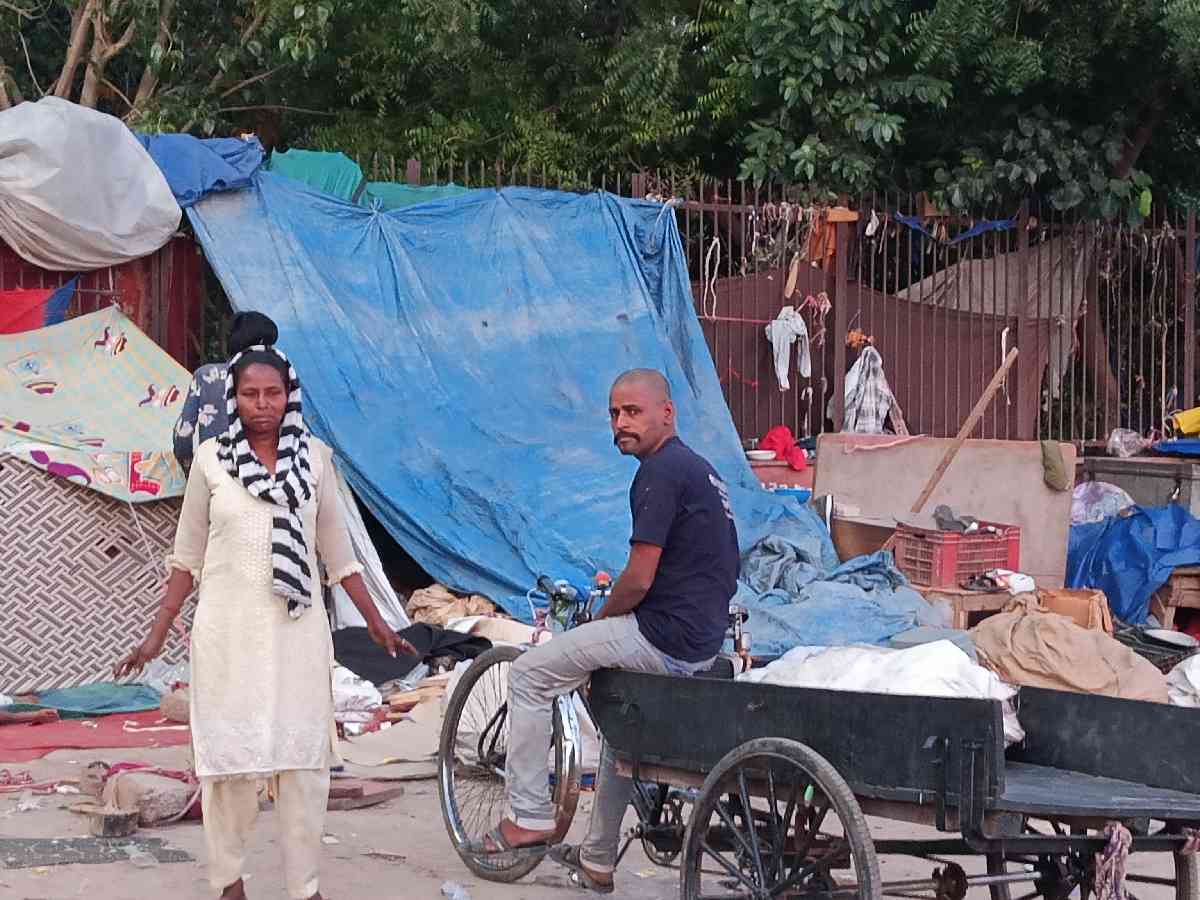
Rosy and Sonu have been residing here for the past 15 years
Delhi: Nestled along the path leading to Meena Bazaar near Jama Masjid, an empty plot of land overlooks the place of worship. Technically, the space was never demarcated by the government for any additional purpose and, over time, has turned into a makeshift parking area and a resting place for the homeless.
The people who stay on this barren stretch are among the most disenfranchised, unable to access even the nearby night shelter. According to the rain basera’s supervisor, entry is not allowed without Aadhaar.
“Nobody is allowed inside here without either permission or identity proof. A lot of people come here at night, but we cannot let people in if they do not have proof,” said Ujjwal.
The shelter, meant for families, leaves other homeless individuals with little choice but to occupy the open land.
Life on the margins
Tarpaulins hang across the boundary wall, creating fragile enclosures. Amid them, 17-year-old Hashim tries to calm a neighbour in a drug-induced rage. The exchanges are frequent and volatile.
According to Hashim, this is an everyday occurrence.
“I am going to be 18 in a few months, so I might just have to make my peace with living here,” he said.
He added that he currently visits the Jamghat NGO centre, which helps juveniles, to “get my mind out of the
life here”, but fears what lies ahead.
“It’s not just drugs that have eroded life here; even something usual like alcohol has made life impossible,” he said.
“I know that it is mostly because of poverty, but that cannot be the end of it.”
Looking at another altercation nearby, he added, “Aadha ladai nashe ke liye hi hota hai (Half of the fights happen around substances).”
Central Delhi’s smack problem
This is not an isolated pocket. Across Central Delhi, substance abuse has grown alongside a rising homeless population. While marijuana remains common, police say there has been a sharp rise in smack (heroin).
Also Read: TCS case brings focus on POSH as only 35% SHe-Box complaints see resolution
On April 14, a 36-year-old resident of Kishanganj, Pooja, was arrested by Delhi Police. Her whereabouts were revealed by Sameer, 30, who had been apprehended on April 7 with 8.6 g of smack. A case under the Narcotic Drugs and Psychotropic Substances (NDPS) Act has been registered, and further investigation is underway.
In another case on March 24, Hauz Qazi Police apprehended Mohammad Ali for drug consumption, leading to the uncovering of an interstate narcotics syndicate. During the investigation, three persons — Binod Kumar, Sonu Kumar Mandal, and Sanjit Kumar — were arrested in Todapur.
Police recovered 8.5 kg of cannabis and around 20 g of smack from Todapur and Raghubir Nagar, where another accused, Surender Prasad, was arrested. The probe eventually led to Bihar, where the primary supplier, Banti Kumar, was apprehended.
While such recoveries may appear limited, smack has long been a persistent presence on Delhi’s streets. Unlike Punjab, where relatively pure heroin is still used in some cases, Delhi is witnessing the spread of adulterated variants, often leading to severe health consequences.
Addiction and mistrust
Among the homeless population, substance use is widespread.
“Everybody uses something or the other,” said Rosy, who lives under a tarpaulin on the same plot. “Even if somebody is taken to a rehabilitation centre, they return with the same, if not more level of addiction. They remain distraught and jittery, then the next high hits.”
Volunteers from de-addiction centres are often viewed with suspicion.
“They try to come and teach us how to ‘live’ without understanding how our lives really are,” said a resident.
A similar pattern is visible in Anand Parbat, where low-quality smack and inhalants are easily available.
“There is a fight almost every day because of how accessible inhalants are,” said Mohit, a resident. “Almost everyone in these slum clusters takes solution. The first ‘high’ is always nice, but then the fights start.”
Identified hotspots
Deputy Commissioner of Police (DCP), Central, Rohit Rajbir Singh said several areas have been identified for high drug availability.
“There are a few areas where we have found high availability and are cracking down on them,” he said.
“These include Paharganj, Anand Parbat, Jama Masjid, Daryaganj, and Hauz Qazi. Multiple raids have been carried out in these areas.”
He added that alongside cheaper drugs, there has been a rise in premium substances.
“Recently, in a raid, we were able to recover MDMA (ecstasy) at a bar in Paharganj,” he said. “Recoveries technically mean that there is high availability of the substance on the streets.”
This shift has also led to rising prices for cheaper intoxicants.
Smack and solution: twin pressures
Sonu, a homeless resident near Jama Masjid, said drug prices have surged. “Earlier it was Rs 50 to Rs 70 for a tube, but now the prices have started rising every day,” he said.
“Right now, a single tube of solution might cost over Rs 200. If one person is addicted, they will arrange for the money no matter what.”
The ‘high’ remains the destination, and the cause for each night feeling like stepping on a minefield. According to the police, there is at least one PCR call from the area every night.
“They just become more violent. I wish I knew how to help them, but I am helpless,” said Rosy. “Even the NGO people gave us some medicine to cure the others’ addiction, but the addicts threatened them away.”
“I want them to leave their addiction, but I do not know how,” she added
Between enforcement and neglect
A senior police officer said action against users is complicated.
“It gets impossible to actually take any action against consumers since they are only in this situation because of personal difficulties,” the officer said. “Employment and awareness are the only two ways through which the issue can actually be solved.”
However, residents allege neglect by authorities.
“They do not come to help us ever,” said Hashim. “The cops only come here to tell us to remove our belongings and our tarpaulins. They see the kids and young people abuse smack and solution, and they do not do anything. They just look at us with remorse.”
Built on Jawaharlal Nehru’s vision, the Delhi landmark has witnessed the evolution of a young…
Delhi steps up NCR coordination to curb winter air pollution by enforcing strict border checks…
Police probe all angles, including a suspected breakup and CCTV footage, after a Class 12…
Two terror attacks, eight years apart, struck ordinary shoppers and changed festive celebrations in the…
NDMC to build a larger tulip garden with parking at Nehru Park, featuring seasonal blooms,…
A 17-year-old student was found burnt at an east Delhi school, with police probing a…

