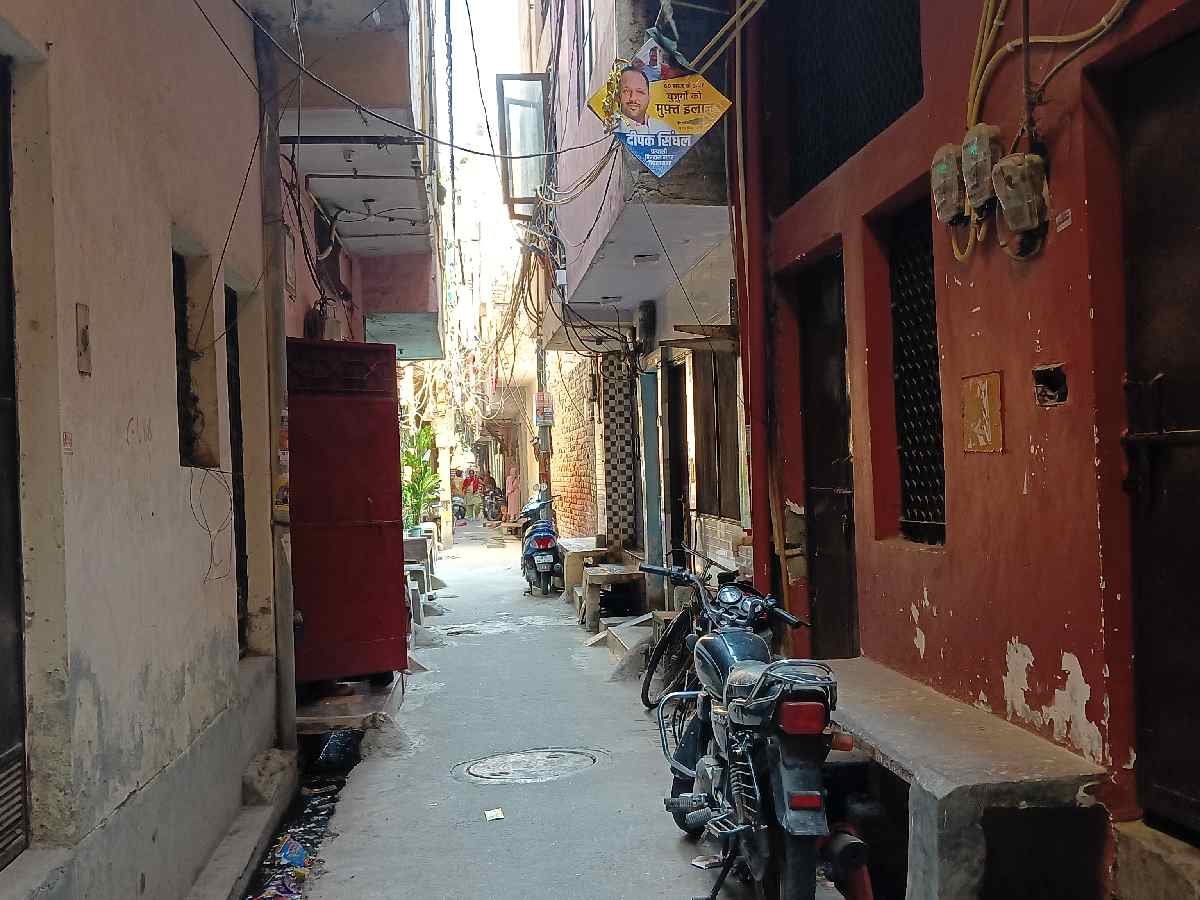
Bhikam Singh Colony's alley where the murder took place
Inside Farsh Bazaar’s cramped alleyway, where a gruesome murder unfolded last year, silence cloaks the memory of that night. The residents—some in denial, some indifferent—continue to live in the shadow of a tragedy no one wishes to remember. For those who do, the memory returns with immense heartache.
With each passing day, trust among neighbours erodes. The cause of the conflict that ended in death? A shared necessity that has become a luxury in the national capital: water.
On April 15, 2024, the Delhi Police arrested a 15-year-old girl for allegedly stabbing a neighbour to death during a dispute over water from a common tap in Farsh Bazaar. The incident took place on April 13.
The victim, Soni, a 34-year-old woman, was declared dead on arrival by doctors at Hedgewar Hospital.
She had sustained multiple injuries, including cuts on her left hand and a stab wound in the stomach. A PCR call was made at 10:59 pm, reporting that the caller’s wife had been stabbed and needed immediate medical assistance.
Shared space, shared tension
Investigations revealed that Soni and her husband, Satbir, had been in conflict with their neighbours. The house’s first floor had four rooms—three occupied by separate families and one reserved for the owner. A common toilet and tap served all tenants, with a small space nearby used for washing clothes and utensils.
On April 13, the mother of the juvenile was filling a tub to wash clothes. Soni, wanting to wash utensils, removed the tub before it was filled. The mother, who had to leave for work, argued with Soni over the shared space.
Later that evening, an intoxicated Satbir confronted the juvenile’s family. During the argument, Soni allegedly twisted the girl’s hand, prompting a visit to Hedgewar Hospital, where she was treated as a non-Medico Legal Case patient. An X-ray was conducted on her hand.
According to the police, after returning home, the girl and her mother got into another altercation with Soni and Satbir. During this second clash, the girl allegedly stabbed Soni.
She was apprehended under Section 302 (murder) of the Indian Penal Code. According to residents, the girl was later released on bail and her family has since moved away. The deceased’s family has also left the neighbourhood.
A year later, the crisis that triggered the tragedy—access to water—remains unresolved in this part of Shahdara. The building where the murder took place still relies on a single tap to serve all its tenants. But this is only part of a larger problem: the locality’s lack of access to clean and sufficient water.
Clean water, a distant dream
Farsh Bazaar and neighbouring areas receive Delhi Jal Board (DJB) water just twice a day—once in the morning and once in the evening. During summer, this supply becomes even more erratic, and clean water becomes scarce.
Some households use borewells and submersible motors, but with depleting groundwater levels, the water is often contaminated. In Bhikam Singh Colony, residents complain about a severe drop in water availability.
Also Read: Delhi battles an alarming rise in motor vehicle thefts
“We have lost trust in the water we receive,” said Javed Mohammed, a resident of Gully No 2, where the murder occurred. “Half the time, emergency services don’t show up. I don’t have a submersible pump, but I had boring done. It was feasible at first, but now with the depleting groundwater, there’s no way out.”
Following the incident, DJB began drilling deeper connections in the area, as the existing pipelines reportedly merge with sewer lines. “Since the two lines overlap, we get extremely dirty water, unfit for any household use. We just have to make do sometimes,” he added.
Construction adds to water stress
Meanwhile, construction near the Krishna Nagar metro station—particularly of the office of former East Delhi Member of Parliament Gautam Gambhir—has further strained groundwater access. Residents blame it for worsening their water woes.
“The construction has led to immense groundwater depletion,” said Anuj Vashisht, another resident of Gully No 2. “We’re the last in a string of alleys receiving DJB water. By the time it reaches us, it turns murky, especially if we switch the motor on at odd hours. Most of our water now comes from cans bought from nearby shops.”
Vashisht once used an RO purifier, but the poor quality of water—contaminated due to sewer and water pipeline overlap—made it ineffective.
Cordiality replaced by caution
While no violent altercations have occurred since the incident last year, the mood in the community remains strained. Interactions have become minimal, reduced to nods and greetings—if that.
“There’s only suspicion,” said Mohammed. “And with the summer, it will only rise with the temperature.”
The crisis in Shahdara reflects a larger pattern across Delhi. In many parts of the city, especially in the North East, access to clean drinking water remains elusive. For these residents, DJB’s emergency water supply services are often their only hope—and even that is a fragile one.
Established to mark the university’s 25 years, Jubilee Hall has witnessed generations of student life.…
Delhi inaugurates the 70th National School Games, hosting over 14,000 participants in 14 sports across…
Delhi High Court asked "Doosra" filmmakers to respond to Sourav Ganguly's plea over alleged violation…
Delhi L-G appointed Paralympian Suvarna Raj as State Commissioner for PwDs following her gold win…
DDA is planning Delhi's longest 24-km cycling track along the Yamuna floodplain, linking key eco-projects…
Police detained several anti-SIR protesters heading to the ECI headquarters in Delhi as mass gatherings…

