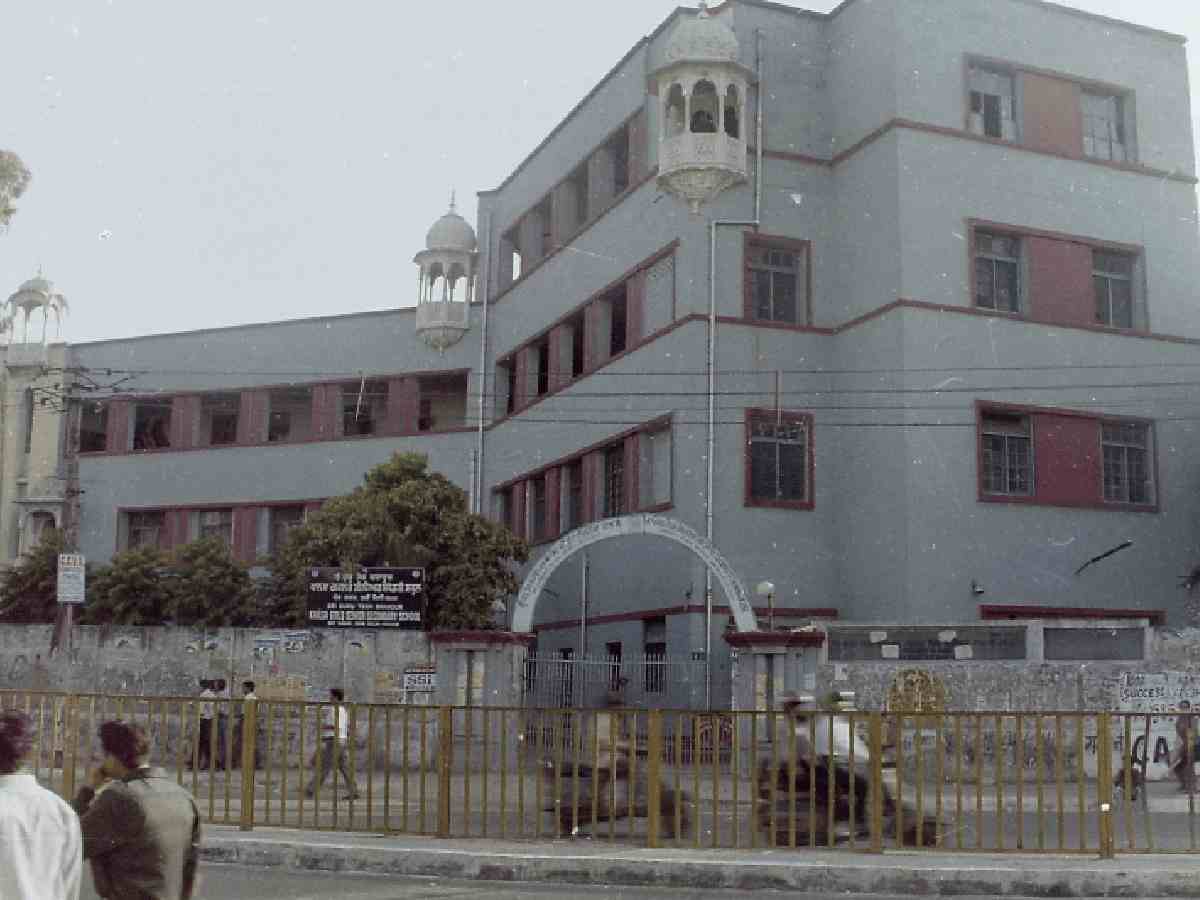
Sri Guru Tegh Bahadur Khalsa College
Khalsa College, established in 1951 in the crowded Dev Nagar area of Karol Bagh, is celebrating its 75th anniversary.
Over the decades, the college developed a distinct identity through the careers its students went on to pursue. There used to be a joke in the Capital that if one wanted to join the Delhi Police, one should first join Khalsa College, Karol Bagh. Countless alumni later served in the Delhi Police. Bhure Lal, a distinguished IPS officer, also studied here in the 1960s.
Few people explain why so many alumni of Khalsa College entered the Delhi Police. Professor Harmeet Singh, who taught Punjabi and later served as Principal of the college, recalls that job opportunities were limited in those days, so many students opted for police careers.
Among those remembered with pride is Kargil war hero Captain Vijayant Thapar, who studied at the college.
A vision takes shape
In the difficult years after the Partition of India, thousands of Punjabi families arrived in Delhi as refugees. They had lost homes, land and loved ones. Education became a way to rebuild lives. It was in this setting that Khalsa College was established. The college owed much to the efforts of the Sikh leader Master Tara Singh.
Old timers recall that Master Tara Singh faced considerable opposition while trying to establish the college. Once, a procession led by him from Gurdwara Sis Ganj to Karol Bagh was lathi-charged. It was organised to put pressure on the government to allow the college. Master Tara Singh’s role reflected his lifelong interest in education and Sikh community welfare. He had earlier worked as a teacher and headmaster and had helped set up other educational institutions for the community. Khalsa College grew out of that vision of service through education.
“Khalsa College was ideal for young men who worked in the morning and studied in the evening. It offered evening classes as well, making higher education accessible to those who had to support their families while continuing their studies,” says banker and former alumnus Kulbir Singh.
The early years
The college started functioning from a newly built wing of the Khalsa School with just 19 students and 15 teachers. Bawa Bachittar Singh served as the founding president of the governing body. A well-known businessman of Delhi and local political figure, he played a pivotal role in providing the institutional leadership and community support needed to launch the college in its earliest, most precarious years. Professor Gurbachan Singh Talib, a respected Sikh scholar, became the first principal. He had come from Khalsa College in Mumbai to take charge. The college quickly became a constituent institution of the University of Delhi after an amount of Rs 2 lakh was deposited with the university. This step was taken following a meeting at Gurdwara Bangla Sahib, where community leaders, including Sardar Baisakha Singh, took the lead.
Among those involved in establishing the college was Sardar Baisakha Singh, a key builder in New Delhi. As part of the celebrated group of Sikh contractors often called the “Panj Pyare” of the capital’s construction, he was responsible for the North Block of the Secretariat and several official bungalows. His involvement in the founding of Khalsa College reflected the same spirit of community service that had earlier helped shape the physical landscape of the new capital.
An academic legacy
The college also attracted distinguished teachers. One of the notable teachers of that time was Professor Frank Thakurdas, who taught Political Science. He brought deep knowledge and a strong commitment to quality teaching. Later, he moved to Kirori Mal College.
Many teachers helped shape the character of the college. Professor Gurbachan Singh Talib set high academic standards in the early years. Other early faculty members brought experience from pre-Partition Punjab and helped create a serious atmosphere of study. Former Rajya Sabha member Janardan Dwivedi also taught here for several years. For many years, Ashok Prasad, who now teaches Chemical and Biological Engineering at Colorado State University, was also on the faculty.
“The college focused on both modern academic subjects and the teaching of Punjabi. This balance helped students stay connected to their roots while preparing them for the future. The first batch of students appeared for Delhi University examinations in 1952,” informs Professor Harmeet Singh.
A new campus
As student numbers grew, the college needed more space. In the 1970s, the main campus of Khalsa College came up at University Enclave in Delhi’s North Campus. The move took place in 1973. The new campus was inaugurated on March 22, 1973 by then Prime Minister Indira Gandhi. The Karol Bagh institution thereafter became known as Guru Nanak Khalsa College and later as Sri Guru Tegh Bahadur Khalsa College.
“The original aim of educating refugee families has grown into a wider mission of quality education for all while keeping Sikh values of service, equality and courage alive,” says Kulbir Singh.
The journey of Khalsa College shows what determined community effort can achieve. Master Tara Singh and other community leaders laid its foundations. Generations of teachers and students have since built on them. The college continues to look forward, true to its motto, while remembering the hard years in which it was born.
Coforge opened its first library in Noida in February 2024; it now claims a combined…
Of the 237 spa centres across 10 zones with valid MCD licences, the South East…
CTI chairman Brijesh Goyal said the Rahul Gandhi rally could affect wholesale and retail markets…
Established to mark the university’s 25 years, Jubilee Hall has witnessed generations of student life.…
Delhi inaugurates the 70th National School Games, hosting over 14,000 participants in 14 sports across…
Delhi High Court asked "Doosra" filmmakers to respond to Sourav Ganguly's plea over alleged violation…


