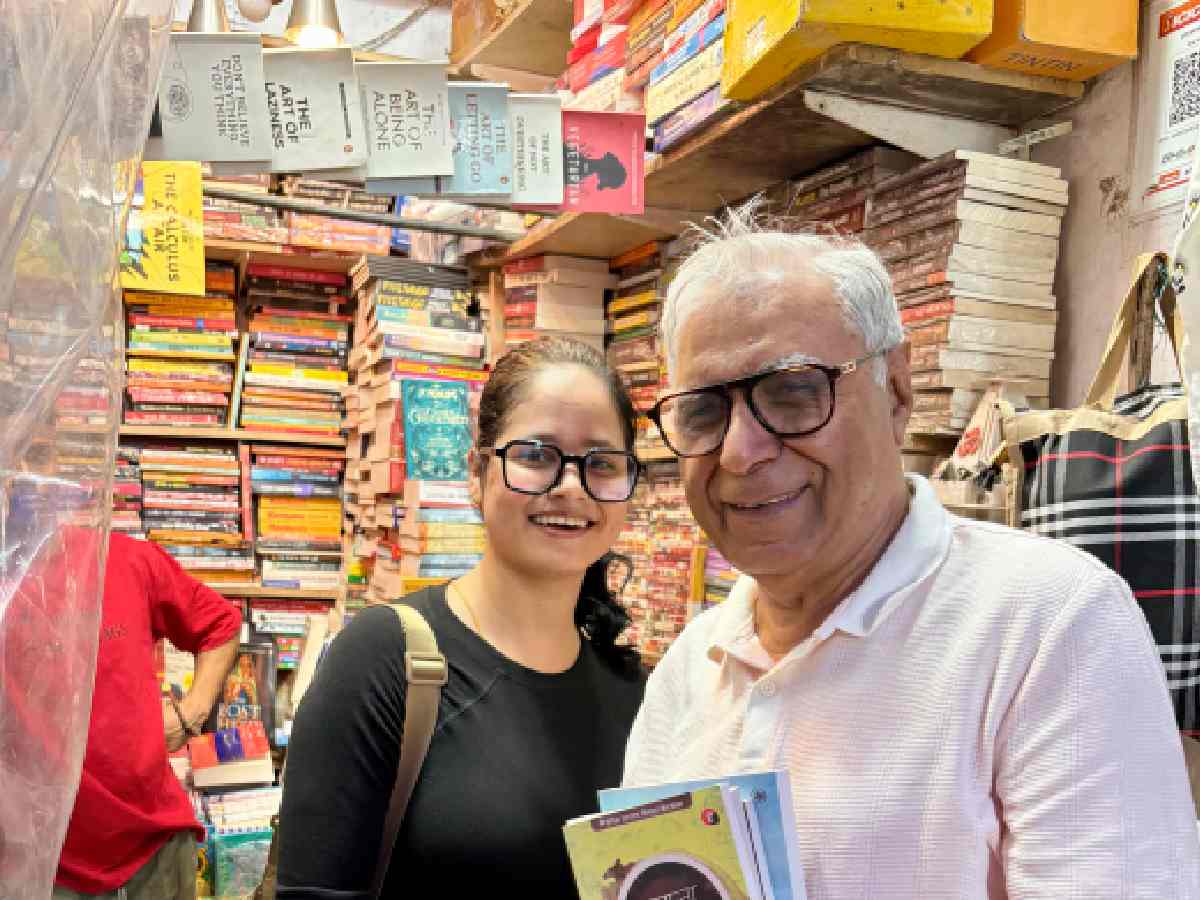
Subhash M Kashyap alongside Neet, a loyal patron, at the bookstore
Tucked inside a clothing shop in Delhi’s bustling Janpath Market, British Book Depot is easy to miss unless books are your lifelong companion.
As you walk through the lane, a small cardboard sign quietly points towards the entrance. Step inside, and you find shelves packed with books of every genre. At the entrance, handwritten boards reading “Pick Any Book Rs 49” and “Pick Any Book Rs 99” catch the eye. Many of these books were once bought from the store, read and returned by readers under its unique half-price return policy. They now wait for a new owner.
Behind these shelves lies a story that began before Independence, survived the Partition and has endured through a simple idea that has served generations of readers.
For octogenarian Subhash Murada Kashyap, the bookstore is more than a business. It is the continuation of a legacy started by his father, freedom fighter Lala Tota Ram, and is rooted in a simple belief: that no child should miss out on reading for want of affordable books.
“I planted this tree myself,” Kashyap says. “I started this scheme for children who want to read but cannot afford books. If a child is deprived of books because of money, our country will be left behind. We have to begin somewhere.”
The half-price return policy was never conceived as a marketing strategy. It grew out of memories of hardship.
“I had two things in mind,” he says. “One was affordability for children and the other was the environment. A book should be read by many people instead of lying unused.”
Where it all began
The story of the bookstore begins far away from Delhi.
Before Partition, the family’s bookstore stood in Dera Ismail Khan in present-day Pakistan. Located in Chhota Bazaar, it was a well-known establishment run by Lala Tota Ram. But the violence of 1947 forced the family to leave everything behind overnight.
“There was fighting everywhere,” Kashyap recalls. “Whatever we had earned, whatever we had built, everything was left behind. We came to India with nothing.”
The family arrived in Delhi through the rehabilitation programme and was allotted a house in Rajinder Nagar. Kashyap was only a few months old when they crossed the border and has no personal memory of the migration, but he grew up listening to stories of the loss his family endured. But reopening a bookstore had to wait. Survival came first.
His father began selling newspapers, and young Kashyap soon joined him.
“When I was five or six years old, my father would make me sit on the bicycle and take me along to distribute newspapers. We sold the Times of India, the Indian Express, Patriot and many others. Newspapers cost 10 paise then, and we earned just one paisa on each copy. Today, people cannot imagine how a family could survive like that, but that was our life.”
Books slowly returned to the family’s life because newspapers and publishing were closely connected. After years of distributing newspapers, Lala Tota Ram started selling books from a small footpath stall near the site where Palika Bazaar now stands. Kashyap helped him after school, unknowingly laying the foundation for what would later become one of Delhi’s best-known second-hand bookstores.
A life of service
His father’s life extended beyond books.
A freedom fighter associated with the Congress movement, Lala Tota Ram shared close ties with several national leaders. According to Kashyap, freedom fighters and political leaders visited their Rajinder Nagar home. He also recalls his father’s close association with Aruna Asaf Ali.
“My father sacrificed a lot for the country,” Kashyap says. “People told him to take advantage of his position and accept favours from the government, but he would always refuse. He used to say, ‘My children will work hard.’”
During the rehabilitation of refugees after Partition, Kashyap says his father’s integrity earned him respect.
“People knew my father was honest. Refugees who had come from Pakistan would approach him because they had nowhere to stay. If my father certified that someone had come from Pakistan, the authorities trusted his word. He could have misused that influence to make crores, but he never did.”
Those lessons shaped Kashyap’s own life.
Despite financial struggles, he completed his education, worked as an accountant with Quality Ice Cream and later at the USSR Cultural Centre in Kerala before returning to Delhi. Yet books were always his true calling.
“I always had an interest in books,” he says. “I became associated with the National Book Trust, organised book exhibitions and finally opened this shop.”
The present store in Connaught Place is around four decades old, but Kashyap considers its origins much older.
“People write that this shop is over 100 years old because the journey began with my father’s bookstore before Partition. This is the same legacy. I simply inherited my father’s shop.”
The story behind the name
Even the name, British Book Depot, has its own story.
According to Kashyap, his father initially ran a shop called Brothers Bookstall. During British rule, he wanted the agency for the popular British magazine Woman and Home. The publishers told him the agency would only be granted if the shop carried a British name.
“So we changed it to British Book Depot,” Kashyap says. “The name has stayed ever since. Every time I see it, it reminds me of my father.”
The idea behind the half-price return policy emerged only after he had been running the shop for a few years.
“Children would come and tell me, ‘Uncle, these books are too expensive. We cannot afford them.’ Every time they said that, I remembered my own childhood. My father could not even afford five rupees for tuition. We struggled to buy books ourselves. That memory never left me.”
The gift of reading
He decided that students could buy books, read them and return them in good condition for a 50% refund. The system encouraged reading while making books affordable for families with limited means.
The response surprised him.
“Children thank me all the time. Some have been coming here for years. I don’t focus only on earning money. I feel I am helping educate the country.”
In the spotlight
Long before the bookstore found a permanent home in Janpath, the family’s footpath stall had become a familiar stop for several prominent personalities. Recalling those days, Kashyap counts former President Giani Zail Singh and Congress leaders Sanjay Gandhi and Jagdish Tytler among the visitors. He believes many of them knew his father because of his role in the freedom movement and his work with refugees after Partition.
The recent attention the bookstore has received on social media has delighted many of its long-time visitors.
“I have been coming here ever since I first explored Janpath after moving to Delhi for my studies in 2017,” says Ramya, a regular customer. “It feels so good to see uncle finally getting the appreciation he deserves. This recognition was long overdue, and I’m happy that more people are now discovering this place.”
Today, the shop houses between 10,000 and 15,000 books ranging from fiction and biographies to academic titles, religious books and competitive exam guides. When asked about his own favourite, Kashyap smiles and points to Mindset by Dr Carol S Dweck.
The real reward
Despite the fame, Kashyap says recognition was never what kept him going.
“I was never hungry for appreciation,” he says with a smile. “For all these years, I have simply sat here, meeting children and readers, greeting them and listening to their stories. Now that people have started appreciating this work, it feels good. My family is happy too.”
For Kashyap, the greatest satisfaction comes not from virality or online recognition, but from watching a reader walk into the tiny bookstore, leave with a book they can afford, and return for another. That, he says, is how his father’s legacy continues: one book, one reader and one generation at a time.
From November 1, non-BS-VI vehicles registered outside Delhi will be restricted; workers who cross at…
Jamia Millia Islamia extends online classes and mid-term exams until Nov 8 following campus protests,…
The proposed Nov 1 Congress rally at Ramlila Maidan could severely disrupt peak festive business…
A youth was allegedly stabbed to death in northwest Delhi’s Pratap Vihar after a dispute…
Jamia students continue their 16-day protest, demanding a definite election date and a timeline for…
Delhi recorded its lowest October minimum temperature in three years at 15.3 degrees Celsius, while…
