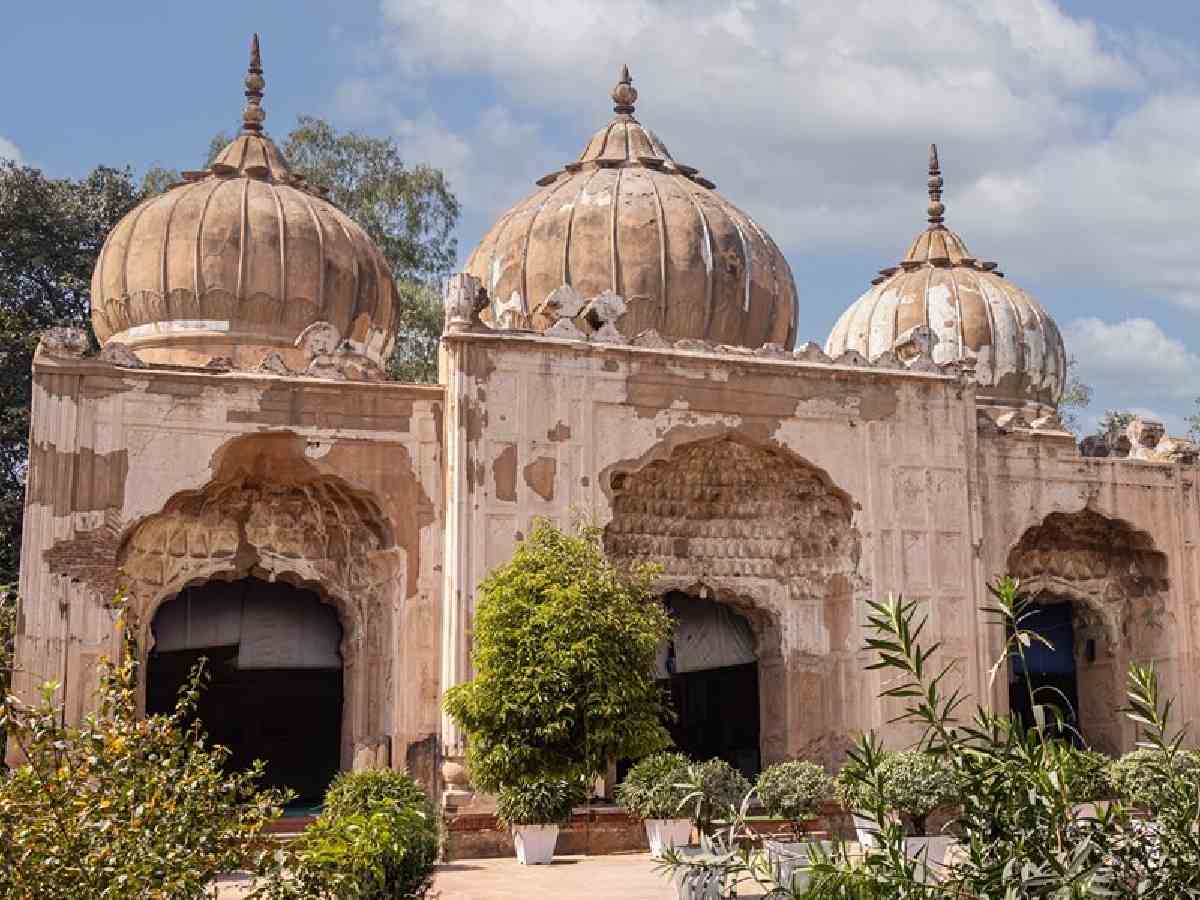
Shahi Masjid Qudsia Bagh
Even as the sun burns fiercely, we wander through the narrow lanes and by-lanes of historic Mehrauli in South Delhi. As we move past the dargah of Hazrat Qutbuddin Bakhtiar Kaki, the air carries the sweet scent of devotion, with several devotees present. Very close to the saint’s resting place stands Zafar Mahal, the last monumental building constructed by the Mughals—not just in the capital, but in the whole of India. Local children play cricket on the dusty ground even as the temperature touches 42°C. The heat does not deter them.
19th-century retreat
Built in phases, Zafar Mahal dates back to the time of Akbar Shah II in the early 19th century as a cool summer retreat. Bahadur Shah Zafar II later expanded it between 1842 and 1848. The imposing red sandstone gateway, delicate jaali screens, arched pavilions, and three-storey structure still overlook quiet courtyards.
Rajinder Kumar, a local social worker who knows every stone of Mehrauli, walks with us. He is saddened that Zafar Mahal, despite its importance, receives little care from the authorities or the tourism department. “Visitors come to Delhi to see symbols of the Mughal period, but they must also see this crumbling Zafar Mahal.”
Touch of breeze
We climb the stairs, feel the breeze under the ‘chhajja’, and stand beside the empty graves meant for emperors. Bahadur Shah Zafar wished to rest here beside the saint, but after 1857 he was exiled to Rangoon (then known as Yangon, the largest city and commercial hub of Myanmar, formerly known as Burma). As William Dalrymple writes in The Last Mughal, “Delhi was once a paradise, / Where Love held sway and reigned; / But its charm lies ravaged now / And only ruins remain.”
From Panipat, where Babur’s victory over Ibrahim Lodi in 1526 laid the foundation of Mughal rule in India, to the final chapter in 1857, numerous well-known and lesser-known buildings, mosques, and gardens sprang up across Delhi. Beyond the famous Jama Masjid and Red Fort, the city hides quieter stories of Mughal heritage.
Noise of city
After Zafar Mahal, we drive to Qudsia Bagh near Kashmere Gate. Amid the noise of the city stands the graceful baradari built by Qudsia Begum, wife of Muhammad Shah. Its lonely pavilion, once part of a grand palace, offers rare peace.
Not far from Qudsia Bagh lies the ruined Dara Shikoh Library. Dara Shikoh, the eldest son of Shah Jahan, loved books and philosophy. He built this as a place for learning and discussions with saints. Though only parts of the structure remain, one can easily imagine scholars reading Persian and Sanskrit texts inside. It feels like a forgotten corner of Mughal wisdom.
In north Delhi’s Shakti Nagar, Roshanara Bagh feels even more intimate. Shah Jahan’s daughter Roshanara Begum created this charbagh garden in the 1650s. Today, it is semi-wild. Her marble-domed tomb and baradari sit quietly among trees and birds.
Monsoon clouds
Not far from Chandni Chowk in Daryaganj stands the elegant Ghata Masjid, also known as Zeenat-ul-Masajid. Commissioned around 1707–1710 by Princess Zeenat-un-Nissa, the second daughter of Emperor Aurangzeb, this mosque was built on the banks of the Yamuna. Its three domes feature striking black and white bands resembling monsoon clouds. Historian Feroz Bakht Ahmed notes that it is a smaller replica of the grand Jama Masjid. The mosque features red sandstone, marble, tall minarets, and a spacious courtyard. It is historically significant as one of the last major Mughal religious commissions during the empire’s waning years. After 1857, it suffered damage and was repurposed as barracks and a school, yet it endured. Its riverside location once welcomed travellers arriving by boat, underscoring its role in Mughal Delhi’s sacred and civic landscape. Zeenat-un-Nissa must have seen the majestic Jama Masjid built by her grandfather, Shah Jahan. That would surely have inspired her to build another mosque similar to it.
No exploration of Mughal Delhi is complete without Humayun’s Tomb. Built in 1570 by Empress Hamida Banu Begum for her husband, Emperor Humayun, this UNESCO World Heritage Site pioneered the grand garden-tomb tradition on the subcontinent. Noted author and journalist Rehan Fazal mentions that the headless body of Dara Shikoh was buried here. It is believed that nowhere else do so many important members of the Mughal clan rest in eternal sleep as they do in Humayun’s Tomb complex.
Arab ki Sarai
If we talk about Humayun’s Tomb, we cannot miss Arab Ki Sarai, also built by Empress Hamida Banu Begum. After her Hajj pilgrimage to Mecca, she brought back around 300 Arab workers and scholars, who were given housing in what later became known as Arab Ki Sarai. India’s first ITI was later set up here. The impressive gateway of Arab Ki Sarai still welcomes visitors. Beautifully restored by the Aga Khan Trust, the sarai’s quiet courtyards and chambers offer a peaceful glimpse into Mughal cultural exchange.
“I sincerely feel that the concerned authorities are duty-bound to take care of lesser-known monuments built by the Mughals or other dynasties. They are part of Delhi’s heritage. They ought to be looked after,” concludes Ujjwal Upadhyay, a South Delhi-based architect and town planner.
Elected to the Delhi Golf Club general committee, Mansher Singh says he wants to build…
A $780 million market built on pavements, where the pleasure of reading meets the price…
Supreme Court advocate Abhishek Pawar alleges women were denied washroom access for seven to eight…
Each day of closure costs shops in Khan Market and Connaught Place between Rs 60,000…
Delhi generates nearly 15,000 tonnes of waste daily, prompting the government to deploy 1,000 mechanical…
Delhi Police has issued an NOC for the Congress rally at Ramlila Maidan on November…

