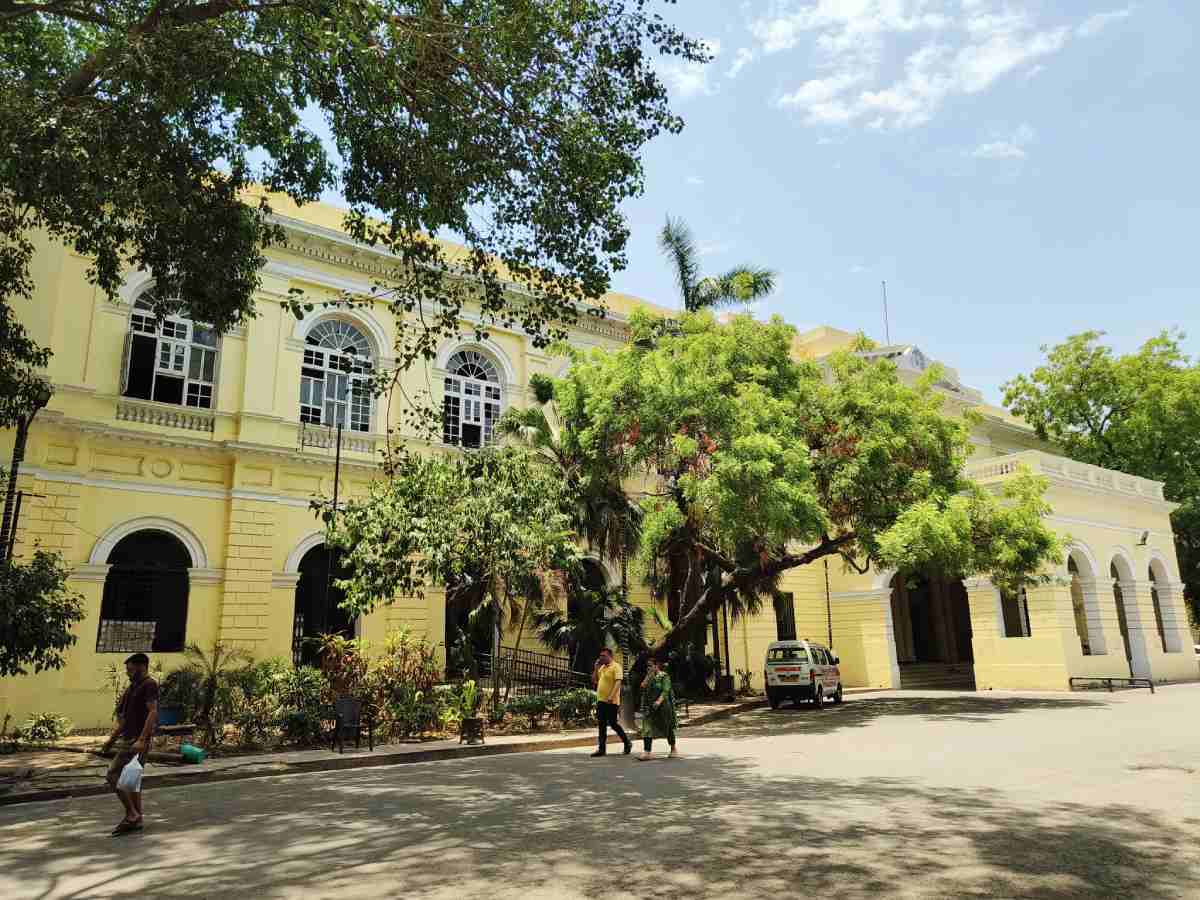
FAILED PROJECT: The municipal corporation first proposed to convert Town Hall into a heritage hotel in 2008. However, it had to be shelved due to lack of interest from hoteliers
The historic Town Hall stands quietly in the cacophony of Chandni Chowk. A witness to the changing face of Delhi for about 160 years, it is a landmark most Delhiites have long identified with. Now it is all set to become a Global Heritage Centre.
The ownership of the new structure will stay with the civic body, as per an agreement signed on September 20 by the Municipal Corporation of Delhi and the Delhi government to restore the Grade-I heritage complex. The project covers the Town Hall, the old Press Building and the adjoining park. Tourism officials will first survey the structure and then prepare a detailed plan.
A British legacy
What for most of its history was known as the Town Hall was built by the British. After the 1857 uprising, the British tore down many Mughal buildings that symbolised the old power. They cleared the site at Chandni Chowk and raised a new building made of yellow bricks. Work began in the 1860s and finished by 1863 or 1866.
The building held a library, a reading room, a small museum and rooms for Europeans. The stated aim was to “improve the local minds” and bring Europeans and Indians together. In 1866, the Delhi Municipality purchased the building for about Rs 1.35 lakh and turned it into the Town Hall. From then until 2010, it remained the city’s civic headquarters.
A new centre for an old city
Why did the British have to construct this large building when they built so little else in Delhi between 1857 and 1911?
“Delhi was no longer the imperial capital. Calcutta held that title. Yet Delhi still mattered. It was a great trading city. Railways had reached it. The walled city remained crowded and commercially alive. The British needed a visible civic centre inside Shahjahanabad itself. A town hall, a library and a municipal office in the middle of Chandni Chowk were necessary to collect taxes and look after
sanitation and markets. [The centre] replaced a Mughal rest-house with a Victorian civic hall. That was the point,” informs veteran journalist KN Gupta.
A Victorian imprint
No single famous architect is named in the records; after 1857, many public works were designed by military engineers and colonial public-works teams rather than celebrity architects. The style is simple Victorian: two storeys of yellow-painted brick and stone, white carved trim, a solid official look. It was meant to look like a city hall in England, planted on a Mughal square.
A bronze statue of Queen Victoria once stood in the front of the building. After Independence, it was removed, with a statue of Swami Shraddhanand taking its place on the main façade. In the gardens behind the building, on a circular pedestal, stands a statue of Mahatma Gandhi. The pillar carries his words about self-reliance and the spinning wheel in English, Hindi and Urdu. It is regarded as the first statue of Gandhi in the capital after his assassination.
The Gandhi statue was the work of Sadashiv Rao Sathe and was installed here in 1952. Sathe was just 28 when he designed it. He later sculpted two other statues in the capital, including that of Chhatrapati Shivaji near Minto Bridge.
Close to the people
Meanwhile, a portrait of Gandhi was unveiled by Sardar Patel in 1950.
“It is a majestic building and I have closely watched it when I was a Municipal Corporator from Vivek Vihar around 15 years ago. Town Hall stayed close to ordinary Delhi because it sat in the middle of everyday life. Chandni Chowk traders, shopkeepers and residents walked past it every day. The municipality met here. The public library was here. Elections and public meetings happened here,” says Jitender Singh Shunty, now a member of the Human Rights Commission of Punjab.
“The area around the Town Hall was called Ghantaghar after the old clock tower that once stood opposite. Even after the tower fell, people still used the name. For 145 years, the city’s municipal affairs — from taxes and licences to water and roads — were administered from these walls. When the corporation finally moved to the new Civic Centre in 2010, the building fell quiet. Yet the square never emptied. Markets, processions and morning walkers still treat the place as their own,”says social worker Ashish Verma, who used to visit here with his father Hari Chand Verma, a MCD member from Hauz Qazi.
A new chapter
The museum plan matters. A civic museum here can show maps, old photographs, municipal records and the story of how Delhi governed itself after 1857.
“The Town Hall was never only a British office. It became the place where Delhi practised local government, argued about the city, and later placed Gandhi’s image where Victoria had stood. Turning it into a heritage centre with a museum will not invent a new meaning,” says Ajay Pande, who covered the MCD for a leading newspaper for many years.
If the restoration is carefully done, visitors will walk through the same halls where councillors once sat and then step out onto Chandni Chowk — still noisy, still crowded, still the real city the building was built to serve. That continuity is the real story of Town Hall.
A $780 million market built on pavements, where the pleasure of reading meets the price…
Supreme Court advocate Abhishek Pawar alleges women were denied washroom access for seven to eight…
Each day of closure costs shops in Khan Market and Connaught Place between Rs 60,000…
Delhi generates nearly 15,000 tonnes of waste daily, prompting the government to deploy 1,000 mechanical…
Delhi Police has issued an NOC for the Congress rally at Ramlila Maidan on November…
CJP chief Abhijeet Dipke received conditional bail following his arrest for participating in a Connaught…


